Over 30 KASI Researchers Accumulate Project Execution Know-how from Planning Stage
NASA Goddard Space Flight Center Oversees Mission Operation and Control
On the 12th, the space telescope SPHEREx, the first infrared survey space telescope, was launched into space.
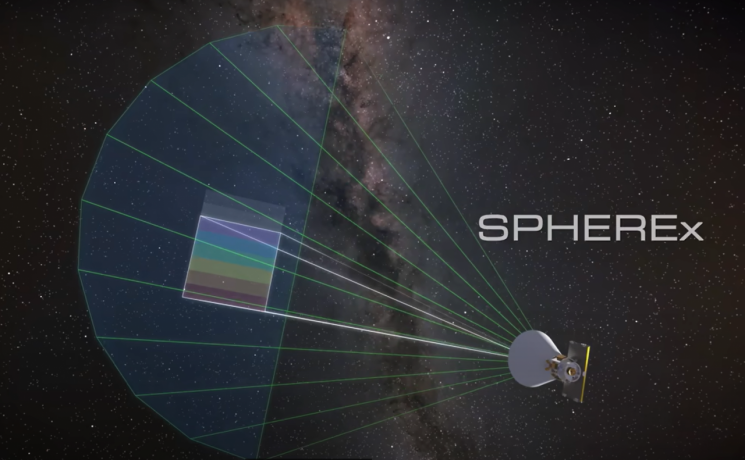
SPHEREx, measuring 1.5m in width, 1.5m in length, 1.3m in height, with a telescope diameter of 20 cm, will conduct surveys in the wavelength range of 0.75 to 5.0 μm for about 2 years and 6 months until September 2027 in a sun-synchronous orbit at an altitude of approximately 650 km.
It will observe the entire sky in 102 different colors to obtain physical information on about 1 billion celestial bodies and create the world's first three-dimensional infrared space map. Through this, it plans to map the distribution of water and carbon dioxide existing in ice form in galaxies to identify environments where life can exist.
SPHEREx is a medium-sized exploration mission promoted by the United States National Aeronautics and Space Administration (NASA) since 2015 with a budget of $242 million (approximately 346 billion KRW, excluding launch costs). The project is led by the California Institute of Technology (Caltech) and involves 12 institutions including the Korea Astronomy and Space Science Institute (KASI) and NASA's Jet Propulsion Laboratory (NASA JPL). KASI is the only international cooperative institution participating in the joint development of SPHEREx, with the Korean government investing 15 billion KRW.
KASI participated from the planning stage of SPHEREx in 2016, having been recognized for its independently developed Near-infrared Imaging Spectrometer for Star formation history (NISS) technology, and has been involved in international joint development since its selection in 2019, with about 30 domestic researchers participating.
The core technology of SPHEREx is imaging spectroscopy, a technology that combines 'imaging observation,' which captures wide areas, and 'spectroscopic observation,' which measures the brightness of light by wavelength. A NASA official highly praised KASI's technology, stating, "Observing the entire universe in 102 different colors is a groundbreaking attempt being done for the first time in the world."
The success of this launch is also significant as it is NASA's first 'rideshare' mission conducting two medium- and small-sized missions in one launch. Along with SPHEREx, two solar wind observation satellites called PUNCH, developed as NASA's small exploration missions, were launched on the Falcon 9 launch vehicle.
The mission operation and control of SPHEREx are overseen by NASA's Goddard Space Flight Center and Jet Propulsion Laboratory. It will communicate with NASA's near-Earth network ground stations located near the polar regions: Troll in Antarctica, Fairbanks in Alaska, Punta Arenas in Chile, and Svalbard in Norway.
After launch, SPHEREx will enter an initial operation phase for about 37 days to conduct test operations and perform its first test observations. After completing the initial operation, it will carry out observation missions for 25 months, orbiting the Earth’s polar orbit 14.5 times a day with a 98-minute period, capturing the universe more than 600 times.
Jung Woong-seop, the Korean principal investigator at KASI, said, "By carrying out the entire project from the planning stage through international cooperation, we have accumulated know-how that will greatly contribute to the future development of the space industry." He added, "SPHEREx will provide important clues to astronomers worldwide for understanding the formation and evolution of the universe."
© The Asia Business Daily(www.asiae.co.kr). All rights reserved.
![Clutching a Stolen Dior Bag, Saying "I Hate Being Poor but Real"... The Grotesque Con of a "Human Knockoff" [Slate]](https://cwcontent.asiae.co.kr/asiaresize/183/2026021902243444107_1771435474.jpg)
















