U.S. Companies Lower Expectations for Soft Landing
Household and Corporate Sentiment Weakens
Trump Says "No Expectation of Recession at All"
The reckless tariff policy of U.S. President Donald Trump is deepening the worries of American companies and self-employed individuals. Despite concerns about a U.S. economic recession, President Trump has shown a stance to push forward with the tariff policy, increasing concerns about economic uncertainty.
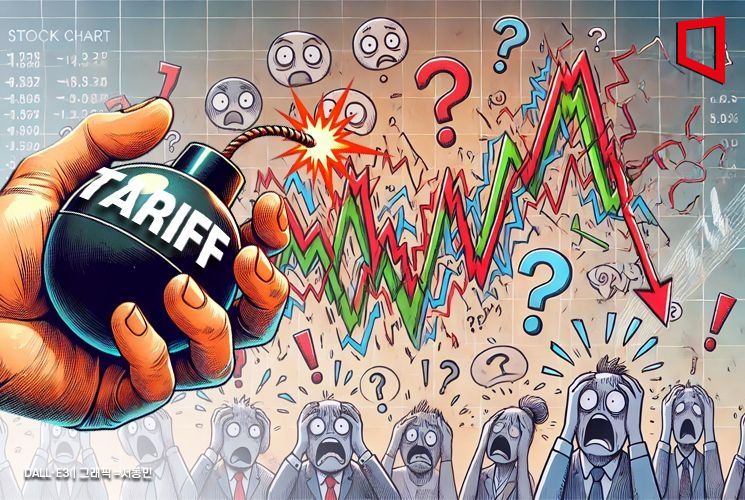
The Wall Street Journal (WSJ) reported on the 11th (local time), citing data from financial information firm AlphaSense, that this year, the term "soft landing" was mentioned only seven times in conference calls of U.S. companies. Although the first quarter has not yet ended, companies view the possibility of a soft landing for the U.S. economy as lower than before, resulting in fewer mentions compared to the first quarter of last year (170 times) or the previous quarter (61 times). As concerns among Americans about price increases due to tariffs and worsening household finances grow, expectations for a soft landing in the economy are gradually fading.
Household and corporate sentiment is also deteriorating. The National Federation of Independent Business (NFIB) announced that small business sentiment has weakened for three consecutive months, eroding the effect of President Trump's election victory. JPMorgan Chase raised the probability of a U.S. recession this year from 30% to 40%, citing extreme policies, and Citigroup downgraded its investment opinion on U.S. stocks from "overweight" to "neutral."
Uncertainty is also rising among U.S. self-employed individuals. According to the NFIB, the small business uncertainty index for February was 104, up 4 points compared to January (100). This is the second-highest figure since 1973, following October last year (110).
The small business optimism index for February also fell by 1.1 points from January (102.8) to 100.7. The optimism index surged by a record margin from 93.7 in October last year to 101.7 in November when President Trump was elected. It then rose further to 105.1 in December before turning downward this year. The NFIB stated in its report, "For various reasons, uncertainty on Main Street is high and increasing," and assessed that "confidence that the economy will continue to grow is disappearing."
President Trump, who triggered this situation, is showing a nonchalant attitude. In a Fox News interview aired on the 9th, he shook market sentiment by saying there is a "transition period" regarding the possibility of a recession this year, but on the same day, he said he "does not expect a recession at all."
At a meeting with major company CEOs held at the Business Roundtable in Washington DC that day, he positively evaluated the effects of tariffs and even said that higher tariffs might be imposed to attract foreign corporate investment.
© The Asia Business Daily(www.asiae.co.kr). All rights reserved.

















