Launched at 12:10 PM on the 12th,
successful communication established at 1:30 PM
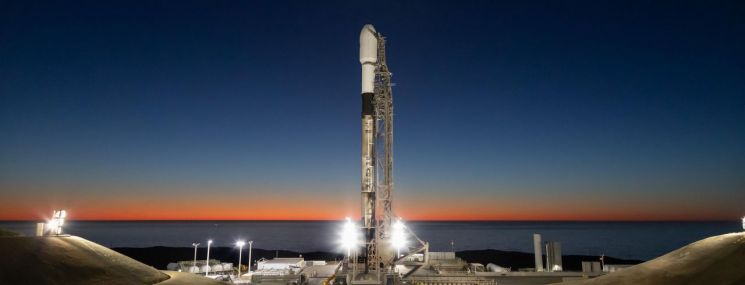
The Korea Aerospace Agency announced that the space telescope SPHEREx, jointly developed by the Korea Astronomy and Space Science Institute and the U.S. National Aeronautics and Space Administration (NASA), was successfully launched at around 12:10 PM on the 12th (8:10 PM on the 11th local time) from the Vandenberg Space Force Base in California, USA.
SPHEREx was launched aboard SpaceX's Falcon 9 rocket, separated from the launch vehicle at around 12:52 PM, and reached a sun-synchronous orbit at an altitude of approximately 650 km. At around 1:30 PM, it successfully communicated with NASA's near-Earth network ground station center in Svalbard, Norway.
After launch, SPHEREx will enter an initial operation phase lasting about 37 days, during which all test operations of the telescope, including inspection and calibration, will be conducted. The telescope's attitude will be precisely controlled, and its operating temperature will be maintained below minus 210 degrees Celsius using its own radiative cooling system. Subsequently, tests of the telescope's optical and spectroscopic performance will be carried out. During this period, the first test observation (First Light) is also planned.
After completing the initial operation phase, SPHEREx will carry out an observation mission for about 25 months. It will orbit the Earth’s polar orbit 14.5 times a day with a 98-minute period, capturing more than 600 images of space. The mission operation and control of SPHEREx will be overseen by NASA’s Goddard Space Flight Center and Jet Propulsion Laboratory (NASA JPL), communicating with NASA’s near-Earth network ground stations located near the polar regions: Troll in Antarctica, Fairbanks in Alaska, Punta Arenas in Chile, and Svalbard in Norway.
Jung Woong-seop, the Korean principal investigator at the Korea Astronomy and Space Science Institute, said, "If SPHEREx successfully completes its mission, it will provide important clues to understanding the formation and evolution of the universe through a three-dimensional infrared space map and an all-sky spectroscopic catalog." He added, "Not only Korea but astronomers worldwide will be able to utilize this data to conduct various studies on celestial objects."
Yoon Young-bin, head of the Korea Aerospace Agency, emphasized, "The successful launch of the SPHEREx space telescope represents a significant advancement in exploring the early light of the universe and the process of galaxy formation, which are important challenges humanity must solve together." He added, "This demonstrates the elevated status of Korea in the field of space science."
© The Asia Business Daily(www.asiae.co.kr). All rights reserved.

















