Controversy Over Withdrawal of Medical School Admissions Increase
"Original Expansion Plan Stands If All Students Do Not Return"
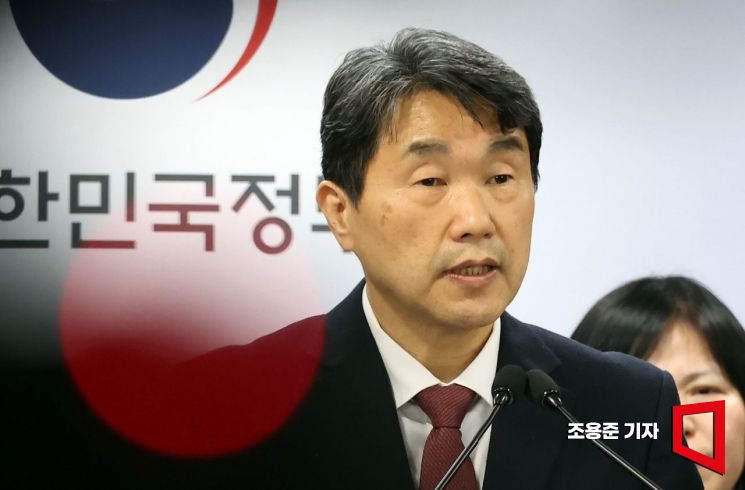 Deputy Prime Minister and Minister of Education Lee Ju-ho held a briefing on March 7 at the Government Seoul Office in Jongno-gu, Seoul, regarding the return of students and the normalization of medical school education, together with Yang Oh-bong, President of Jeonbuk National University and Chair of the Presidents' Council for the Advancement of Medical Schools, Lee Hae-woo, President of Dong-A University, and Lee Jong-tae, Chairman of the Korea Association of Medical Colleges and Graduate Schools of Medicine. 2025.3.7 Photo by Jo Yong-jun
The government’s acceptance of a plan to revert the medical school admission quota for the 2026 academic year back to the previous level of 3,058 students has sparked ongoing repercussions. The Presidential Office has taken a firm stance, stating that if all medical students do not return by the end of March, the original plan to increase admissions will remain in effect.
A senior official from the Presidential Office said on the 12th, "Claims that the medical reform pushed by the Yoon Seok-yeol administration has failed or that the government has ‘surrendered’ are not true. The government’s announcement to accept the 3,058 quota is based on the premise that medical students will return by the end of March. If the students do not return, the original plan to increase the quota by 2,000 to a total of 5,058 remains valid."
The Presidential Office has openly expressed discomfort regarding the background of the announcement made on the 7th by Deputy Prime Minister and Minister of Education Lee Ju-ho, who held a briefing to declare acceptance of the adjusted medical school admission quota of 3,058 for next year. Given the significant impact on the direction of medical reform, the Presidential Office conveyed the position of key aides, including Chief Secretary Jeong Jin-seok, to President Yoon and Prime Minister Han Deok-soo to wait until the impeachment ruling was issued. However, the Ministry of Education pushed forward with the plan. Critics argue that the Ministry hastily announced the policy out of concern over accountability as the reality of medical students not returning by the March semester became apparent.
A Presidential Office official stated, "Prime Minister Han has been deeply involved in medical reform issues since last year and, even while acting as the interim head, regularly convened ministers once a week to monitor the status of medical students’ return." The official added, "When the Ministry of Education presented unfounded optimism about the students’ return, the Prime Minister warned against it and proposed safety measures." Following Prime Minister Han’s suspension, the interim leadership of Choi Sang-mok empowered Deputy Prime Minister Lee, which inevitably minimized the voices of the Presidential Office and the Ministry of Health and Welfare, who had been leading the medical reform efforts. This is a regrettable situation."
A Ministry of Health and Welfare official lamented, "Using the quota issue as a bargaining chip to bring medical students back is fundamentally inappropriate. The quota should be determined based on reasonable grounds, as the medical community has always insisted, and discussions about the quota should be based on those grounds, not negotiations."
Meanwhile, the dean of a regional medical school said, "We are earnestly hoping for the students’ return," but also acknowledged, "However, realistically, it is true that it may not be easy for all medical students to return."
© The Asia Business Daily(www.asiae.co.kr). All rights reserved.

















