Number of Employed Aged 15-29 Drops by 235,000
Eoljuka Youth in Their 20s Taking a Break Surges by 18.1% to 460,000
Amid a sluggish economy and a shift in the job market toward experience and occasional recruitment, the number of young people frustrated by the narrowing doors to employment is increasing. The population of 'Eoljuka' youth, who have lost their way after failing to secure desired jobs, has exceeded 500,000 for the first time since related statistics began in 2003. With a decrease in youth employment, the employment rate stood at 44.3%, the lowest since the COVID-19 pandemic period.
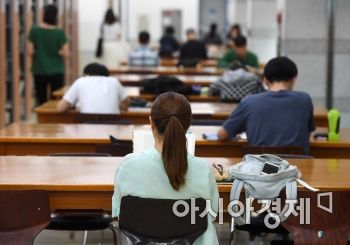 The increase in the number of employed persons remained below 100,000 for five consecutive months for the first time since the global financial crisis. The number of unemployed persons exceeded 1 million for six consecutive months. According to the "June Employment Trends" announced by Statistics Korea on the 11th, the number of employed persons last month was 27,126,000, an increase of only 106,000 compared to a year earlier. On the same day, students at a university library in Seoul are giving up their vacation and working hard to prepare for employment.
 Photo by Moon Honam munonam@
Employment Increased but Youth Employment Faces a Cold Wave
According to the 'February 2025 Employment Trends' released by Statistics Korea on the 12th, the number of employed persons aged 15 and over last month was 28,179,000, an increase of 136,000 (0.5%) compared to the same month last year. Although employment decreased by 52,000 in December last year due to the temporary end of job projects, the upward trend has continued since January (135,000).
By age group, employment increased among those aged 60 and over (342,000) due to aging and among those in their 30s (116,000) influenced by the second baby boomer generation. In contrast, employment decreased among those in their 20s (-228,000), 40s (-78,000), and 50s (-8,000). Particularly, employment among those in their 20s continued to decline for the second consecutive month, with a decrease of 205,000 in January followed by a further drop, maintaining a negative trend in the 200,000 range.
Youth employment indicators are especially deteriorating. The number of employed persons aged 15 to 29 was 3,557,000, down by 235,000. This is the largest decrease since January 2021 (-314,000) during the COVID-19 pandemic. The youth employment rate also fell to 44.3%, the lowest since February 2021 (42.0%). This contrasts with the employment rate for those aged 15 and over (61.7%) and the OECD comparison standard for those aged 15 to 64 (68.9%), which rose by 0.1 and 0.2 percentage points, respectively.
Gong Mi-sook, Director of the Social Statistics Bureau at Statistics Korea, said, "Employment among youth decreased in manufacturing, construction, and professional scientific sectors," adding, "Sectors with a high proportion of youth employment, such as wholesale and retail trade and manufacturing, are experiencing declines." She further noted, "The increasing preference for experienced hires and the rise in occasional recruitment are working against youth."
In fact, employment decreased in construction (-167,000), manufacturing (-74,000), and wholesale and retail trade (-65,000). The negative trend in construction and manufacturing has lasted for 10 and 8 months, respectively. Employment increased in health and social welfare services (192,000), professional, scientific and technical services (80,000), and information and communication (65,000).
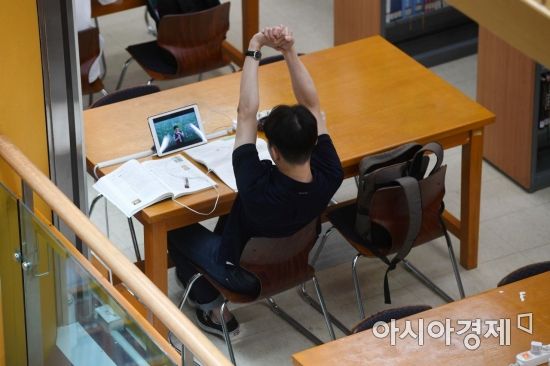 The increase in the number of employed persons remained below 100,000 for five consecutive months for the first time since the global financial crisis. The number of unemployed persons exceeded 1 million for six consecutive months. According to the "June Employment Trends" released by Statistics Korea on the 11th, the number of employed persons last month was 27,126,000, an increase of only 106,000 compared to a year earlier. On this day, students at a university library in Seoul are giving up their vacation and working hard to prepare for employment. Photo by Moon Honam munonam@
'Eoljuka' Youth Surpass 500,000... "No Desired Jobs"
Last month, the economically inactive population remained steady at 16,575,000, an increase of 7,000 (0.0%) compared to the same month last year. However, among the economically inactive, the population who are 'Eoljuka'?neither working nor seeking jobs?rose by 123,000 (4.8%) to 2,697,000, raising concerns.
Especially, the number of 'Eoljuka' youth reached 504,000, an increase of 61,000 (13.8%). This is the first time since related statistics began in January 2003 that the 'Eoljuka' youth population has exceeded 500,000. The number of 'Eoljuka' youth in their 20s, who should be entering economic activity, surged by 71,000 (18.1%) to 460,000.
Director Gong explained, "The main reason cited by 'Eoljuka' youth was 'difficulty finding desired jobs,' followed by 'taking a break for the next job'." Indeed, a survey on long-term 'Eoljuka' youth conducted by the Korea Employment Information Service the day before showed that the highest reason for choosing to be 'Eoljuka' was 'lack of suitable jobs (38.1%).'

Jang Ju-seong, Director of the Human Resources Policy Division at the Ministry of Economy and Finance, explained, "In the past, it took about 8 to 9 months on average from the time of university graduation or starting job seeking to successful employment, but nowadays the job search period has extended to nearly a year." He added, "As a result, the number of 'Eoljuka' youth is increasing."
The government plans to strengthen tailored support measures as the number of 'Eoljuka' youth rises. Director Jang said, "Various youth-targeted measures are being prepared and implemented. The Youth Employment All-Care Platform has been fully launched this month, and if it settles this year, it is expected to help improve youth employment conditions."
© The Asia Business Daily(www.asiae.co.kr). All rights reserved.


















