Plan Reduced from 40,000 to 20,000 Troops
Italy and Poland Refuse to Send Forces
Reluctance to Accept Participation from T?rkiye
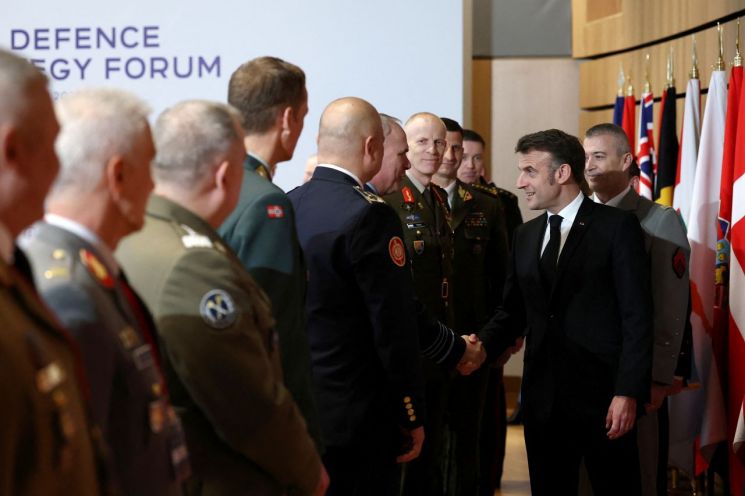 On the 11th (local time), Emmanuel Macron, President of France, is greeting representatives of military commanders from 34 countries attending the post-war security conference on Ukraine held in Paris, France. Photo by Reuters and Yonhap News.
As peace negotiations to end the Ukraine war gain momentum, European countries are deeply concerned about the composition of peacekeeping forces to be stationed in post-war Ukraine. With the United States refusing to participate in the formation of peacekeeping forces and security support, the size of the peacekeeping force is at risk of being halved from the original plan. Some European countries are refusing to dispatch troops for peacekeeping missions, fearing it could further provoke Russia, and conflicts over troop recruitment and maintenance costs have intensified, putting a brake on the formation of the peacekeeping force.
Security Guarantee Meeting for Ukraine in Paris: "Peacekeeping Force Expected to be Around 20,000"
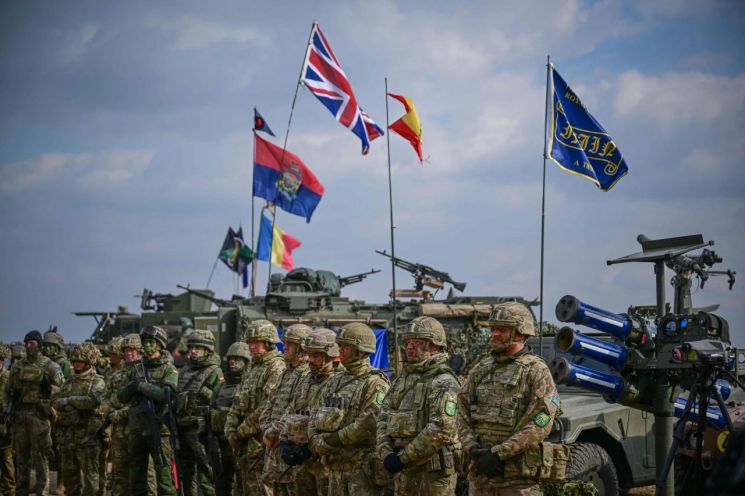 On the 19th of last month (local time), soldiers from NATO member countries are conducting joint military training at the Smardan training ground located in Gala?i, Romania. Photo by AFP and Yonhap News Agency
On the 11th (local time), a post-war security meeting for Ukraine was held in Paris, France. In the absence of a U.S. representative, military commanders from 34 Western countries including France, the United Kingdom, and Germany attended. The New York Times (NYT) reported that a major topic of discussion was the plan for Europe to independently establish a peacekeeping force in Ukraine without the United States.
With the U.S. completely refusing both troop deployment and support, the size of the possible peacekeeping force continues to shrink. Currently, European countries expect the deployment size to be around 20,000 troops. As recently as December last year, the peacekeeping force size proposed by French President Emmanuel Macron was around 40,000 to 50,000 troops.
Camille Grand, a defense expert at the European External Action Service, explained, "The European countries' peacekeeping force will be about 15,000 to 20,000 troops, which from Russia's perspective would not be large enough to be considered a NATO combat brigade. For Ukraine's security guarantee, three lines of defense are needed: the Ukrainian military, the European peacekeeping force, and the air force deterrence capability in the rear."
The NYT also pointed out, "The Trump administration rejected European countries' requests to deploy U.S. troops even in a rear position for the Ukraine peacekeeping force. Without any U.S. support, European countries would have to immediately replace military support that the U.S. has fundamentally provided, such as procurement of military supplies, training, intelligence gathering, transportation, and refueling, which would be difficult to finance."
Italy and Poland Refuse Deployment... Supply Support Difficulties Arise After U.S. Withdrawal
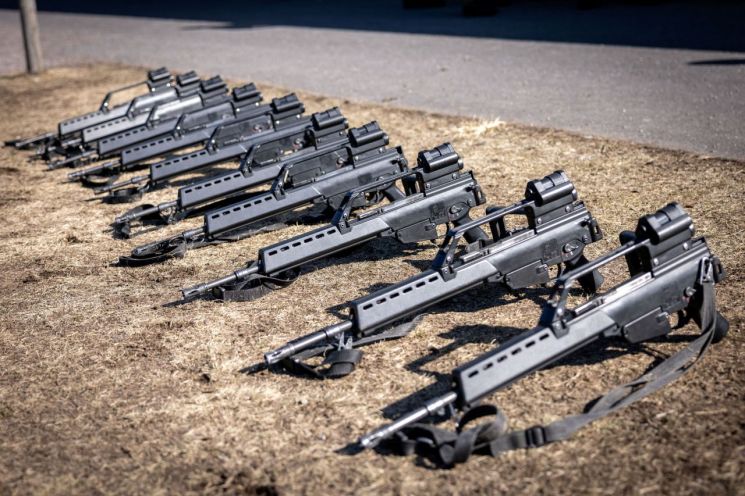 On the 6th (local time), firearms were lined up at a reserve forces training held at the German Belitz military base. Photo by Reuters and Yonhap News Agency
The refusal of some European countries to deploy troops is also complicating the formation of the peacekeeping force. According to CNN, countries such as Italy, Spain, Poland, and Hungary oppose sending peacekeeping troops. They believe that discussing troop deployment while peace negotiations with Russia are still ongoing could further provoke Russia. Particularly, Hungary, a pro-Russian country, strongly opposed troop deployment by being the sole country absent from the resolution to expand military support for Ukraine at the European Union (EU) summit held on the 6th.
The so-called Baltic States?Estonia, Latvia, and Lithuania?which share borders with Russia, also hold negative views on troop deployment. They are concerned that if Ukraine troop deployment becomes a reality, the number of NATO combat troops stationed in their countries will decrease.
Russia strongly opposes the formation of a European peacekeeping force itself. Russian Foreign Minister Sergey Lavrov stated at a press conference on the 11th, "The peacekeeping force appears to be nothing more than an attempt to preserve the remnants of Ukraine's autonomous government," adding, "The priority should be to end the racist behavior of the Ukrainian regime that is eradicating Russian culture, language, and media."
Controversy Over Pro-Russian T?rkiye’s Participation in Troop Deployment
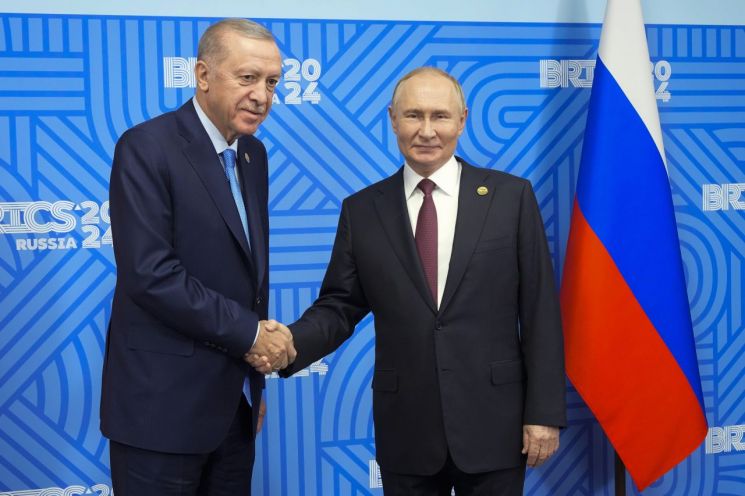 President Recep Tayyip Erdogan of Turkiye (left), attending the BRICS summit held in Kazan, Russia, last October, is greeting President Vladimir Putin of Russia (right). Photo by AP and Yonhap News
The issue of T?rkiye's participation in the peacekeeping force is also controversial. T?rkiye, which has the second-largest military power in NATO after the United States, has expressed willingness to participate, but there is considerable opposition to the idea that a pro-Russian country like T?rkiye would constitute a significant part of the peacekeeping force, which could make Ukraine's security guarantee more difficult.
According to Bloomberg, President Recep Tayyip Erdo?an stated at a security summit with major European countries held in London on the 2nd of this month, "It has become difficult to imagine building European security without T?rkiye," and added, "If deemed necessary, we are prepared to deploy troops to Ukraine as part of a peacekeeping mission."
While France, Germany, and the United Kingdom, which are struggling with the formation of the peacekeeping force, welcome this, many NATO member countries including the United States are showing negative attitudes toward T?rkiye's troop deployment. T?rkiye, which maintained a pro-Russian stance during the Ukraine war, has had diplomatic frictions with European Union (EU) countries, making it difficult to form a joint European peacekeeping force with other European countries.
Germany's public broadcaster Deutsche Welle pointed out, "T?rkiye made mediation efforts between Ukraine and Russia during the war, such as reopening the Black Sea grain export route, but was ultimately excluded by the United States, and mediation for peace negotiations is being led by Saudi Arabia. Even if T?rkiye has a strong willingness to intervene in the Ukraine issue, if the U.S. excludes it and Europe distances itself from the pro-Russian T?rkiye, it will be difficult to actually implement military support."
© The Asia Business Daily(www.asiae.co.kr). All rights reserved.
![Clutching a Stolen Dior Bag, Saying "I Hate Being Poor but Real"... The Grotesque Con of a "Human Knockoff" [Slate]](https://cwcontent.asiae.co.kr/asiaresize/183/2026021902243444107_1771435474.jpg)


















