Kim Moon-soo Requests Stronger Sentencing Guidelines for Wage Arrears Crimes
Ministry of Employment and Labor Calls for Harsher Penalties to Address Unpaid Wages
Proposes Clearer Aggravating Factors and Stricter Probation Standards
Kim Moon-soo, Minister of Employment and Labor, met with Lee Sang-won, Chairman of the Sentencing Commission at the Supreme Court in Seocho-gu, Seoul, on the 11th, and requested strengthening the sentencing guidelines related to wage arrears crimes.
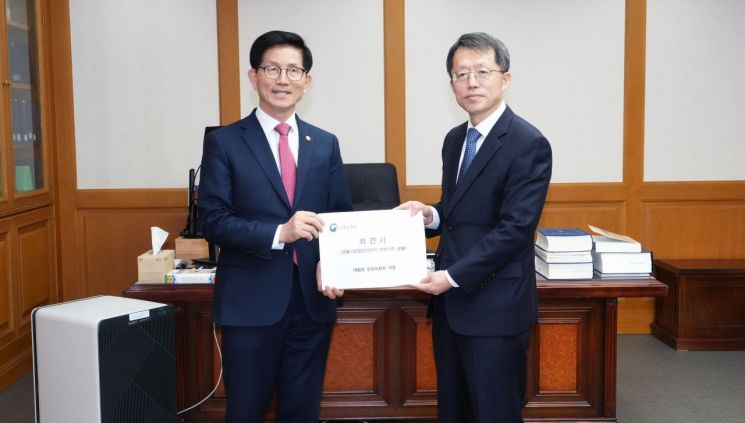 Minister of Employment and Labor Kim Moon-soo (left) and Lee Sang-won, Chairman of the Supreme Court Sentencing Commission, are taking a commemorative photo at the Supreme Court Sentencing Commission on the 11th. Photo by Ministry of Employment and Labor
Last year, the amount of unpaid wages surpassed 2 trillion won for the first time ever, highlighting the seriousness of the issue. The Ministry of Employment and Labor believes that increasing the punishment level for wage arrears crimes is necessary to change the complacent attitude of employers who think "paying a small fine is enough."
The sentencing guidelines for 'Labor Standards Act violation crimes' related to unpaid wages were established by the 5th Sentencing Commission (2015?2017) and have been in effect since July 1, 2016. Since then, there have been no significant changes except for some minor textual revisions.
With the 10th Sentencing Commission launching next month, the Ministry plans to continue discussions to strengthen the sentencing guidelines for Labor Standards Act violation crimes. They intend to subdivide the crime types, which are currently categorized into three types based on the scale of unpaid wages, and request an increase in sentencing standards for large-scale wage arrears.
They also propose establishing sentencing guidelines for fines. Additionally, they request that the number of affected workers and the duration of wage arrears be explicitly stated as sentencing aggravating factors, and that for large-scale unpaid wages above a certain threshold, probation should not be granted by including 'probation as a negative major consideration' in the guidelines.
Minister Kim said, "Wage arrears are not simply a failure to fulfill debt obligations," adding, "They are a violation of personal rights that directly affect the survival of workers and their dependents and deny the value of labor provided by workers." He further stated, "In fact, it is a serious crime against the livelihood, equivalent to wage theft and fraud."
© The Asia Business Daily(www.asiae.co.kr). All rights reserved.

















