The Born Korea Faces New 'Doenjang Ingredient' Controversy
Allegations Raised Over Use of Imported Ingredients
in Agricultural Promotion Zone Restricted to Domestic Processing
Complainant Says, "Use of Imported Ingredients Contradicts
Commitment to Supporting Local Farmers... Punishment Needed"
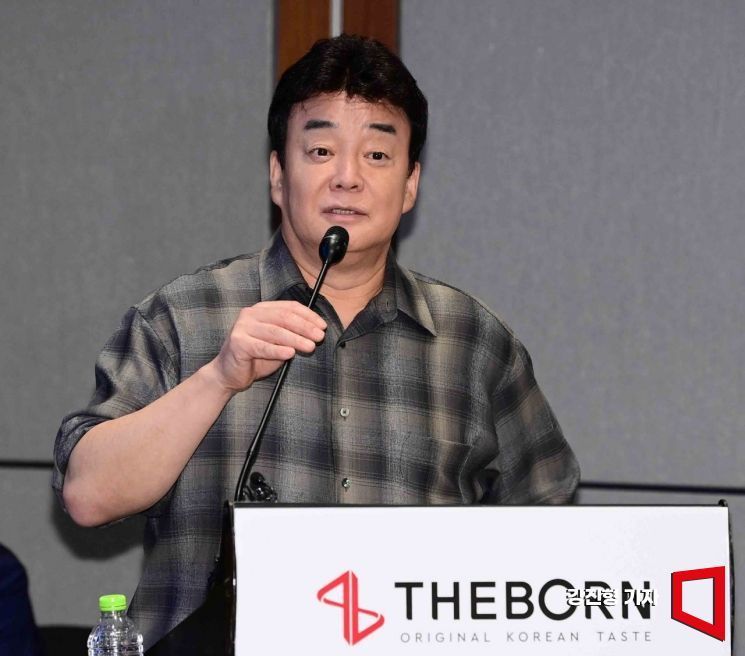
Concerns have been raised that The Born Korea, led by broadcaster and entrepreneur CEO Baek Jong-won, violated the Farmland Act by producing products using imported raw materials in an agricultural promotion zone.
At The Born Korea's Baekseok factory in Yesan, Chungnam, products made with Chinese improved meju doenjang and imported raw materials such as foreign soybeans and wheat are being sold. Asia Today reported on the 10th that "the Baekseok factory is, in principle, a place where imported raw materials cannot be used," adding, "because the address of 359-71, Yeoktap-ri, Oga-myeon, Yesan-gun, Chungnam, where the Baekseok factory is located, is designated as an agricultural promotion zone." Agricultural promotion zones prohibit the construction of processing and manufacturing facilities, but as an exception, facilities that process agricultural and marine products produced domestically are allowed. Violations of this rule can result in imprisonment for up to five years or a fine of up to 50 million won under Article 59 of the Farmland Act.
The ingredient labels on the doenjang produced at the Baekseok factory show that the improved meju doenjang, soybeans, and wheat flour are all from China, the United States, Australia, and other foreign countries. This has led to criticism that it contradicts CEO Baek's usual stance of "supporting local farmers." Currently, a complaint has been filed on the National Petition System requesting punishment of CEO Baek and The Born Korea's Baekseok factory for violating the Farmland Act. The complainant stated, "This is already the second time the Baekseok factory has been involved in controversy over violating the Farmland Act," and added, "It is hard to understand the use of imported raw materials, which contradicts the usual principle of coexisting with local farmers. Punishment according to relevant laws seems necessary."
Previously, the Baekseok factory was also reported for using two temporary structures (vinyl greenhouses) as warehouses without permission for farmland conversion. In response, The Born Korea explained, "The temporary structures were used as 'fixed agricultural greenhouses,' and when farmland is used as a greenhouse, permission for farmland conversion is not required. However, some spaces were used like warehouses, which became an issue," and apologized, saying, "Regardless of the reason, we apologize for not properly understanding the relevant laws."
The Born Korea has faced continuous public criticism following the 'Baek Ham' controversy. Ahead of the Lunar New Year holiday, the company sold pork ham gift sets at a 45% discount from the regular price, sparking debates over price and quality. Later, it was embroiled in controversy over violating the Liquefied Petroleum Gas (LPG) Act after a video surfaced showing cooking near a high-pressure gas cylinder in an indoor kitchen last year.
Additionally, the fruit beer 'Gamgyul Oreum' released by The Born Korea's franchise Yeondon Bolkatsu faced issues due to insufficient content. Criticism toward CEO Baek continued after it was revealed that the chicken steak meal kit, heavily promoted with an emphasis on 'coexistence with farmers,' used chicken sourced from Brazil. It was also later revealed that The Born Korea used vinyl greenhouses near the Baekseok factory for purposes other than those permitted, leading to a demolition order from administrative authorities. In response, the Yesan Police Station has received a complaint and is investigating The Born Korea and Yedeok Academy for violations of the Farmland Act, Mountainous Area Management Act, and Building Act.
Amid ongoing controversies, The Born Korea's stock price hit its lowest since listing. According to the Korea Exchange on the 11th, the company's stock price (as of 9:20 a.m.) fell to 28,500 won early in the trading session. This marks a decline beyond half from the highest price of 64,500 won since listing, entering a further downward trend. Industry insiders attribute The Born Korea's controversies and poor stock performance more to 'owner risk' than to business results. As CEO Baek has established himself as a leading figure in the domestic food service industry, his actions significantly impact the company's image and stock price. As the company's stock price falters, shareholder discussion boards on portal sites have become venues for harsh criticism. Posts calling for delisting have even appeared, with shareholders responding in agreement.
© The Asia Business Daily(www.asiae.co.kr). All rights reserved.
![Clutching a Stolen Dior Bag, Saying "I Hate Being Poor but Real"... The Grotesque Con of a "Human Knockoff" [Slate]](https://cwcontent.asiae.co.kr/asiaresize/183/2026021902243444107_1771435474.jpg)

















