Listening to On-site Opinions on the 52-Hour Workweek Regulation
Kim Moon-soo, Minister of Employment and Labor, said on the 11th at a semiconductor research and development (R&D) site, "I deeply felt that the government must urgently support the semiconductor industry so that it can take off again," and added, "We will cooperate with related ministries to promptly prepare government-level measures."
Minister Kim made these remarks at a meeting to improve semiconductor R&D working hours held at Dongjin Semichem R&D Center in Pangyo, Seongnam. He said, "Last November in Pyeongtaek, I heard about the difficulties faced by semiconductor companies, but the situation has become even more difficult in just a few months." This statement was made amid the situation where the Semiconductor Special Act, which includes an exemption clause for semiconductor R&D personnel from the 52-hour workweek, has not passed the National Assembly, indicating the government’s intention to seek support measures.
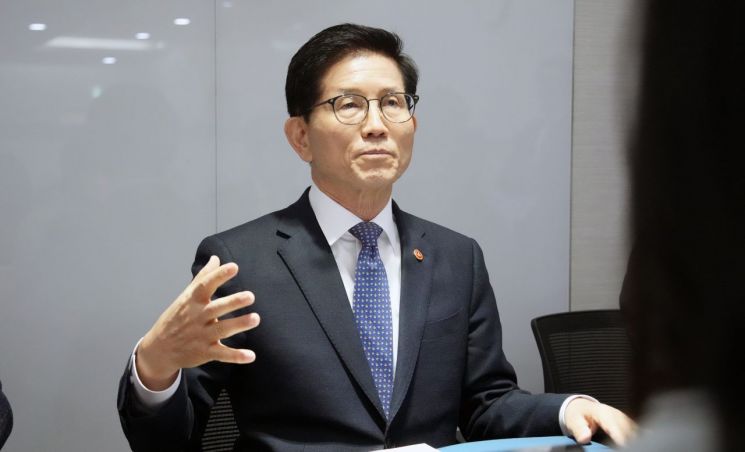
The meeting was organized by the Ministry of Employment and Labor and the Ministry of Trade, Industry and Energy to listen to the difficulties faced by the semiconductor field regarding the 52-hour workweek regulation and to explore government-level measures. Attendees included semiconductor materials, parts, and equipment companies such as Samsung Electronics, SK Hynix, Dongjin Semichem, and Jusung Engineering, as well as fabless companies like Rebellion and Telechips. Economic organizations such as the Korea Chamber of Commerce and Industry and the Korea Employers Federation, along with the Korea Semiconductor Industry Association, were also present.
At the meeting, semiconductor companies expressed that the working hour regulations not only reduce R&D performance but also cause problems such as hindering collaboration between departments. They also pointed out cases where the culture of immersing in research weakens, such as being forced to take leave once the maximum working hours are reached. The Korea Employers Federation urged that, given the Semiconductor Special Act is not passing immediately, at least the special extended working hours system related to semiconductor R&D should be improved.
Minister of Trade, Industry and Energy Ahn Deok-geun said at the meeting, "The United States, Japan, and Taiwan are fostering their semiconductor ecosystems as a matter of national destiny, and China has closely pursued our country’s mainstay memory semiconductors," adding, "I express concern over the reality that only our semiconductor industry is being held back by working hour regulations." He also mentioned, "I hope that improvements to the working hour system, reflecting the voices from the semiconductor R&D field, will enhance the competitiveness of our semiconductor industry."
Meanwhile, Minister Kim criticized the opposition party’s opposition to the passage of the Semiconductor Special Act at a press corps meeting held the day before, saying, "They have no intention of reviving the Korean economy." He emphasized the government’s willingness to support semiconductors by stating, "If they don’t even try to save semiconductors, they have no right to talk about the economy," and "If the law cannot be changed and the Ministry of Employment and Labor is asked to handle it administratively, we are willing to do so."
© The Asia Business Daily(www.asiae.co.kr). All rights reserved.

















