A digital-based water supply network control system has been developed to enhance the stability of tap water supply.
The Electronics and Telecommunications Research Institute (ETRI) announced on the 11th that it has developed a "digital twin-based water supply network control system" that can detect abnormal situations in the water supply network and simulate and predict operational status.
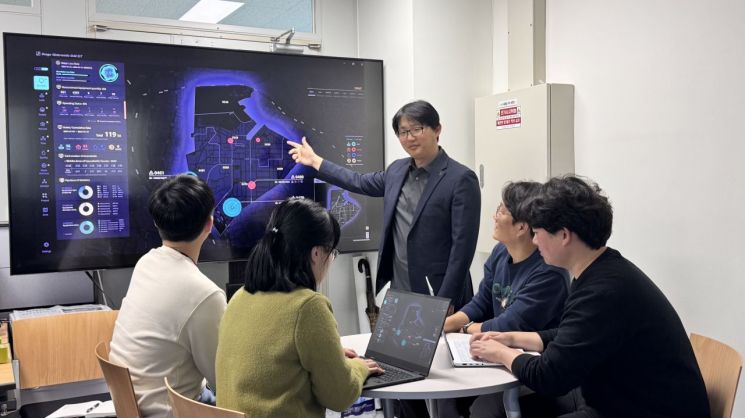 The ETRI research team is holding a meeting regarding the operation of the 'Digital Twin-based Water Supply Network Control System.' Photo by Electronics and Telecommunications Research Institute of Korea
Digital twin refers to the implementation of real-world facilities or processes in virtual reality through software (models). The core technologies of the digital twin control system include real-time monitoring based on sensor data analysis, simulation, and prediction.
Among these, real-time monitoring performs functions such as detecting indoor and outdoor leaks in the water supply network, identifying suspected leak areas, detecting water quality abnormalities, recognizing water hammer, and estimating its location.
The simulation and prediction technologies simulate flow rate, pressure, and residual chlorine in the water supply network, simulate water quality accidents, recommend control valves for isolating leaking pipelines, evaluate pipeline aging, and forecast weekly water demand.
Existing water supply network management systems have managed various data necessary for monitoring and simulation/prediction?such as geographic/spatial information, environmental data, pipeline attributes, pressure, flow rate, water quality, vibration, and remote meter reading?in a distributed manner.
However, the digital twin control system integrates these data for unified management at a glance. The AI model based on this data is designed to flexibly respond to abnormal data caused by communication errors or sensor malfunctions. Additionally, it is noteworthy that the system is periodically updated to reflect the latest data characteristics.
Above all, this control system can monitor various abnormal situations such as leaks, water quality abnormalities, and water hammer in an integrated manner, improving the accuracy of detecting interrelated abnormal situations.
The simulation function equipped in the digital twin control system by ETRI visually and intuitively displays the distribution of flow rate, pressure, and residual chlorine values, helping managers select locations for new measuring instruments or identify areas where water flow is stagnant.
It also developed a function to simulate how flow rate and pressure change when a large number of consumers are added to a specific area, allowing verification of how residual chlorine values change when part of the tap water inside the pipe is discharged externally.
ETRI expects that once the digital twin control system is deployed in actual water supply industry sites, it will dramatically improve the efficiency of network operation and maintenance and the stability of tap water supply.
Currently, ETRI is conducting field demonstrations by introducing the digital twin control system in one central district under the jurisdiction of the Daegu Metropolitan Waterworks Headquarters, while simultaneously advancing system upgrades to enhance field applicability, scalability, and reliability.
In the future, based on the results of field demonstrations, the plan is to expand the digital twin control system demonstration zones to metropolitan local governments nationwide.
Byun Woo-jin, head of ETRI’s Daegu-Gyeongbuk Research Headquarters, said, “The digital twin control system will contribute to maximizing the safety and efficiency of the water supply network by integrating real-time monitoring of the network status, improving the quality of tap water, and enhancing the reliability of water services.”
© The Asia Business Daily(www.asiae.co.kr). All rights reserved.

















