The Republic of Korea Navy's 2nd Fleet Command announced on the 11th that it hosted an integrated port defense exercise at the Pyeongtaek-Dangjin Port International Passenger Terminal. This exercise was conducted as part of the 2025 Freedom Shield exercise.
Participants in the exercise included the 2nd Fleet's Base Defense Battalion, the Army's 169th Brigade under the 51st Division, Pyeongtaek Regional Maritime Affairs and Fisheries Office, Pyeongtaek Police Station, Pyeongtaek Coast Guard, Pyeongtaek Fire Station, and Pyeongtaek Customs.
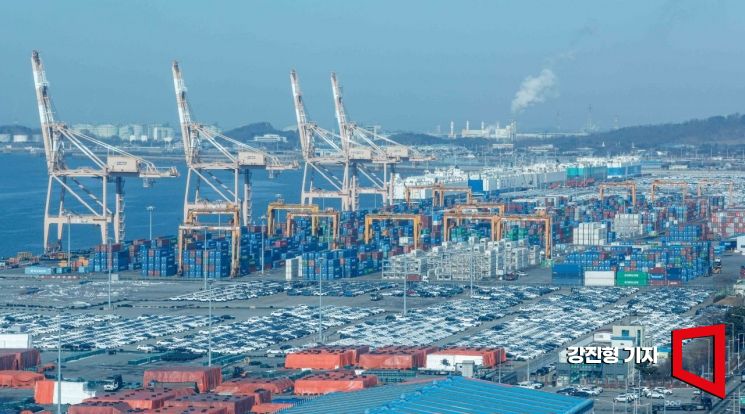 President Donald Trump signed a proclamation imposing a 25% tariff without exceptions on steel and aluminum products imported into the United States, and announced that tariffs on automobiles and semiconductors are also under consideration. On the 13th, export vehicles were waiting to be loaded at Pyeongtaek Port, Gyeonggi Province. 2025.2.13. Photo by Kang Jin-hyung
This exercise, held for the first time at the newly opened Pyeongtaek-Dangjin Port International Passenger Terminal building which opened in December last year, was conducted to strengthen the rapid port defense response capabilities of the Navy and related agencies against potential aerial and chemical, biological, radiological, and nuclear (CBRN) threats at national critical facilities. Pyeongtaek-Dangjin Port houses national critical facilities including the international passenger terminal and the Korea National Oil Corporation.
The exercise began when a report of an unidentified flying object crashing was received by the Pyeongtaek Regional Maritime Affairs and Fisheries Office. The Navy and related agencies established and operated an Integrated Port Defense Coordination Headquarters in response to the situation, practicing realistic procedures for responding to CBRN terrorism.
In response to support requests from related agencies, the Army's 169th Brigade deployed as the initial response unit to the passenger terminal, controlling civilian access to nearby areas. Upon arrival, the 2nd Fleet's CBRN Rapid Response Team conducted detection, sample collection, and decontamination of CBRN materials centered around the crash site of the unidentified flying object, and installed a human decontamination station at the site together with the Pyeongtaek Fire Station.
Colonel Choi Soon-ho, commander of the 2nd Base Defense Battalion of the Navy's 2nd Fleet, who oversaw the exercise, stated, “Through this exercise, we were able to master integrated response capabilities to CBRN terrorism scenarios using unidentified drones or other devices that could occur at any time. We will continue to firmly protect national critical facilities in the West Sea based on close cooperation with related agencies.”
© The Asia Business Daily(www.asiae.co.kr). All rights reserved.

















