Three Institutions Release Doctor Supply Projections: Seoul National University College of Medicine, Graduate School of Public Health, and Korean Medical Association
Claims of "Surplus Until 2037" Countered by "Even With Increases, 28,000 Shortage by 2050"
Outcome Depends on Number of Working Days... Regional Balance and Medical Delivery System Reform Needed, Not Just Quota Increases
Amid ongoing conflicts between the medical community and the government triggered by the increase in medical school quotas, a new study projecting the number of doctors revealed divided opinions: some argue that without increasing quotas, there will be a shortage of doctors in the future, while others believe there will be an oversupply even without an increase. However, experts commonly agree that simply increasing the number of doctors cannot resolve pressing issues such as the imbalance between medical demand and supply.
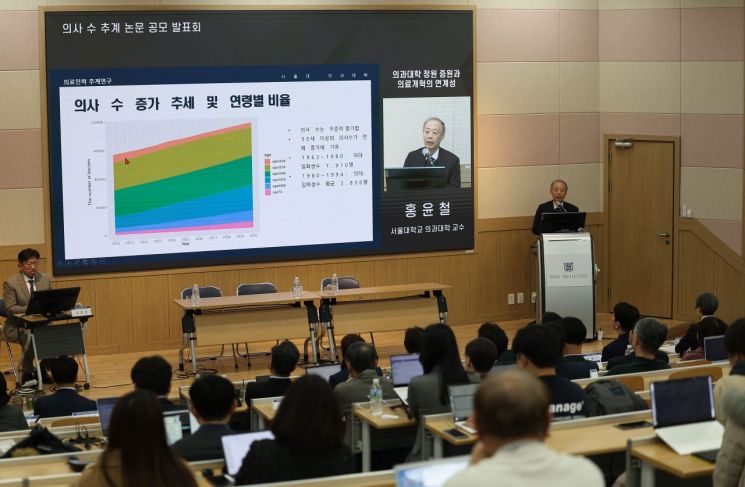 Professor Hong Yoon-chul of Seoul National University College of Medicine is explaining the projected trend of physician number increase at the 'Physician Number Projection Paper Contest Presentation' held on the 10th at Seoul National University Hospital College of Medicine in Jongno-gu, Seoul. Photo by Yonhap News
The Emergency Response Committee of Seoul National University College of Medicine and Seoul National University Hospital held a 'Doctor Number Projection Research Presentation' on the 10th at Yang Yunseon Hall in the Convergence Building of Seoul National University College of Medicine, where research results submitted by three teams?from Seoul National University College of Medicine, Seoul National University Graduate School of Public Health, and the Korea Medical Association Medical Policy Research Institute?were disclosed.
First, the Seoul National University College of Medicine research team projected that the supply of doctors would remain in surplus for the time being without increasing medical school quotas or reforming the healthcare system. Professor Hong Yooncheol of Seoul National University College of Medicine stated, "Assuming doctors work 265 days annually, close to a five-day workweek, the number of doctors will be in surplus until 2037," adding, "The policy goal should rather focus on how to utilize the surplus medical workforce."
In the long term, without quota increases or reforms, it was estimated that there would be a shortage of 16,241 doctors by 2050. The research team suggested, "These results indicate that expanding medical school quotas is not an urgent matter yet," and recommended, "If strong healthcare system reforms are implemented, expanding medical school quotas will not be necessary, so the direction of healthcare reform should be set from the perspective of the healthcare desired by the public."
On the other hand, the Seoul National University Graduate School of Public Health research team analyzed that if medical school quotas are not increased, there will be a shortage of 9,063 doctors by 2030, 21,345 by 2040, and 28,664 by 2050. Accordingly, the shortage is expected to peak in 2050 and then decrease to 17,843 by 2060. They also predicted that if medical school quotas are increased by 1,500 annually starting in 2026, the shortage in 2050 would reduce to 5,612, and by 2060, it would shift to a surplus of 10,764 doctors.
Im Yoona, a visiting researcher at Seoul National University Graduate School of Public Health, said, "There will be an imbalance in medical personnel by type of medical institution, with shortages in tertiary and general hospitals and surpluses in clinics," adding, "Doctor workforce policies should not be limited to quota discussions but should be comprehensively discussed in conjunction with balanced medical supply across regions and reforms of the medical delivery system."
The Korea Medical Association Medical Policy Research Institute projected that if the current doctor working days of 289.5 days are maintained, there will be a surplus of 3,161 doctors by 2035 even without increasing quotas. They estimated a surplus of 11,481 doctors if quotas are increased over five years. However, applying a working day assumption of 265 days like Seoul National University College of Medicine and Graduate School of Public Health, they predicted a shortage of 9,691 doctors by 2035 without quota increases, and a shortage of 1,371 doctors even with quota increases.
Moon Seokgyun, deputy director of the Korea Medical Association Medical Policy Research Institute, pointed out, "This study confirms that the Korean government's prediction of a shortage of 10,000 doctors by 2035 underestimated working days," adding, "This does not reflect the reality of the medical field."
Professor Oh Joohwan of Seoul National University College of Medicine emphasized, "All three studies point in the same direction that healthcare reform is necessary, and the number of quota increases is not the key issue," stressing, "The shortage of doctors cannot be resolved by simply increasing quotas without reforming the medical delivery system or payment methods."
© The Asia Business Daily(www.asiae.co.kr). All rights reserved.
![Clutching a Stolen Dior Bag, Saying "I Hate Being Poor but Real"... The Grotesque Con of a "Human Knockoff" [Slate]](https://cwcontent.asiae.co.kr/asiaresize/183/2026021902243444107_1771435474.jpg)











