Foreign Investors Net Sell 6.3185 Trillion Won This Year
Seven Consecutive Months of Net Selling Until Last Month
Selling Dominance Continues This Month...
Exchange Rate and Resumption of Short Selling as Key Variables for Foreign Demand
Foreign investors have continued their 'Sell Korea' march this year, net selling 6 trillion won in the domestic stock market. Having maintained net selling for seven consecutive months until last month, foreign investors recorded the third longest streak of net selling in history, drawing market attention to when they might turn around. Experts point to the exchange rate and the resumption of short selling as variables affecting changes in foreign investor demand.
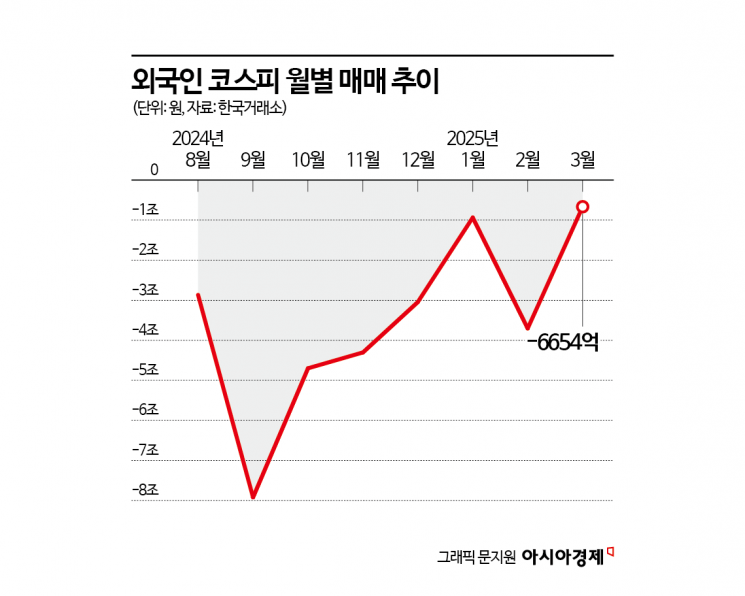
According to the Korea Exchange on the 11th, foreign investors have net sold 6.3185 trillion won in the domestic stock market up to the previous day. They sold 5.3032 trillion won in the KOSPI market and 1.0153 trillion won in the KOSDAQ market, respectively.
Foreign investors have maintained a net selling streak for seven consecutive months from August last year to last month. This is the third longest in history, with foreign investors previously recording 11 months of consecutive net selling from June 2007 to April 2008, and eight months from February to September 2002.
The scale of foreign net selling steadily decreased from around 7 trillion won in September last year to below 1 trillion won in January this year, but exceeded 3 trillion won again in February. The selling dominance continues this month as well. Foreign investors have net sold 665.4 billion won in the KOSPI market up to the previous day this month.
The exchange rate is cited as the background for the continued foreign selling trend. Lee Kyung-min, a researcher at Daishin Securities, said, "The increased pressure of won depreciation is the reason for the large-scale selling by foreigners at the end of last month and the continued selling in early March," adding, "Political uncertainty has expanded due to events such as the election of President Donald Trump and the martial law situation, keeping the won-dollar exchange rate unstable. It fluctuates around the 1,450 won level due to economic instability and political risks."
Since the exchange rate is acting as a cause for the continued foreign selling, it is expected that foreign demand will change if the exchange rate stabilizes. The researcher explained, "Triggered by the domestic political risk resolution such as the impeachment trial verdict this week, the won-dollar exchange rate is expected to enter the mid-1,300 won range in the first half of 2025," and added, "If additional won appreciation pressure expands, foreigners could seek foreign exchange gains." He further stated, "Especially near the peak of won depreciation against the dollar, the possibility of changes in foreign demand expecting a future won appreciation may increase. Subsequently, if won appreciation against the dollar unfolds, the intensity of foreign net buying will strengthen."

The resumption of short selling at the end of this month is also expected to act as a variable in foreign demand. Yoo Myung-gan, a researcher at Mirae Asset Securities, said, "The ban on short selling was one of the causes of foreign capital outflow due to reduced price efficiency and lower trading turnover," adding, "If short selling resumes, positive effects on foreign demand are expected."
Cho Chang-min, a researcher at Hyundai Motor Securities, also analyzed, "Looking at past cases where short selling bans were implemented, this short selling measure will have a limited impact on the stock market itself, but there are positive factors expected from the resumption of short selling, such as improvement in the foreign-led demand environment," adding, "In particular, the proportion of short selling transactions correlates with the proportion of foreign investors' stock market transactions, so as short selling transactions become active, foreign demand recovery and the expansion of foreign influence on demand may occur." He further added, "Due to the recent continuous foreign net selling, the foreign ownership ratio has sufficiently decreased, so it is expected that this could act as a trigger for short-term demand recovery."
© The Asia Business Daily(www.asiae.co.kr). All rights reserved.


















