On March 10, the domestic stock market closed mixed. While Federal Reserve Chair Jerome Powell's optimism about the U.S. economy helped stabilize investor sentiment, the lack of clear buying momentum limited the market's gains.
On this day, the KOSPI closed at 2,570.39, up 6.91 points (0.27%) from the previous trading day. The index had opened at 2,555.40, down 8.08 points (0.32%), but rebounded as buying interest centered on defense and oil refining stocks emerged. Individuals and institutions recorded net purchases of 208.6 billion won and 143.2 billion won, respectively, while foreigners alone sold a net 441 billion won.
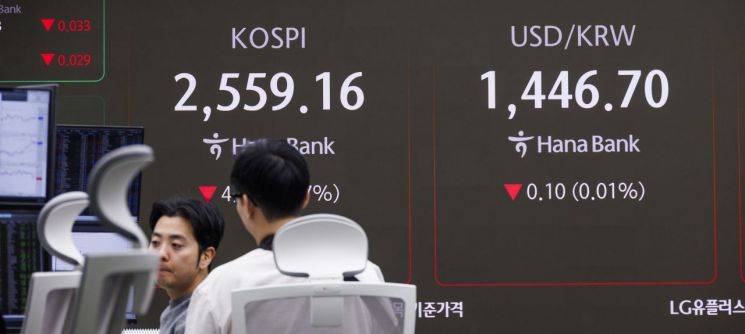
Kim Ji-won, a researcher at KB Securities, stated, "Defense stocks showed strength due to sector rotation among individual stocks," and added, "With a high-level meeting between the U.S. and Ukraine scheduled for March 11, expectations remain for a ceasefire and increased European defense spending." Regarding steel stocks, she explained, "They weakened as the U.S. is set to impose a 25% tariff on steel and aluminum without exceptions starting March 12."
Among large-cap stocks, Korea Zinc (14.19%), Samsung Fire & Marine Insurance (6.44%), Hanwha Systems (5.45%), Korea Aerospace Industries (5.14%), and POSCO Future M (4.39%) rose. Following news that a major Russian oil refinery was damaged by a Ukrainian drone attack, energy stocks such as S-Oil (8.74%) and SK Innovation (6.02%) also performed strongly. On the other hand, Hanwha Aerospace (-3.97%), Doosan (-3.67%), SK Hynix (-2.34%), and HD Hyundai Heavy Industries (-2.22%) declined. Worries over deflation in China (falling prices amid an economic slowdown) led to weakness in cosmetics and entertainment stocks, including HYBE (-4.40%) and Amorepacific (-2.31%).
By sector, non-ferrous metals (9.80%), energy (3.35%), insurance (3.25%), trading companies (3.12%), electrical products (2.38%), and hotel & leisure (1.52%) sectors gained, while media (-2.98%), steel (-2.04%), and cosmetics (-1.41%) sectors saw declines.
The KOSDAQ ended trading at 725.82, down 1.88 points (0.26%). The index had started the day at 724.78, down 2.92 points (0.40%). While foreigners and institutions recorded net sales of 26.5 billion won and 41.8 billion won, respectively, individuals purchased a net 56.9 billion won.
Among the top KOSDAQ stocks by market capitalization, Chinese consumer-related stocks such as JYP Entertainment (-9.31%) and CJ ENM (-3.36%) showed marked weakness. In addition, shares of HLB Life Science (-7.34%), HLB (-6.99%), Voronoi (-4.64%), and Silicontwo (-3.76%) fell. Conversely, Hugel (6.45%), EcoPro BM (5.40%), PharmaResearch (3.77%), Nature Cell (3.16%), and Lunit (3.11%) saw their shares rise.
Researcher Kim commented, "Concerns remain as Trump has mentioned the possibility of further tariff hikes on Canada and Mexico," and added, "Based on attractive valuations, the Korean market is expected to continue its relatively solid performance compared to the U.S., with strength persisting in the leading sectors."
Key events scheduled for this week include the release of the U.S. February Consumer Price Index (CPI) on March 12, the U.S. February Producer Price Index (PPI) on March 13, and the preliminary University of Michigan inflation expectations for March on March 14. In addition, from March 12, the U.S. government will begin imposing tariffs on steel and aluminum.
© The Asia Business Daily(www.asiae.co.kr). All rights reserved.

















