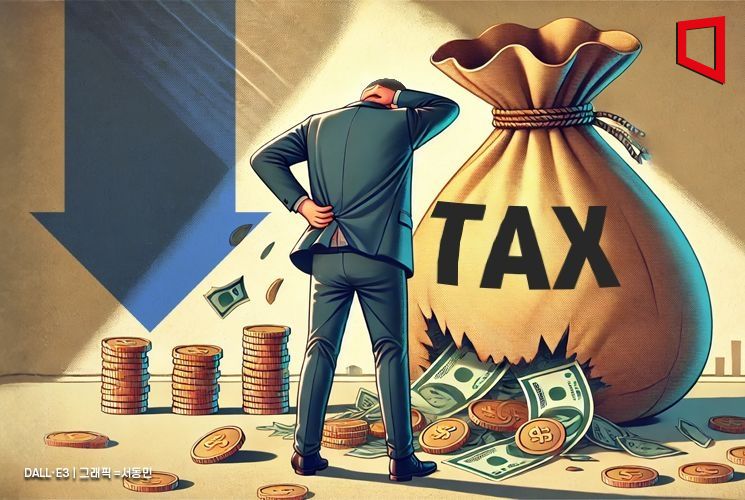
This year marks the third consecutive year in which a tax revenue shortfall appears inevitable. Last year's large-scale tax revenue deficit was due to the budget being based on rosy forecasts such as the semiconductor boom, but this year, unlike before, the global economic slowdown has become apparent as the tariff war triggered by the Trump administration intensified.
According to the Ministry of Economy and Finance on the 11th, the government is paying close attention to the scale of corporate tax revenue expected to come in by the deadline for corporate tax filing and payment this month. According to the revenue budget, corporate tax in March this year should increase significantly compared to the previous year, but the Ministry of Economy and Finance is skeptical that this will be easy.
March is the month when companies that close their accounts at the end of the year make their final tax payments on profits earned over the past year. Therefore, the scale of revenue this month can be used to gauge whether there will be a tax revenue shortfall for the year. Corporate tax revenue in March last year was 18.7 trillion won, down 5.5 trillion won (22.8%) from the previous year. Ultimately, the total corporate tax revenue for 2024 (62.5113 trillion won) was 15.2 trillion won less than the original budget.
An official from the Ministry of Economy and Finance explained, “At the time of closing last year's revenue budget, operating profits of KOSPI-listed companies had increased by 200% until August. It is believed that this trend continued until the third quarter, but in the fourth quarter, the growth in semiconductor exports slowed, and some companies such as Samsung Electronics did not achieve market expectations.”
The government had anticipated in the 2025 revenue budget that corporate tax revenue this year would increase by 10.8 trillion won from last year to 88.5 trillion won. It expected that the increase in corporate tax due to profit growth of major semiconductor companies such as Samsung Electronics and SK Hynix would drive the overall increase in national tax revenue.
However, Samsung Electronics recorded 6.5 trillion won in operating profit in the fourth quarter, less than the market expectation of 7.7 trillion won, due to weak demand for memory semiconductors. In the fourth quarter of last year, memory semiconductor prices fell due to price competition from Chinese companies, leading to a slowdown in exports. SK Hynix recorded 8.0828 trillion won, in line with the market expectation of about 8 trillion won.
Some speculate that Samsung Electronics may not pay taxes in March as it could deduct taxes for operating losses in 2023 this year. However, the Ministry of Economy and Finance expects that, unlike the previous year, the corporate tax revenue in March will not decrease significantly even if Samsung Electronics and SK Hynix do not pay corporate tax.
According to the Ministry of Economy and Finance, the two companies already paid taxes at the time of the interim payment in August last year based on strong first-half performance exceeding the previous year's losses. Therefore, it is unlikely that the two companies will not pay taxes due to the carryforward loss deduction system (a system allowing companies to deduct losses for up to 10 years and pay taxes accordingly) for losses in 2023. While there is concern that taxes paid may be less than expected due to fourth-quarter performance, it is unlikely that they will not pay taxes at all.
The biggest issue is August, when the interim payment is due. Corporate tax revenue collected during this period, when companies pay taxes based on first-half performance, is expected to fall significantly short of predictions. This was a situation that could not have been anticipated when the revenue budget was prepared in August last year. A Ministry of Economy and Finance official said, “No one could have predicted the economy in the first half of this year, including the Trump administration imposing actual tariffs, and since it is difficult to make definitive statements going forward, it is hard to say how corporate tax will turn out.”
In fact, exports have entered a slowdown phase. On a daily average basis, exports decreased from 7.7% in January to 5.9% in February. This is due to a 53.1% year-on-year drop in prices of general-purpose semiconductors such as NAND flash caused by global demand slowdown. With the inauguration of the Trump administration's second term, the tariff war has intensified, and global trade volume is expected to shrink significantly, leading to a decline in exports of major Korean companies.
© The Asia Business Daily(www.asiae.co.kr). All rights reserved.
![Clutching a Stolen Dior Bag, Saying "I Hate Being Poor but Real"... The Grotesque Con of a "Human Knockoff" [Slate]](https://cwcontent.asiae.co.kr/asiaresize/183/2026021902243444107_1771435474.jpg)
















