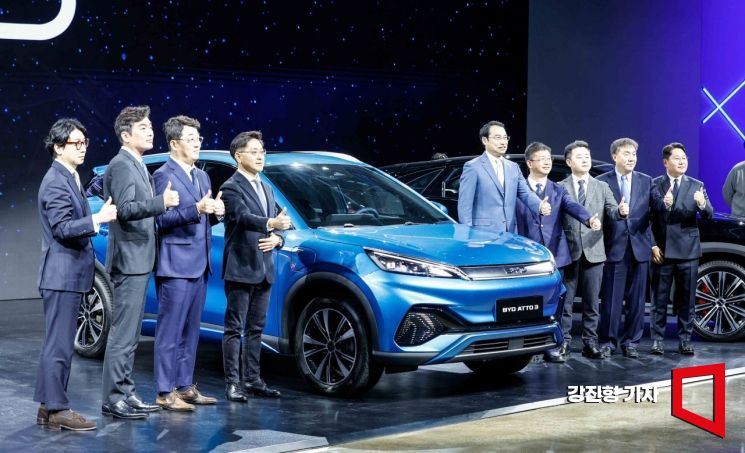
 On the 16th, the BYD Atto 3, officially launched in Korea, was unveiled at the 'BYD Brand Launch Media Showcase' held at Incheon Sangsang Platform. Incheon - Photo by Kang Jin-hyung
As Chinese company BYD, which ranked first in global electric vehicle sales last year, prepares to enter the Korean market, the domestic automotive industry is becoming tense. With domestic sales declining due to the electric vehicle chasm (temporary demand stagnation), there are concerns that BYD, leveraging its price competitiveness, could start by capturing the commercial vehicle market such as rental cars and taxis, eventually encroaching on the general passenger car market. However, the subsidy approval process for BYD's Atto 3 is delayed, and major domestic rental car companies are reluctant to introduce the Atto 3, so it is expected to take some time before BYD fully enters the Korean market.
BYD's Atto 3 launch is delayed because it has not completed procedures with the Ministry of Environment and the Ministry of Trade, Industry and Energy. On the 11th, a Ministry of Environment official said, "BYD submitted basic information for the subsidy approval process of the Atto 3 to the Ministry of Environment on the 28th of last month, but some documents were incomplete, so we requested supplements," adding, "It seems BYD hurriedly submitted the documents at the end of last month, but we cannot specify which documents are insufficient or when the process will be completed."
For the Atto 3 to be launched domestically, it must also pass the Ministry of Trade, Industry and Energy's registration process as an 'eco-friendly vehicle.' A ministry official explained, "The Korea Energy Agency is reviewing the Atto 3's energy consumption efficiency and single-charge driving range submitted by BYD," adding, "If there are no issues, it is expected to be registered as an eco-friendly vehicle as early as the end of this month." If the Energy Agency's fuel efficiency verification is delayed, the Atto 3's launch will likely be postponed accordingly. In response to the domestic launch delay, BYD Korea has decided to provide about 300,000 KRW worth of charging credits to customers who pre-ordered the vehicle.
While the delay in BYD's Atto 3 launch brings some relief to the domestic electric vehicle industry, it remains cautious. According to BYD, the domestic selling price of the Atto 3 is 31.5 million KRW for the base model and 33.5 million KRW for the Plus model, the lowest among global launch prices. With tax benefits and government and local government electric vehicle subsidies added, the purchase price can be in the high 20 million KRW range. A Korea Electric Vehicle Association official said, "Cost-effectiveness is important for young consumers, who are the main customers in the mid-to-low price electric vehicle market, so if the perception that 'Atto 3 also has good quality' forms, there will definitely be young consumers choosing the Atto 3," adding, "The evaluations and reactions of early adopters who pre-ordered the Atto 3 will play a crucial role in BYD's success in Korea."
BYD may also pursue a strategy to expand its market share in Korea's electric vehicle market by focusing first on commercial vehicles such as rental cars and taxis. Kim Kyung-yu, a senior researcher at the Korea Institute for Industrial Economics and Trade, said, "BYD is likely to first penetrate the rental car market and then target the general consumer market," adding, "Just as the car-sharing company SoCar encouraged consumers to experience its service through various discounts, if extensive promotions for the Atto 3 are conducted when using rental cars, more users will choose the Atto 3 as a trial."
However, it is expected to take a considerable amount of time for domestic rental car companies to introduce the Atto 3. Both Lotte Rental and SK Rent-a-Car, the top two rental car companies in Korea, are not considering introducing the Atto 3. This is due to ongoing consumer concerns about the quality and safety of Chinese cars. An SK Rent-a-Car official said, "When purchasing vehicles, we cannot ignore consumer preferences and the resale value of used cars," adding, "We are not considering introducing Chinese electric vehicles, including BYD."
Uncertainty about the resale price of used cars 3 to 4 years later is also one reason rental car companies hesitate to adopt BYD. Half of rental car companies' profits come from selling used cars after operating them as rentals. A Lotte Rental official said, "Rental cars serve to let consumers experience the vehicles, but there is significant uncertainty about Chinese electric vehicles and BYD," adding, "For the same reason, there is no data on consumer preferences, so we cannot estimate how much profit can be made when selling used cars, making it difficult to proactively introduce BYD."
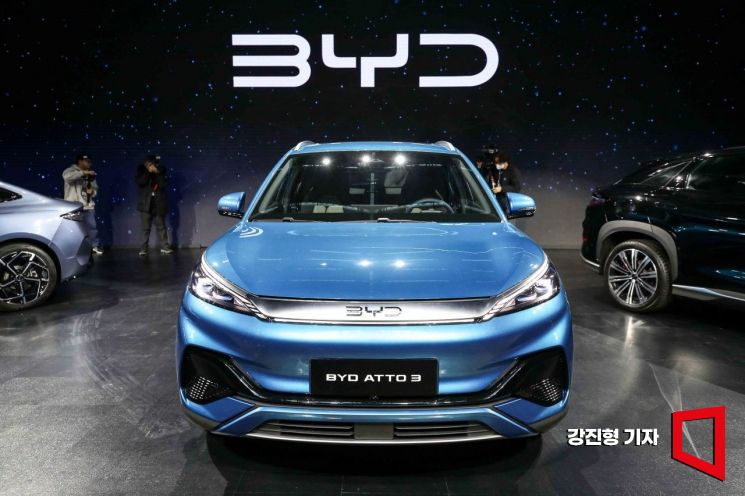 On the 16th, the BYD Atto 3, officially launched in Korea, was unveiled at the 'BYD Brand Launch Media Showcase' held at Incheon Sangsang Platform. Incheon - Photo by Kang Jin-hyung
© The Asia Business Daily(www.asiae.co.kr). All rights reserved.


















