Trump's Second Term: LNG-Centered Diplomacy
Pressure on Trade Surplus Allies to Increase U.S. Purchases
Production Expansion... Alaska Project Revived
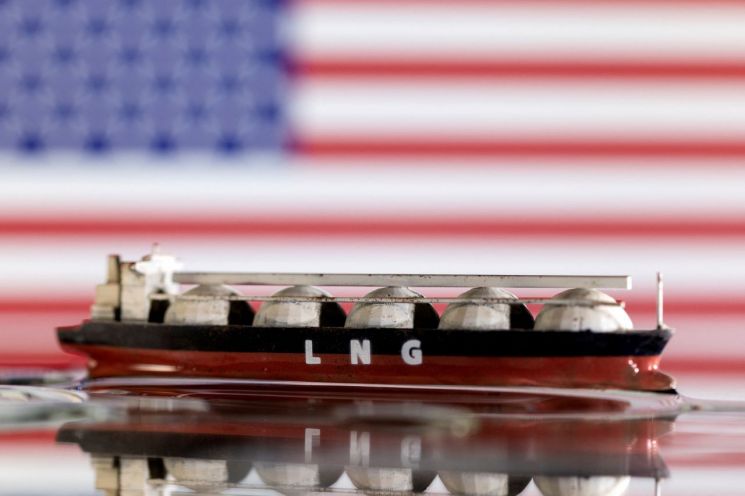
The United States, the world's number one liquefied natural gas (LNG) exporter, has been pushing to expand LNG exports since the second Trump administration took office. While pressuring key allies to increase purchases of U.S.-made LNG using tariff measures, it is also reviving the Alaska LNG project to boost domestic production. However, the fact that China, which is engaged in a trade war with the U.S., is the largest LNG importer is considered a key variable.
According to Bloomberg Businessweek on the 10th, BloombergNEF estimated that the U.S. would expand its LNG production capacity by 60% in the first half of Trump's second term. It also predicted that by 2030, one out of every three LNG carriers worldwide would depart from the U.S.
Since the beginning of his administration, President Donald Trump has emphasized energy policy, and it is expected that the U.S. will continue its policies to expand LNG production and exports. Along with shale oil, which Trump calls "Liquid Gold," LNG is a core element of the energy policy. Vice President JD Vance raised his voice at a Pennsylvania rally last year, saying, "We are sitting on the 'Saudi Arabia of Natural Gas.' Now we have to bring it to the market."
The U.S. has only recently emerged as a major player in the LNG market. U.S. LNG exports reached a historic high of 91.2 million tons (t) in 2023, surpassing Australia and Qatar, which were at about 80 million tons, to take the top spot. According to Bloomberg News, U.S. LNG exports were only 767,000 tons in 2016 but sharply increased to 14 million tons in 2017, 49 million tons in 2020, and 81 million tons in 2022.
The Trump administration is simultaneously increasing domestic LNG production and exports. A key focus of the administration is the reactivation of the Alaska LNG project. It is reported that during the visit of Minister Ahn Deok-geun of the Ministry of Trade, Industry and Energy to the U.S. from the 26th to 28th of last month (local time), the U.S. side requested Korean companies to participate in the Alaska LNG project. From the perspective of the Korean government and companies, there are practical issues such as the need to completely overhaul refining systems that have been focused on relatively inexpensive Middle Eastern oil.
On the 4th, during his first congressional speech of his second term, President Trump said that South Korea and Japan hope to participate in the Alaska gas pipeline project, stating, "South Korea and Japan will each spend (invest) trillions of dollars. This has never happened before, and it will be a very wonderful thing." He announced this as if to show off, despite the fact that no agreement had been reached between the two countries.
At the same time, the U.S. is pressuring its allies in export markets using tariffs as leverage. Europe has announced plans to expand U.S. LNG imports to replace Russian gas, and in Asia, India, Japan, and South Korea are considering increasing purchases of U.S.-made LNG. The Korean government is reviewing expanding imports of U.S. energy such as LNG to reduce its trade surplus with the U.S. South Korea's trade surplus with the U.S. was $55.7 billion in 2024, ranking eighth. This is why there are concerns that it could become a prime target of President Trump.
However, despite the U.S.'s moves to strengthen its LNG dominance, there are variables. China, which is engaged in a trade war with the U.S., is one of them. China was the world's largest LNG importer as of last year. Since China imposed retaliatory tariffs on U.S.-made LNG, import disruptions were expected. Amy Myers Jaffe, a professor at New York University, told Businessweek, "No government wants a market that is highly dependent on imports," adding, "In the short term, it may be unavoidable, but in 10 years, there will be other options."
© The Asia Business Daily(www.asiae.co.kr). All rights reserved.

















