More Than Half of Public Housing in the 3rd New Towns
Will Not Be Available Until After 2030
Starting from the Seoul metropolitan area, concerns over housing supply shortages are growing, and it has been revealed that the number of public housing units in the 3rd New Towns that can be occupied within three years is only about 10,000 units. More than half of the public housing in the 3rd New Towns is scheduled for occupancy after 2030, making it difficult to resolve supply shortages in the coming year and in 2027.
According to the '3rd New Town Annual Occupancy Plan' submitted on the 10th by Korea Land & Housing Corporation (LH) to Lee Yeon-hee, a member of the National Assembly Land, Infrastructure and Transport Committee from the Democratic Party, the total number of public housing units to be built in the 3rd New Towns?Goyang Changneung, Namyangju Wangsuk, Bucheon Daejang, Incheon Gyeyang, and Hanam Gyosan?is 87,101 units. This accounts for 47% of the total 186,000 housing units planned for the 3rd New Towns. The remainder will be supplied by the private sector.
The first public housing occupancy will begin next year in Incheon Gyeyang (1,285 units). In 2027, occupancy is planned for Goyang Changneung (2,089 units), Namyangju Wangsuk (3,905 units), Bucheon Daejang (2,505 units), and Hanam Gyosan (1,115 units). The total occupancy volume by 2027 will be 10,899 units.
Afterwards, an additional 11,462 units will be supplied in 2028 and 16,403 units in 2029. Of the total volume, 48,337 units, accounting for 55%, will only be available for occupancy after 2030.
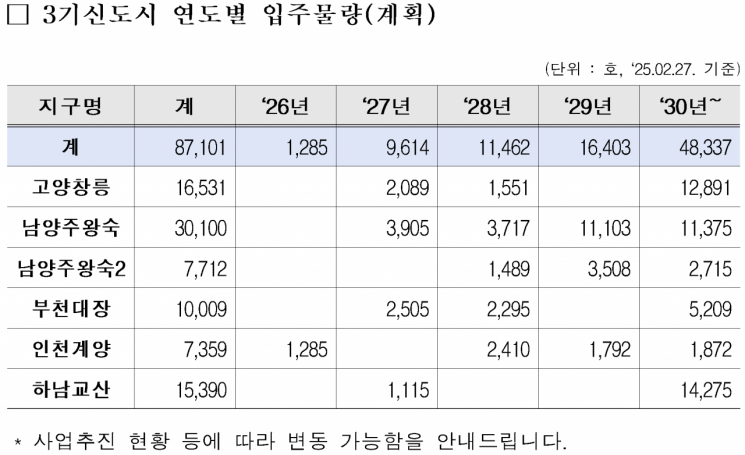
This volume is possible if the LH public housing projects proceed as planned. However, if the projects are delayed due to rising construction costs and issues such as real estate project financing (PF) insolvency, the occupancy schedule may also be postponed.
Amid growing concerns over shortages of public housing in the 3rd New Towns, a housing occupancy cliff is expected to fully manifest in the Seoul area next year. Real estate information company Real Estate R114 forecasted that the number of apartment units available for occupancy in Seoul will sharply drop from 31,300 units this year to 7,768 units next year. The number of apartment units available for occupancy in the Seoul metropolitan area next year is predicted to decrease by 40%, from 113,465 units this year to 69,642 units. This will be the first time in 10 years since 2015 that the metropolitan area’s occupancy volume falls below 100,000 units.
The cause of the occupancy cliff lies in the decrease in construction starts that began two years ago. The Korea Research Institute for Human Settlements (KRHS) predicted in its November report last year titled 'Evaluation and Suggestions on the Current Government’s Housing Supply Expansion Policy' that construction starts would decrease to 140,000 units in 2022 and 100,000 units in 2023, leading to the completion volume of metropolitan area apartments falling below the average annual level (156,000 units) from 2025 onward.
KRHS stated, "Considering that it takes an average of 2 to 3 years from construction start to completion in the housing supply process, the impact of the decrease in construction starts will become significant in 2025," and added, "Looking at the occupancy volume announced by Real Estate R114, the supply decrease will become more pronounced after the second half of 2025."
© The Asia Business Daily(www.asiae.co.kr). All rights reserved.

















