95.95 Million Vehicles Produced Worldwide, Down 0.5% from Previous Year
South Korea Drops in Ranking for First Time in Five Years Due to Weak Domestic Demand
"Extraordinary Policy Support Needed to Promote Domestic Production"
Due to sluggish domestic demand, domestic automobile production has decreased, causing South Korea's global production ranking to drop from 6th to 7th place.
According to the "2024 Global Automobile Production Status and Implications" report released on the 10th by the Korea Automobile Mobility Industry Association, global automobile production in 2024 is expected to decrease by 0.5% from the previous year to 93.95 million units. This marks the first decline since the sharp drop (-15.4%) caused by the COVID-19 pandemic in 2020.
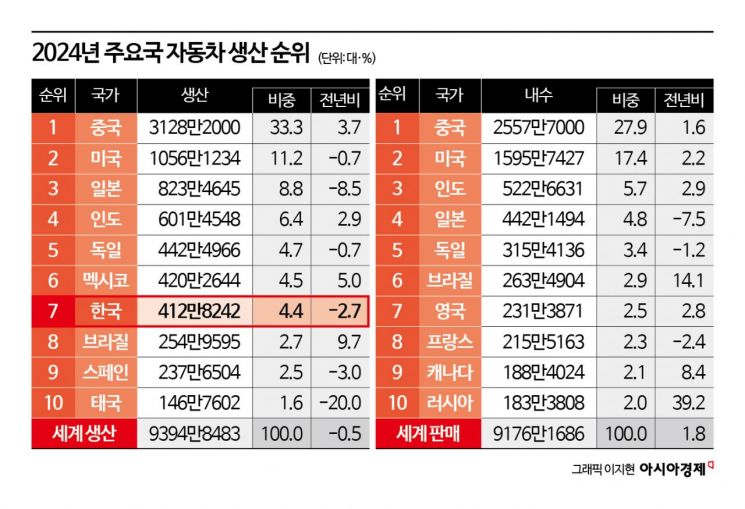
The global production decline is mainly attributed to production setbacks in Japan (-8.5%) due to quality certification fraud issues at some companies such as Toyota and Honda. Production also decreased in Thailand (-20.0%), South Korea (-2.7%), and Spain (-3.0%).
Domestic automobile production in South Korea reached 4.13 million units, down 2.7% from the previous year due to weak domestic demand, despite a 0.6% increase in export volume.
China, the United States, Japan, and India maintained their positions as the top four producers for the fourth consecutive year, accounting for 59.7% of global automobile production.
China produced 31.28 million units, a 3.7% increase from the previous year, achieving first place for the 16th consecutive year, driven by government-led domestic demand stimulation and export promotion policies. The United States recorded a slight production decrease of 0.7% to 10.56 million units, as manufacturers focused on inventory management despite a 2.2% increase in domestic sales.
India showed solid simultaneous growth in domestic sales and exports, producing 6.01 million units, up 2.9% from the previous year.
Among the mid-tier producers with annual production around 4 million units, South Korea lost its 6th place ranking to Mexico.
Germany's production fell to 4.42 million units, down 0.7%, following a 1.2% decrease in domestic sales. Mexico achieved a record high production of 4.20 million units, a 5.0% increase from the previous year, thanks to growth in both exports and domestic sales, reclaiming 6th place after five years.
The report diagnosed that the South Korean automobile industry is facing internal and external challenges such as domestic demand limitations and intensified global competition, threatening the industrial base.
The report stated, "The domestic automobile market has the limitation of low potential demand, so even if domestic demand recovers compared to the previous year, the effect on production expansion will not be significant. China's strengthening global market dominance and the possibility of U.S. tariff imposition act as factors reducing exports. In particular, U.S. tariff policies are expected to accelerate overseas production and investment expansion by domestic manufacturers, including finished vehicle companies."
It also expressed concern that the decline in domestic factory operating rates could lead to worsening management in the parts industry and employment reductions, potentially negatively impacting the entire upstream and downstream industries.
An association official stated, "There is a need for extraordinary policy support such as expanding tax benefits for future vehicle production and facility investment, domestic demand stimulation measures to expand eco-friendly vehicle adoption, and the introduction of a 'Domestic Production Promotion Tax System (tentative)' to promote and support domestic production."
© The Asia Business Daily(www.asiae.co.kr). All rights reserved.

















