After Grabbing Attention with Sensational Fake News,
Victims Lured into Investments
Ongoing Cases Highlight Dangers of Illegal Impersonation Ads
Actress Shin Ae-ra warned that investment advertisements fraudulently using her name are circulating.
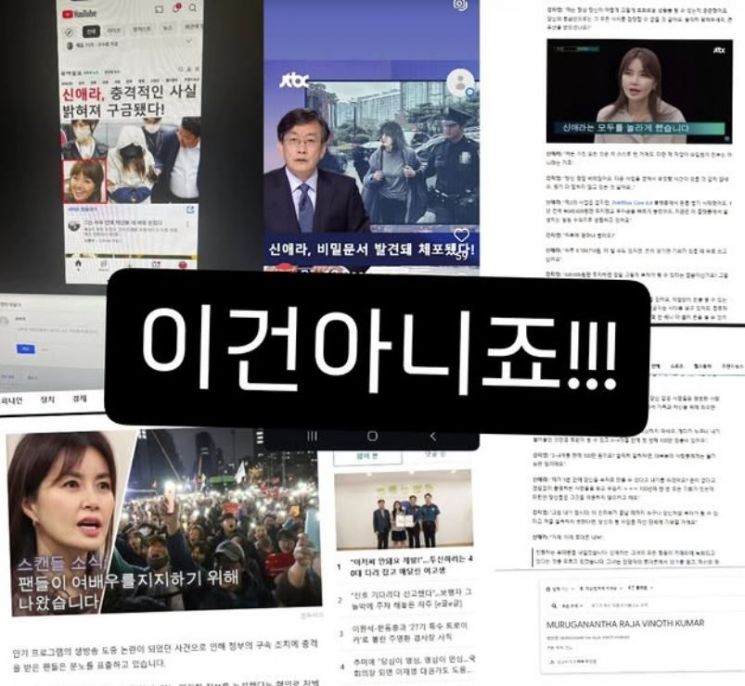
On the 7th, Shin Ae-ra shared examples of investment advertisements that used her name without permission through social networking services (SNS). She said, "These are completely false claims and even deepfakes. Normally, I ignore such things, but I am posting this because some people might get harmed." She emphasized, "I do not engage in any stocks, coins, or other investments that generate monthly income through unethical means." Shin Ae-ra warned, "Please do not fall for these ridiculous schemes. My agency is considering criminal charges, so I urge those involved to stop these illegal activities immediately. I am very angry."
The post shared by Shin Ae-ra contained fake news claiming that she had been arrested and detained. This is a type of advertisement that attracts people's attention and then induces them to invest. Shin Ae-ra added the phrase "This is not okay!" to the post where she shared the photo.
Recently, illegal stock investment inducements, including impersonation scams of celebrities, have been ongoing. A representative method involves using deepfake technology that synthesizes images through artificial intelligence (AI) or voice synthesis technology to exploit well-known celebrities and lure people into joining investment-related chat rooms.
According to statistics from the National Police Agency, from September to December last year alone, there were over 1,000 cases of illegal activities in investment chat rooms, including celebrity impersonation scams, with damages exceeding 120 billion won. Most of these investment chat room scams occur through SNS and use burner phones and fake bank accounts, making police investigations difficult.
Recent scam cases include a company using singer Kim Jong-min’s photo to advertise a "special event for returns," stating, "If you deposit more than 20 million won, additional returns will be paid." In December last year, reports were filed against multiple SNS accounts impersonating Sung Kim, President of Hyundai Motor Group. In the same year, model-turned-broadcaster Hong Jin-kyung announced on her SNS, "I do not operate anything like 'Hong Jin-kyung Economics Department' nor any stock investment-related chat rooms."
Other methods include ▲hundreds of people in SNS open chat rooms posting fake profit certification thank-you messages (actually copying and pasting fake IDs using macros) and ▲scams where victims deposit small amounts, earn profits, and withdraw them, but when larger amounts are deposited, the money is embezzled.
In March last year, members of a group formed to resolve online phishing crimes impersonating celebrities (Yusamo), including broadcaster Song Eun-i, famous lecturer Kim Mi-kyung, former Meritz Asset Management CEO John Lee, and former Hanwha Investment & Securities CEO Joo Jin-hyung, held a press conference urging measures to prevent damage. The list of names in the press release included 137 people such as broadcaster Yoo Jae-suk, singer Uhm Jung-hwa, and YouTuber Ddotty.
© The Asia Business Daily(www.asiae.co.kr). All rights reserved.
![Clutching a Stolen Dior Bag, Saying "I Hate Being Poor but Real"... The Grotesque Con of a "Human Knockoff" [Slate]](https://cwcontent.asiae.co.kr/asiaresize/183/2026021902243444107_1771435474.jpg)
















