Ministry of Education Presents Four Educational Models
Emphasizes "No Reduction in Curriculum"
The Ministry of Education announced four curriculum operation models proposed by the deans of medical schools to ensure the smooth education of first-year medical students (classes of 2024 and 2025), whose numbers have doubled this year. Based on these models, each university will establish an operation plan suited to their circumstances, and the Ministry plans to provide necessary support.
On the 7th, the Ministry of Education announced the 'Plan for Student Return and Normalization of Medical Education,' introducing four educational operation models for the classes of 2024 and 2025 proposed by the 'Korean Association of Medical Colleges and Medical Schools (KAMC)'?a consultative body of deans from 40 medical schools?and universities. According to the Ministry, the number of first-year medical students in the classes of 2024 and 2025 increased from 3,058 last year to 7,623 this year, an average increase of 2.49 times.
These models focus on compressing the six-year medical education curriculum for the class of 2024 into 5.5 years, enabling them to graduate one semester earlier than the class of 2025. The class of 2024 medical students are effectively in a 'practical first-year' status, having not attended classes last year due to collective action. Since the academic status of the first semester for the class of 2024 varies by school, the Ministry explained that different models can be referenced depending on the situation. Among universities, nine have processed the first semester for the class of 2024 as 'all students completed,' 19 as 'partial completion,' two as 'all failed,' and nine as 'leave of absence.'
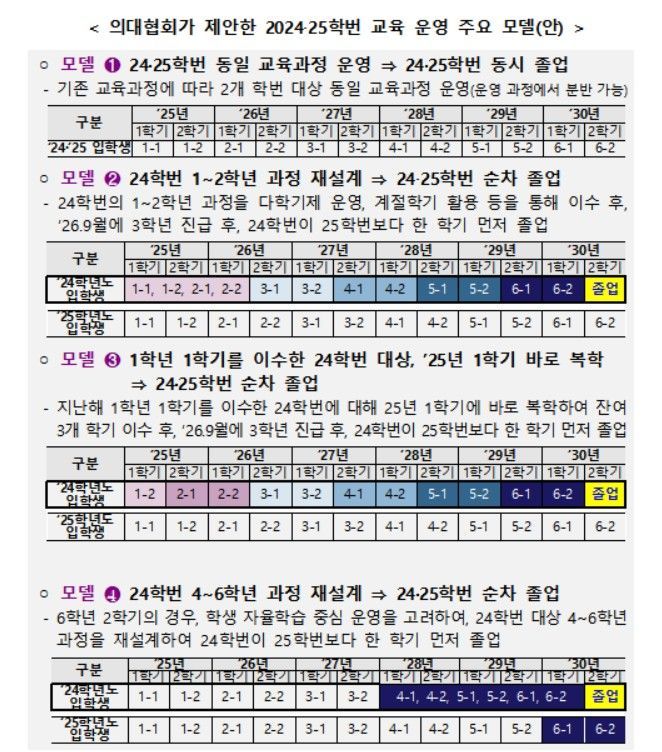
Model 1 operates the existing curriculum as is, allowing the classes of 2024 and 2025 to graduate simultaneously. Both classes complete the six-year curriculum without any special measures to graduate the class of 2024 earlier. Division by class year is possible during operation.
Models 2 to 4 compress the curriculum completion period for the class of 2024 into 5.5 years, resulting in different graduation times. The class of 2024 graduates after completing the first semester of 2030, while the class of 2025 graduates after the second semester of 2030. Model 2 assumes a scenario where students of the class of 2024 are either held back or take a leave of absence and must complete all 12 semesters starting from the first semester this year. The first and second-year courses for the class of 2024 are operated through multi-semester or seasonal semesters, allowing completion of the second semester of the second year curriculum by the first semester of 2026.
Model 3 proposes reinstating the class of 2024 students who completed the first semester of the first year to the second semester of the first year in March this year. By returning directly to the second semester of the first year this semester and sequentially completing the remaining semesters, they can graduate one semester earlier than the class of 2025.
Model 4 redesigns the fourth to sixth-year curriculum for the class of 2024, considering the characteristics of medical education. Medical schools operate the sixth-year second semester without classes for autonomous study in preparation for the national licensing exam; this part is compressed to advance the graduation of the class of 2024.
The Ministry emphasized that this period reduction does not lead to 'poor-quality education.' A Ministry official stated, "Although the period is slightly shortened, the curriculum that must be learned over 12 semesters is faithfully completed, and the process is compressed considering the situation. It does not mean that essential content is omitted or simplified."
Each university will refer to the models proposed by the KAMC, gather opinions from students and faculty, and prepare a six-year medical education operation plan considering their individual circumstances. The Ministry of Education and local governments will provide administrative and financial support necessary for implementing these operation plans.
There have been significant concerns that the increase in medical school quotas would lead to shortages in equipment and educational spaces. The Ministry stated that it is investing 150.8 billion KRW for facility and equipment expansion and 172.8 billion KRW in loans to improve conditions at private universities, promoting infrastructure improvement and space expansion.
Universities have set roadmaps to utilize existing facilities or expand new ones. Nine national universities will start designing medical school buildings within this year to expand essential educational facilities such as lecture rooms and practice rooms. Twenty-two private universities have either started remodeling existing facilities or have plans in place. Ten universities plan to construct new buildings. They intend to operate new facilities by 2029, when the increased number of medical students will begin clinical practice classes.
Regarding equipment necessary for medical education, expansion will be carried out gradually starting with equipment for first and second-year students. This year, the budget for supporting experimental and practical equipment at national university medical schools totals 7.57 billion KRW.
To dispel concerns about poor medical education, financial support through accreditation by the Korea Institute of Medical Education and Evaluation (KIMEE) will also be expanded. The KIMEE support budget increased from 40 million KRW last year to 290 million KRW this year. A Ministry official explained, "Based on the results of KIMEE's major change evaluations, universities will be encouraged to make sincere self-efforts, and administrative and financial support will be provided if necessary."
© The Asia Business Daily(www.asiae.co.kr). All rights reserved.

![Clutching a Stolen Dior Bag, Saying "I Hate Being Poor but Real"... The Grotesque Con of a "Human Knockoff" [Slate]](https://cwcontent.asiae.co.kr/asiaresize/183/2026021902243444107_1771435474.jpg)
















