Four Models Proposed for Medical Education Normalization
Government to Respect University Autonomy on 2026 Admission Quota
Strict Measures for Non-returning Students; No Special Academic Adjustments
Over 600 Billion KRW Invested to Expand Medical Education Infrastructure
The government has ultimately reached a conditional agreement to 'restore to the original state' the medical school admission quota for 2026. On the premise that all medical students return to their studies by March, the admission quota for medical schools in 2026 can be adjusted to 3,058 students, the same as the 2024 academic year. For the education of the 24th cohort, who did not attend classes last year, and the 25th cohort, who entered this year, four models were proposed depending on each university's situation.
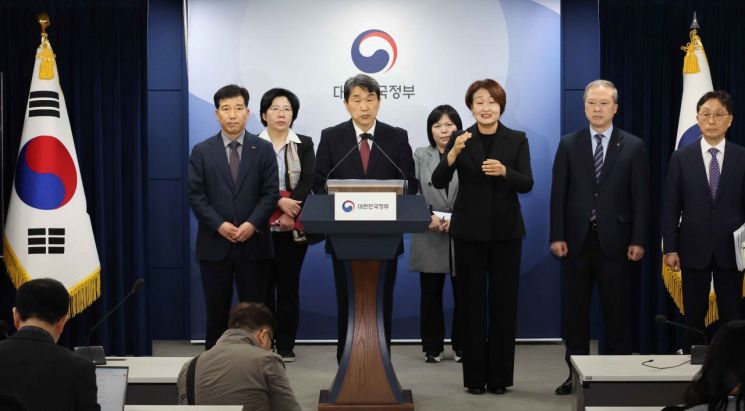
On the 7th, Lee Ju-ho, Deputy Prime Minister for Social Affairs and Minister of Education, announced the 'Plan for Student Return and Normalization of Medical Education' at the Government Seoul Office, together with Yang Oh-bong and Lee Hae-woo, chairpersons of the Presidents' Council for the Advancement of Medical Schools, and Lee Jong-tae, chairman of the Korean Association of Medical Colleges and Medical Schools. Minister Lee stated, "Considering the start of the new semester in March and the 2026 academic year admission schedule, we have discussed with the medical education community with an urgent mindset that the issue of medical education must be resolved. The government intends to respect the autonomous decisions of university presidents regarding the 2026 admission quota, based on the Medical Schools Council's recommendation, on the premise that all students return by the end of March."
Previously, the Medical School Association submitted a petition signed by deans to the government stating that "if the 2026 admission quota is accepted as 3,058 students, medical students will definitely return." The Medical Schools Council also proposed to the government that, assuming all medical students return and classes proceed normally in the 2025 academic year, the admission quota for medical schools in 2026 be adjustable by university presidents to 3,058 students, the same as in 2024.
The Ministry of Education accepted this proposal. The government decided to respect the autonomous decisions of university presidents regarding the 2026 admission quota, on the premise that all students return by the end of this month. The medical school quota for 2026, which was confirmed last year as 5,058 students, will remain unchanged, but universities recruiting students will be allowed to adjust the 'admission quota' to 3,058 students.
However, if medical students do not return by the deadline at the end of this month, the adjustment plan will be withdrawn and the admission quota will be maintained at 5,058 students. Academic operations will also strictly apply related regulations such as university rules this year. No special measures will be taken to facilitate student return this year, and if students do not attend classes or engage in collective actions, they will be dealt with according to principles such as academic warnings, failure, or expulsion. Exceptional measures such as artificial academic schedule adjustments or blanket approval of leaves of absence will not be applied.
Four Models Proposed for Medical Education
Measures were also introduced to educate both the 24th cohort, who could not properly complete the first-year curriculum last year due to collective action opposing the increase in medical school admissions, and the 25th cohort, who entered this year. According to the Ministry of Education, the number of first-year medical students in the 24th and 25th cohorts increased from 3,058 last year to 7,623 this year, an average increase of 2.49 times.
Considering that education for new and returning students must be conducted over the next six years starting this year, the Ministry prepared measures based on various models proposed by the Medical School Association for the education of the 24th and 25th cohorts. Each university will establish an operational plan after gathering student opinions and analyzing educational conditions based on these models.
The first model is to operate the existing curriculum as is, allowing the 24th and 25th cohorts to graduate simultaneously. Both cohorts will complete the six-year curriculum without any special measures to graduate the 24th cohort early. Class division by cohort is possible during operation.
The second to fourth models compress the education period to allow the 24th cohort to graduate one semester earlier than the 25th cohort. The 24th cohort will graduate after completing the first semester of 2030, and the 25th cohort will graduate after the second semester of 2030. The second model operates the first and second years of the 24th cohort in a multi-semester system so that they can complete the second semester of the second year curriculum in the first semester of next year.
The third model applies to students of the 24th cohort who completed the first semester of the first year last year. They can return to school in the first semester this year and sequentially complete the remaining semesters, graduating one semester earlier than the 25th cohort.
The fourth model redesigns the fourth to sixth-year curriculum for the 24th cohort. Considering that the second semester of the sixth year in medical school is mainly self-study for the national examination, the six-semester curriculum can be completed over about five semesters starting from the first semester of the fourth year.
When operating curricula that differ in graduation timing for the 24th cohort, an additional medical licensing examination will be conducted for them. The allocation and selection of residency quotas, training, and acquisition of specialist qualifications will also proceed smoothly considering the schedule.
The government will invest a total of 606.2 billion KRW this year to expand infrastructure and support educational innovation following the increase in medical school admissions. Universities are improving educational conditions in universities and hospitals, and 32 universities with increased medical school quotas have newly hired 595 medical school faculty members in the first half of this year. Expansion of medical education spaces such as lecture rooms and practice rooms is also underway according to each university's plan.
To support students' clinical practice in hospitals, improvements in university hospital conditions are also being made. Each university hospital is promoting the expansion of spaces such as clinical practice preparation rooms and seminar rooms in time for clinical practice education for the increased number of students in 2029. A clinical education training center capable of systematic training such as simulated surgery will be built in national university hospitals by 2028. Private medical schools will support loans to strengthen essential medical capabilities of university hospitals, including improving educational conditions of affiliated hospitals and expanding medical facilities and equipment.
The Ministry of Education plans to establish a policy advisory body tentatively named the 'Medical Education Committee' to normalize medical education. Dedicated personnel at each medical school will monitor the university's educational operations and identify support needs.
Minister Lee said, "The Ministry of Education will continue to cooperate closely with related ministries, the Medical School Association, and field experts to make every effort to normalize medical education. We earnestly hope that students will trust the government and universities' commitment and promptly return to their studies on site."
© The Asia Business Daily(www.asiae.co.kr). All rights reserved.



















