Cracks in the Transatlantic Alliance After Trump’s Second Term Begins
U.S.-Russia Relations Grow Closer... Europe Seeks to Counterbalance
Shared Interests Align Europe with China
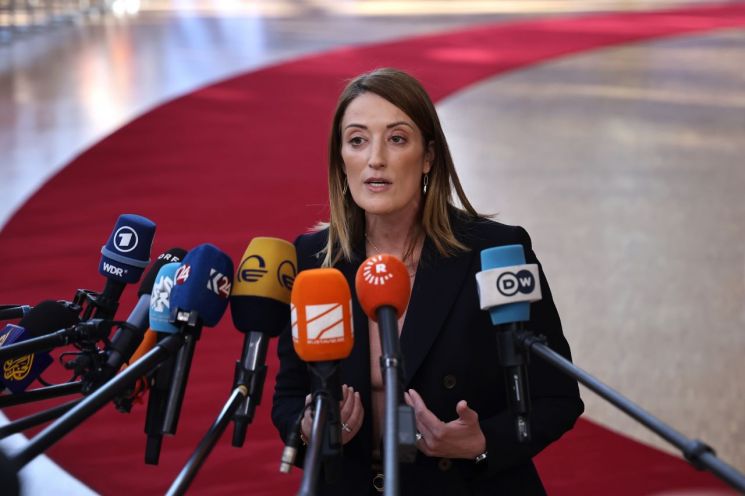 Roberta Metsola, President of the European Parliament, held a press conference immediately after arriving at a European Parliament meeting held in Brussels, Belgium, on the 6th (local time). The Hong Kong daily South China Morning Post (SCMP) reported that the European Parliament is considering lifting sanctions that block official meetings with senior Chinese officials. /Photo by EPA and Yonhap News Agency
The transatlantic alliance between the United States and Europe, which began to fracture after the inauguration of the second Trump administration, has deteriorated into a crisis amid the Russia-Ukraine peace negotiations. Europe, seeking allies to counterbalance Russia’s growing closeness with the U.S., is exploring an escape route through restoring relations with China. This aligns with China’s interests as it has faced consecutive U.S. export sanctions and direct and indirect tariff attacks.
According to the Hong Kong daily South China Morning Post (SCMP) on the 6th, the European Parliament is pushing to lift sanctions that block meetings with senior Chinese officials. Roberta Metsola, President of the European Parliament, proposed the withdrawal of these measures last month. This move was prepared in April 2023, about two years after the European Union (EU) and China imposed mutual sanctions following conflicts over human rights abuses in the Xinjiang region in 2021. Since then, Chinese parliamentarians have not been invited to visit the European Parliament, and both sides have banned official delegation visits.
The U.S. is at the center of this new phase in EU-China relations. SCMP diagnosed that the geopolitical alliance was shaken with the inauguration of President Donald Trump. SCMP noted, "Since the return of U.S. President Donald Trump, the transatlantic relationship between the U.S. and Europe has experienced its most serious rift in decades."
The U.S. has openly sided with Russia regarding the Russia-Ukraine war negotiations. President Trump, who has staged a 'bromance' with President Vladimir Putin, has not hesitated to praise him and sparked international outrage by stating that "Russia did not invade Ukraine first." The U.S. also declared a large-scale trade war against Europe. In response, European societies, led by France, have voiced the need to counter Russia and urged efforts toward self-strengthening. On the 5th, French President Emmanuel Macron mentioned the use of France’s nuclear deterrent, the 'nuclear umbrella theory,' to confront the Russian threat during a national address, which immediately drew strong backlash from the Kremlin.
As U.S. pressure on China intensifies, China is actively conducting a diplomatic offensive in Europe under the banner of a 'charm offensive.' Chinese diplomats are touring European capitals, delivering messages about the need to jointly maintain a multilateral order, emphasizing that Trump’s policies are undermining the existing international order. Lu Saye, China’s special representative for Europe, known for his 'wolf warrior' diplomacy in France, said at the Chinese People’s Political Consultative Conference (CPPCC) in Beijing on the 5th, "The Trump administration’s overt and dominant policies toward Europe and its treatment of allies are frankly very shocking from a European perspective."
China has also increased its diplomatic budget, signaling that it will continue these efforts this year. At the opening ceremony of the National People’s Congress (NPC, equivalent to South Korea’s National Assembly) held the day before, China’s Ministry of Finance announced that this year’s diplomatic budget was set at 64.56 billion yuan (approximately 12.8 trillion won), an 8.4% increase from last year. This is a larger increase than last year’s 6.6% and exceeds the 7.2% increase in defense spending for the third consecutive year. Analysts noted this contrasts with the isolationism of the Trump administration, which championed 'America First' policies.
© The Asia Business Daily(www.asiae.co.kr). All rights reserved.
![Clutching a Stolen Dior Bag, Saying "I Hate Being Poor but Real"... The Grotesque Con of a "Human Knockoff" [Slate]](https://cwcontent.asiae.co.kr/asiaresize/183/2026021902243444107_1771435474.jpg)
















