European Defense Spending Expansion Pushes Euro to Year-High
EU Announces 'Rearmament Plan' to Strengthen Military Capabilities
U.S. President Donald Trump's "America First" foreign policy is shaking the international order just over a month into his administration. Some European countries have responded with strong reactions, saying "America is no longer an ally," in response to tariff policies and defense cost diplomacy toward allies represented by America First, spreading a self-reliance theory that they must build the power to defend themselves without U.S. assistance.
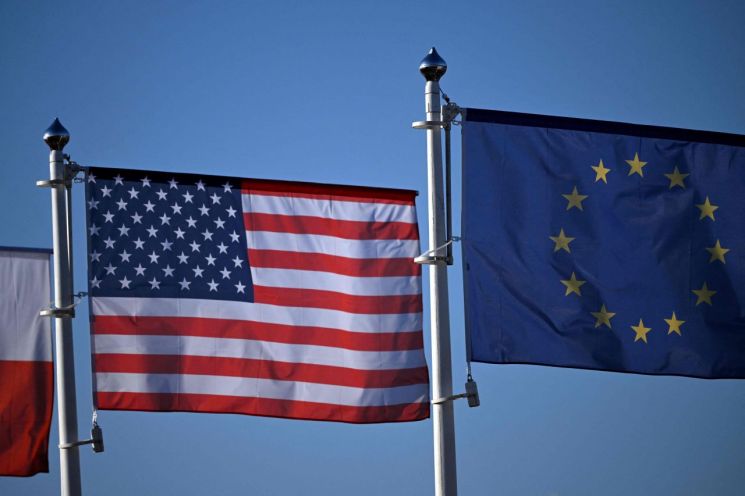 U.S. President Donald Trump's "America First" foreign policy is shaking the international order just over a month into his administration. Some European countries have responded with strong reactions, saying "America is no longer an ally," in response to tariff policies and defense cost diplomacy toward allies, which represent America First. There is a growing call for self-reliance, emphasizing the need to build the capacity to defend themselves without U.S. assistance. AFP·Yonhap News
The European Union (EU) held a special summit in Brussels, Belgium, on the 6th, attended by Ukrainian President Volodymyr Zelensky, to discuss support for Ukraine and ways to strengthen European defense capabilities. Upon arriving in Brussels that day, Zelensky emphasized, "From the first day of the war until now, and throughout last week, I am truly grateful for standing with Ukraine," adding, "It is very important that the EU and individual countries have expressed their willingness to support." Ursula von der Leyen, President of the European Commission, said, "Now is the moment to show that we will stand with Ukraine no matter how long it takes," expressing strong support. Polish Prime Minister Donald Tusk also emphasized, "Europe is stronger than Russia," and "We can fight and win against Russia in all military and economic aspects."
Meanwhile, the European Union (EU) has introduced the so-called "REARM Europe Plan" to strengthen defense capabilities, a core aspect of self-reliance. The plan aims to mobilize funds amounting to at least 800 billion euros (approximately 1,229 trillion won) to encourage member states to increase defense spending. The European Commission, the EU's executive body, proposed activating country-specific exceptions to temporarily suspend the application of EU fiscal rules, allowing individual member states to actively mobilize public funds for the defense sector.
European Powers Taking Security Self-Reliance... Germany and the UK "Increasing Defense Spending," France "Considering Nuclear Umbrella"
The German political sphere, currently discussing the formation of a new government, has decided to push for a special budget exceeding 1,000 trillion won to expand military spending and improve economic structure. Within the ruling Christian Democratic Union (CDU), there are even calls to reintroduce conscription, which was abolished in 2011. The UK also plans to increase defense spending from the current 2.3% of GDP to 2.5% by 2027. This would mean an annual increase of 13.4 billion pounds (about 24.3 trillion won) in defense expenditure starting in 2027.
The UK government plans to cut the overseas aid budget from 0.5% of GDP in 2027 to 0.3% to cover the necessary funds. Nordic country Denmark has also announced a major rearmament, adding 50 billion kroner (about 10 trillion won) to defense budgets this year and next. Although Denmark had already planned to increase defense spending by a total of 190 billion kroner (about 38 trillion won) over ten years starting last year, it judged that this alone was insufficient.
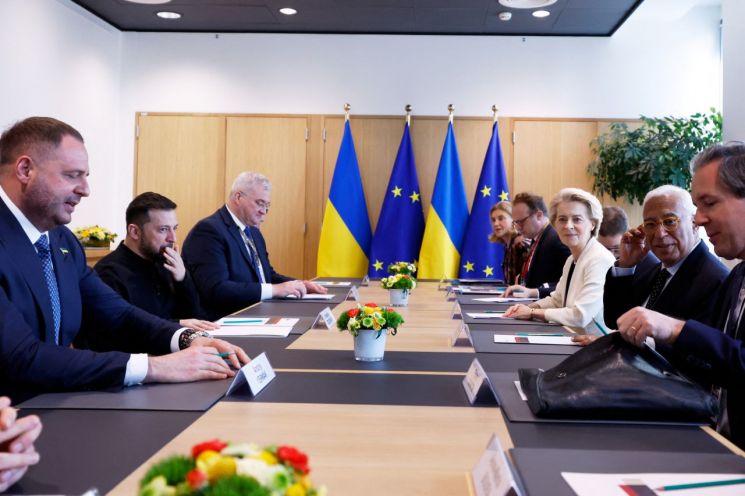 The European Union (EU) held a special summit on the 6th in Brussels, Belgium, attended by Ukrainian President Volodymyr Zelensky, to discuss support for Ukraine and measures to strengthen European defense capabilities. Photo by Reuters and Yonhap News.
France, which has long advocated for European self-reliance, originally aimed to expand its defense budget from the current 50.5 billion euros (about 78 trillion won) to 68 billion euros (about 106 trillion won) annually by 2030, but is now considering raising this target due to recent changes in the international situation. On the 6th (local time), French Defense Minister S?bastien Lecornu appeared on Radio France Inter and said that defense capability must be accelerated, estimating that "our military will need about 90 billion euros (about 140 trillion won) annually to maintain the stamina suitable for various missions." Additionally, France is taking steps to prepare European security self-measures, including considering providing a "nuclear umbrella" to neighboring countries.
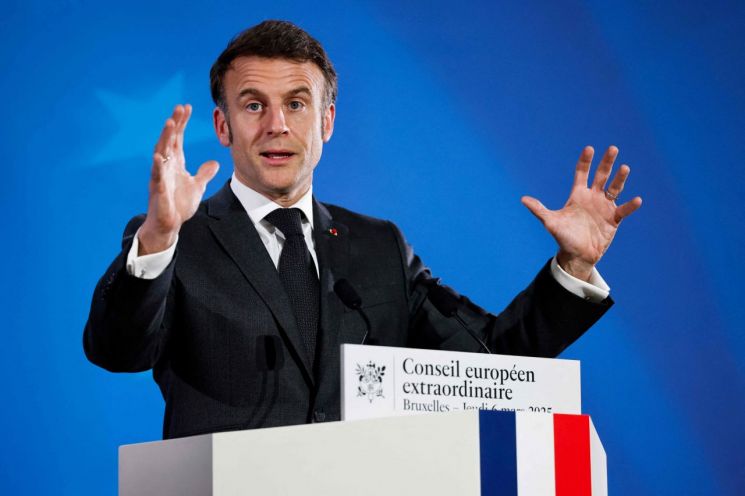 President Macron, who has long advocated for a "French nuclear umbrella" for Europe, declared in a national address on the 5th that Europe must be able to protect itself against the potential threat from Russia, stating, "We have decided to initiate a strategic dialogue on nuclear deterrence to protect Europe's allies." AFP Yonhap News
President Emmanuel Macron, who has long advocated for a "French nuclear umbrella" for Europe, declared in a national address on the 5th that Europe must be able to protect itself against potential threats from Russia, stating, "We have decided to start a strategic dialogue on nuclear deterrence to protect our European allies." There is a favorable response from some parts of Europe as well. Lithuanian President Gitanas Naus?da told reporters before the EU summit on the 5th, "I think it is a very interesting idea," adding, "A nuclear umbrella could be a strong deterrent against Russia."
Meanwhile, concerns that the U.S. "security umbrella" may weaken have caused turmoil in the bond market as the EU pushes forward with the "rearmament plan," including support for Ukraine and strengthening independent defense capabilities. In particular, on the 5th, when Europe decided to increase defense spending by relaxing fiscal rules, the euro rose to its highest value this year.
© The Asia Business Daily(www.asiae.co.kr). All rights reserved.



















