The Korea Forest Service announced on the 7th that it plans to expand the per capita urban forest area to 15㎡ by 2027.
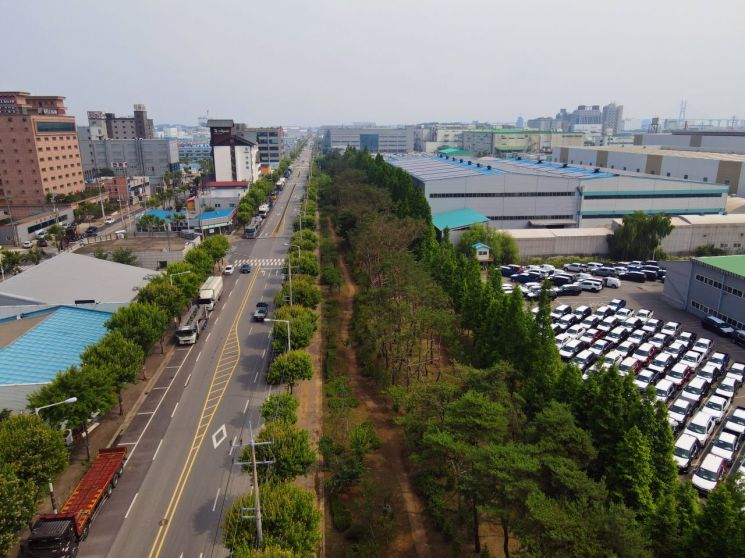 A panoramic view of the fine dust blocking forest created in the Poseung Industrial Complex area, Pyeongtaek-si, Gyeonggi-do. Provided by the Korea Forest Service
Previously, since 2019, the Korea Forest Service has established 588 climate-responsive urban forests and urban wind path forests in 17 cities. Additionally, to promote students' health and create a pleasant environment for their commute to school, 279 Child Safety Green Forests have been expanded.
Furthermore, this year, plans are in place to additionally create 107 climate-responsive urban forests, 20 urban wind path forests, and 60 Child Safety Green Forests.
The expansion of urban forests has been found to play a positive role in environmental improvement, such as reducing fine dust, and in urban living. For example, according to a study published this year by the National Institute of Forest Science in the International Journal of Environmental Research and Public Health titled "A Study on the Increase of Urban Forests and the Decrease in Respiratory Disease-related Medical Visits," the fine dust concentration in the fine dust blocking forest "Gomsolluri Forest" established in Siheung-si, Gyeonggi-do, decreased by 49.5%, from an average of 85.2㎍/㎥ between 2006 and 2023 before establishment to 43.0㎍/㎥ after establishment.
Using the same criteria, the number of respiratory disease-related medical visits in the surrounding area decreased by 43.4%, from 36,709 before establishment to 20,776 after establishment. This indicates that the creation of urban forests is effective in reducing fine dust concentration and has contributed to improving respiratory diseases among local residents.
The effects of urban forests have also been confirmed overseas. For instance, a study investigating the impact of urban forests on air quality and climate, focusing on the Jinan area in northern China (Atmosphere, 2024), found that the concentration of fine particulate matter (PM2.5) in areas with urban forests was 6.3 to 6.5㎍/㎥ lower, and ozone concentration was 21 to 23㎍/㎥ lower than in areas without urban forests.
Additionally, the temperature in urban forest areas was 4.1 to 6.8 degrees Celsius lower, and relative humidity was 12.9 to 13.4% higher, providing residents with a relatively more comfortable living environment.
Kim Ki-cheol, Director of the Urban Forest Landscape Division at the Korea Forest Service, stated, “We will continue to expand urban forests so that all citizens can enjoy the benefits of forests nearby, nurture them into valuable and healthy forests, and strive to maximize the effects of urban forests.”
© The Asia Business Daily(www.asiae.co.kr). All rights reserved.
![Clutching a Stolen Dior Bag, Saying "I Hate Being Poor but Real"... The Grotesque Con of a "Human Knockoff" [Slate]](https://cwcontent.asiae.co.kr/asiaresize/183/2026021902243444107_1771435474.jpg)
















