Tariff Exemption on USMCA Items
Trump Delays 25% Tariff Bomb for a Month
"Rollercoaster Tariff Policy" Causes Global Concerns
U.S. President Donald Trump decided to delay the 25% tariff bomb he dropped on Mexico and Canada for about a month just two days after imposing it. The tariff exemption deadline was set until April 2, the date when mutual tariffs were announced to each country. Amid growing concerns about a tariff-induced 'Trumpsession' (an economic recession caused by President Trump's policies), foreign media described the rollercoaster tariff policy changing daily as "a psycho-drama."
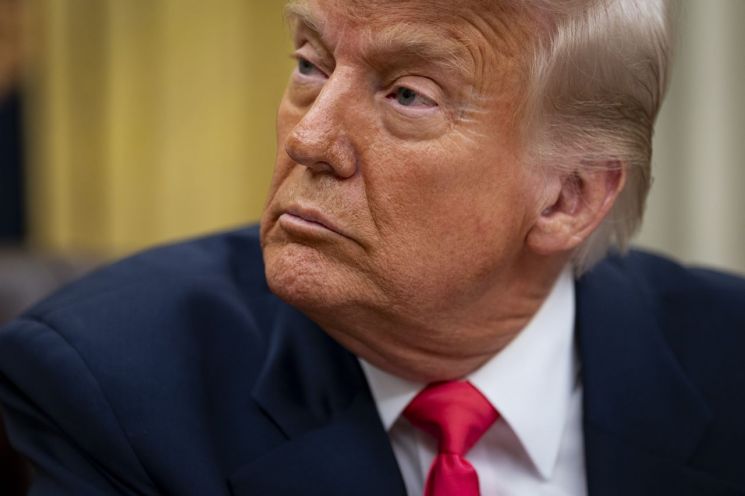
On the 6th (local time), President Trump signed an executive order exempting tariffs on all goods covered by the United States-Mexico-Canada Agreement (USMCA) among imports from Mexico and Canada until April 2.
This temporary tariff suspension came just two days after the U.S. implemented the 25% tariffs it had delayed for a month on the two countries on the 4th. The White House announced the day before that it would exempt tariffs on automobiles from Mexico and Canada for a month, and the next day expanded the exemption to most items.
Before signing the executive order that day, President Trump said on his social networking service (SNS) Truth Social, which he created, "After speaking with Claudia Sheinbaum, President of Mexico, we agreed that Mexico does not have to pay tariffs on all goods covered by the USMCA," adding, "This agreement is valid until April 2."
April 2 is the date President Trump announced for imposing reciprocal tariffs considering tariffs and non-tariff barriers of each country. While Mexico, Canada, and U.S. companies such as automakers based in these countries have bought some time, there is a high possibility that they will face high tariffs again after a month. U.S. Secretary of Commerce Gina Raimondo also seemed to keep this in mind, saying, "We hope Mexico and Canada will do enough regarding fentanyl," and "We hope that this part of the conversation will be excluded from the negotiation table when new tariffs are applied."
The White House stated that 38% of Canadian imports and half of Mexican imports subject to USMCA are covered by the tariff exemption. Many Canadian energy products not covered by USMCA are subject to a 10% tariff. However, CNN reported that the U.S. has practically not imposed tariffs on items not covered by USMCA so far.
President Trump's temporary tariff suspension is analyzed as due to the highly integrated supply chains of the three North American countries under the free trade agreement (FTA) USMCA, making it difficult for the U.S. to avoid economic damage from tariff measures. The U.S. Big Three automakers requested a tariff exemption from President Trump the day before for the same reason. Concerns about stagflation (rising prices amid economic slowdown) due to tariff hikes are growing even within the U.S. There are also forecasts of a Trumpsession, suggesting that not only Mexico and Canada but also the U.S. could fall into a recession.
U.S. companies are already engaging in conservative management activities due to tariff uncertainties. According to the U.S. Department of Commerce, the trade deficit in January this year reached a record high of $131.4 billion. This is analyzed as a result of companies preemptively stockpiling imports due to President Trump's tariff bombardment. The Institute for Supply Management (ISM) wrote in its February Manufacturing Purchasing Managers' Index (PMI) report that "customers (companies) are halting new orders due to tariff uncertainties."
However, since President Trump has declared mutual tariffs next month following the item-specific tariffs on steel and aluminum this month, the reckless tariff bombardment is expected to continue despite concerns about expanding economic uncertainties. There is also an analysis that this is a calculated 'madman' strategy to maximize uncertainty and gain an advantageous position in negotiations, but the world is helplessly suffering.
Reuters quoted officials from Mexico and Canada negotiating with the Trump administration, saying, "The reasons the U.S. imposes tariffs keep changing," and "The tariff negotiations, which repeat every 30 days like a psycho-drama, are frustrating the other parties."
© The Asia Business Daily(www.asiae.co.kr). All rights reserved.

















