The concentration of fine particulate matter (PM-2.5) in Gimpo-si and Gwangju-si, Gyeonggi-do, was found to be significantly higher compared to other regions.
The Gyeonggi-do Institute of Health and Environment announced on the 7th that it has published a report titled "Customized Fine Particulate Matter Diagnosis and Evaluation for Gyeonggi-do Regions (Focusing on Northern and Eastern Gyeonggi)" which diagnoses the causes of fine particulate matter based on data from 2021 to 2023 in the northern and eastern parts of Gyeonggi-do.
The Institute selected areas with high fine particulate matter pollution levels and many days classified as 'Bad (36㎍/㎥ or higher)' and 'Very Bad (76㎍/㎥ or higher)' to include region-specific countermeasures in the report. Gimpo-si was selected as the key diagnostic area in northern Gyeonggi, and Gwangju-si in eastern Gyeonggi. The research team analyzed the emission sources and their contributions in each region.
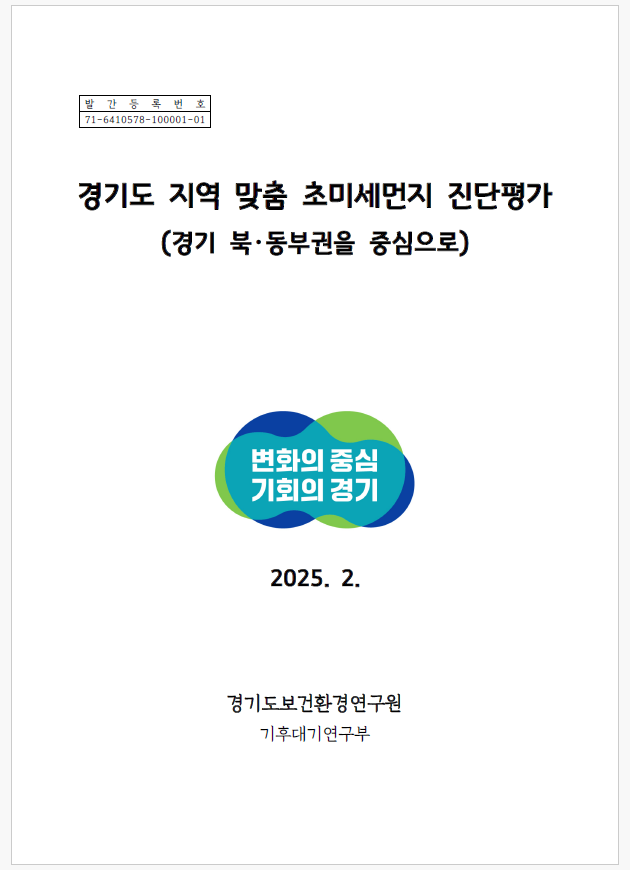 Cover of the Gyeonggi-do Regional Customized Fine Dust Diagnosis and Evaluation Report by the Gyeonggi-do Institute of Health and Environment
In Gimpo-si, domestic factors accounted for 46.4% and foreign factors for 53.6% of the fine particulate matter. By emission source, agriculture (39.2%) and fugitive dust directly emitted into the atmosphere without passing through emission outlets (20.4%) were evaluated as having significant impacts.
In Gwangju-si, domestic factors accounted for 48.8% and foreign factors for 51.2%. Among emission sources, mobile pollution sources such as automobiles, railroads, and construction machinery (37.4%) and fugitive dust (26.6%) showed high contributions.
The Institute distributed the report to related departments including the Gyeonggi Provincial Government, 31 city and county offices, and the Urban Environment Committee, and posted the research results on the Gyeonggi-do Institute of Health and Environment website (gg.go.kr/gg_health) for public access.
© The Asia Business Daily(www.asiae.co.kr). All rights reserved.

















