U.S. Commerce Department's Initial Target Was a Chinese-Invested Firm
Chinese Company Caught Using Korea as a Circumvention Export Route
U.S. Fueled Confusion by Sending Letters Without Recipients
LS Cable & System Does Not Export 1kV Products in Question
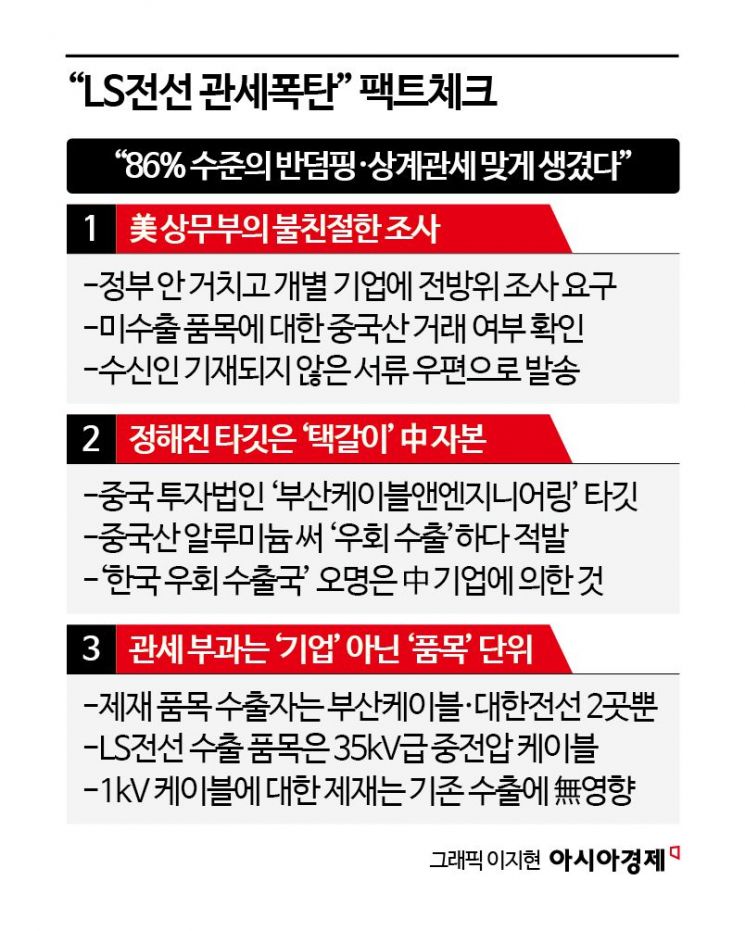
The United States has decided to impose anti-dumping and countervailing duties at a rate of about 86% on all aluminum wire and cable (AWC) exported from Korea. Some speculated that LS Cable & System was penalized for non-cooperation with the U.S. Department of Commerce investigation, but this has been confirmed to be inaccurate. The initial target of the U.S. was a Chinese-invested company caught for 'circumvention exports,' and LS Cable & System does not export 1kV-grade cables, so it is not subject to this. In particular, the confusion was exacerbated by the U.S. sending unilateral letters to individual companies without going through the Korean government.
According to the U.S. Federal Register on the 7th, the Department of Commerce determined that imports of AWC made in Korea using Chinese raw materials as of January this year are not included within the scope of 'anti-dumping and countervailing duties on Chinese AWC.' They concluded that the Chinese imports were 'circumvention exports' routed through Korea and announced plans to impose the same tariffs as on Chinese AWC. The anti-dumping and countervailing duties are 52.8% and 33.4%, respectively.
The investigation began in October 2023. In December of that year, the Department requested 11 Korean cable companies to submit data on 'export volume and export value of Chinese-origin transactions from January 2020 to September 2023' within 15 days. Most companies failed to submit the data within the deadline, and Gaon Cable, a subsidiary of LS Cable & System, submitted a response in July of the following year.
The controversy arose when the Department of Commerce stated it would apply 'Adverse Facts Available (AFA)' to LS Cable & System and Gaon Cable for being uncooperative in the investigation. This means that dumping margins could be applied unfavorably in the future. However, the Department simultaneously clarified that the 'subject products' are low-voltage cables under 1kV. The key point is that most Korean companies, including LS Cable & System, do not export these products to the U.S.
◆The U.S. Department of Commerce sent 'recipient-less' letters abruptly= There are three peculiarities behind the misunderstanding that LS Cable & System would face a 'tariff bomb.' First, by diplomatic convention, the counterpart to the U.S. Department of Commerce is the Ministry of Trade, Industry and Energy (MOTIE) in Korea. If there are requests concerning all Korean companies, it is reasonable to send a consolidated request through MOTIE. However, the Department of Commerce unusually sent documents directly to individual companies. Moreover, some letters sent to companies did not specify recipients, making it difficult for companies to respond.
LS Cable & System and others were not designated as 'mandatory respondents,' meaning they were not the main targets of the investigation. Only two companies, Busan Cable & Engineering and Daehan Cable, export 'low-voltage cables under 1kV.' Requesting data on products not even exported can be seen as somewhat unreasonable. A government official said, "There have been such cases in the past, but since this is not a regular investigation but one triggered by a specific issue, it can be awkward from the perspective of individual companies."
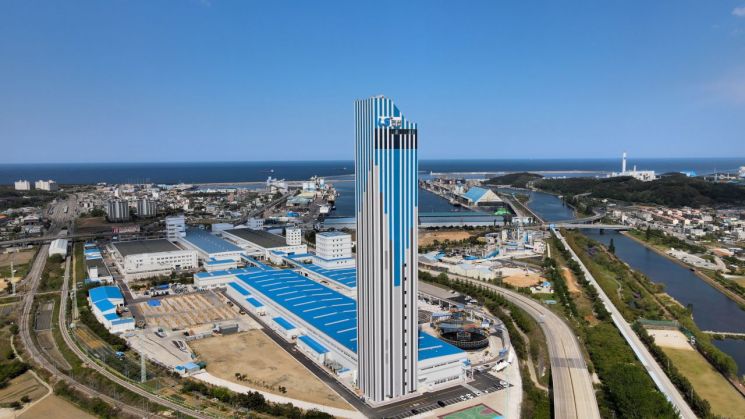 Exterior view of LS Cable & System's Donghae Plant Submarine Building 4 and VCV Tower. Photo by LS Cable & System
◆The predetermined target: Chinese capital entering Korea for 'relabeling'= LS Cable & System and others were not the original targets of the U.S. The products LS Cable & System exports to the U.S. are 35kV medium-voltage cables, which were not included in the investigation. The company caught for circumvention exports is 'Busan Cable & Engineering,' a company 100% invested by the Chinese Huatong Cable Group. Although a small and medium-sized enterprise, its sales reached 153.1 billion KRW as of 2023.
According to the U.S. Department of Commerce, this company imported Chinese aluminum, processed and manufactured cables in Korea, and exported them to the U.S., where it was caught. The industry views this as setting up a factory in Korea to perform so-called 'relabeling.' Chinese capital used Korea as a 'circumvention export' route to evade anti-dumping and countervailing duties on Chinese AWC. The investigation being limited to 1kV cables was aimed at this company's export products. A representative from LS Cable & System said, "The 1kV-grade cables that became an issue in the U.S. Department of Commerce investigation are not exported to the U.S. and there are no plans to do so." He added, "Above all, not all production items use Chinese aluminum."
◆Tariff imposition is based on 'products,' not 'companies'= The misunderstanding that LS Cable & System would face a 'tariff bomb' before any actual measures were taken ultimately caused unnecessary concerns. It narrowed the position of Korean companies while the Trump administration was applying tariff pressure.
Tariffs are set and imposed based on 'products,' not on a company basis. While companies like LS Cable & System and Gaon Cable may have AFA measures recorded against them, which could disadvantage them in future export negotiations, they have stated they have no plans to export 1kV cables, so the impact is effectively none.
LS Cable & System is actually expanding its presence in the U.S. market, including the solar power sector. On the 6th, it announced an order for aluminum power cables for a solar power plant worth 25 million USD (about 36.3 billion KRW). This is possible because anti-dumping, countervailing duties, or AFA designations are applied on a 'product' basis.
A Ministry of Trade, Industry and Energy official said, "The core of the investigation was not tariffs but whether there was 'circumvention exports.' Companies that do not use Chinese materials should be considered unrelated from the start rather than discussing whether they are affected."
© The Asia Business Daily(www.asiae.co.kr). All rights reserved.


















