Fund Duration Set at 20 Years
Focused Investment in Early-Stage Startups
On the 6th, China decided to establish and operate a national-level fund worth approximately 200 trillion won to invest in advanced industries such as artificial intelligence (AI), quantum science and technology, and hydrogen batteries.
Zheng Shanjie, director of the National Development and Reform Commission of China, stated at a joint press conference of economic ministers held in Beijing during the Two Sessions that "a national venture capital guidance fund will be established soon. The goal is to make innovative enterprises excellent, strong, and large."
The state-run China Central Television (CCTV) referred to this new fund as a "carrier-level fund in the startup sector," explaining that it will "mainly guide early-stage investments by financial capital, investments in small enterprises, long-term investments, and investments in hardcore technology," and that it will "absorb about 1 trillion yuan (approximately 200 trillion won) from local and social capital." The fund's duration is 20 years.
The fund will focus investments on the early stages of startups in advanced science and technology sectors such as AI, quantum technology, and hydrogen batteries. It will also be used to support the development of innovative and core technologies with originality in small and medium-sized enterprises at early and mid-stages, as well as to foster strategic emerging industries and future industries.
CCTV reported that areas mentioned in the previous day’s government work report at the National People's Congress, such as bio-manufacturing, embodied intelligence (AI with a physical entity interacting with real environments), and 6th generation mobile communications (6G), will be included in the investment scope.
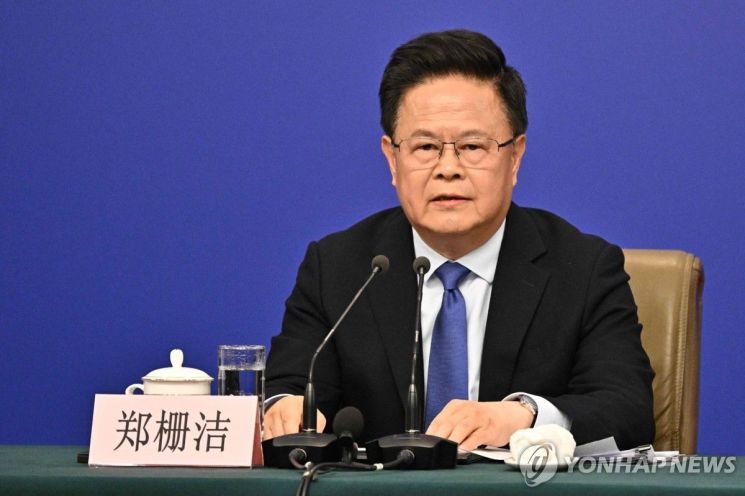
Policy support related to boosting domestic demand, the biggest theme of this year’s Two Sessions, was also mentioned at the press conference. Last year, domestic demand was the third topic in the Two Sessions work report, but this year it was the first, and Premier Li Qiang mentioned consumption 31 times in the report.
Director Zheng explained that funds supporting the replacement of old consumer goods with new ones were expanded from 150 billion yuan (about 30 trillion won) last year to 300 billion yuan (about 60 trillion won) this year, and that the "Special Action Plan for Consumption Promotion" will soon be announced and implemented.
The finance minister and central bank governor expressed the Chinese authorities’ intention to support an active fiscal policy this year, including raising the fiscal deficit ratio and increasing the issuance of special local government bonds, as well as easing equity ratios and interest rates.
Finance Minister Lan Foan said regarding the 4% fiscal deficit ratio set by China this year, "The deficit level and scale are the highest in recent years, and counter-cyclical adjustments (macroeconomic policies that ease when the economy faces downward pressure by lowering interest rates, and cool down overheating when the economy is overheated) will be further expanded."
Regarding local government debt issues, he mentioned that "the pressure to resolve debt has greatly eased," noting that as of the previous day, local government debt refinancing bonds amounted to 2.96 trillion yuan (about 590 trillion won).
People’s Bank of China Governor Pan Gongsheng also reaffirmed the willingness to supply liquidity to the market, stating, "Depending on domestic and international economic and financial conditions this year, the reserve requirement ratio (RRR) and interest rates will be lowered at an appropriate time. Currently, the average RRR for financial institutions is 6.6%, so there is still room for reduction."
Addressing the United States, which is a trade conflict counterpart, Minister of Commerce Wang Wentao said, "Individual countries are wielding tariff clubs to disrupt the international trade order and shock global industrial and supply chains. Threats and intimidation do not work on China, and if the United States continues down the wrong path, we will stand together to the end (resist). However, the two countries can meet at an appropriate time, and their teams can communicate promptly."
© The Asia Business Daily(www.asiae.co.kr). All rights reserved.

















