Announcement of 10-Year Cultural Policy Vision 'Cultural Korea 2035'
"Relocation of National Arts Organizations to Regions to Bridge Cultural Gaps"
"The plan to integrate the secretariats of national arts organizations will be well organized within this year."
On the 6th, Yoo In-chon, Minister of Culture, Sports and Tourism, expressed this position regarding the recently controversial plan to integrate the boards of directors of five national arts organizations and establish an integrated secretariat during the 'Cultural Korea 2035' briefing held at the Government Seoul Office.
Minister Yoo emphasized that since the five arts organizations subject to integration oppose the plan due to concerns such as infringement on their autonomy, he will discuss further with the arts organizations and examine what they truly want. He added that if opposition persists until the end, the plan might not be pursued.
This was a reiteration of the stance he expressed at the full meeting of the National Assembly's Culture, Sports and Tourism Committee the day before.
'Cultural Korea 2035' is a report outlining the mid- to long-term policy directions and tasks for cultural policy over the next decade. Earlier, as it became known that the plan to establish an integrated secretariat for national arts organizations would be included in Cultural Korea 2035, the performing arts community protested and controversy arose.
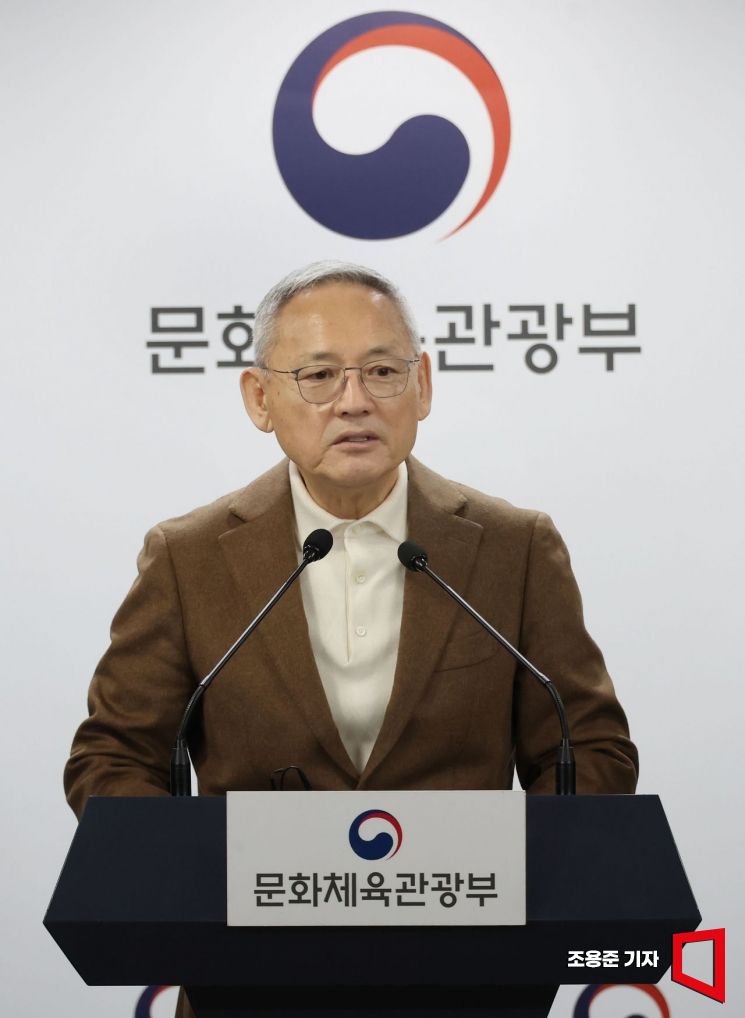 Yoon In-chon, Minister of Culture, Sports and Tourism, is announcing the mid- to long-term key projects in the fields of culture, sports, and tourism at the Government Seoul Office in Jongno-gu, Seoul on March 6, 2025. Photo by Jo Yong-jun
Minister Yoo explained that the integrated secretariat was basically intended to assist the arts organizations.
"The reason for integrating the secretariats is nothing else but simply to allow artistic directors and arts organizations to focus solely on art. There were actual requests to be able to concentrate only on art. Since there are many secretariat tasks such as budgeting and administrative issues, the idea was to free the arts organizations from those. Discussions have been ongoing since May last year, but now that it has come to this, they are opposing it, so I feel there might be something I don't know. Since the secretariat integration issue is not something to be done immediately today or tomorrow, we will continue to discuss it well throughout this year."
On this day, there was also criticism that the plan for an integrated secretariat for national arts organizations was not included in the November public hearing for 'Cultural Korea 2035.' In response, the Ministry of Culture, Sports and Tourism explained that although the content was not included in the public hearing materials at that time, discussions with stakeholders had been ongoing before that, and a process of further concretization was necessary.
However, Minister Yoo stated that the relocation of national arts organizations to regional areas will be pursued gradually.
'Cultural Korea 2035' includes six core tasks and 30 detailed tasks, with the first core task being balanced regional cultural development. Minister Yoo emphasized that although he has long stressed national balanced development, there have been few properly implemented balanced development policies, and he intends to relocate national arts organizations to local areas to resolve cultural disparities between regions.
The Ministry of Culture, Sports and Tourism plans to relocate the Seoul Arts Troupe to Gwangju as a priority. Cultural Korea 2035 includes a plan to create conditions this year and send the Seoul Arts Troupe to Gwangju next year. Minister Yoo emphasized that he will make the Seoul Arts Troupe an organization affiliated with the National Gwangju Asia Culture Center to enable exchanges with performing arts groups from various Asian countries. He also mentioned plans to cooperate with regions that establish arts troupes nationwide and explained that related budgets will be secured in advance to support regions founding arts troupes.
Minister Yoo explained that the background for announcing Cultural Korea 2035 is to prepare for upcoming changes.
"There are many challenges to solve such as the risk of regional extinction, cultural disparities between regions, low birthrate, aging population, low growth, and the AI (Artificial Intelligence) great transformation. The changes in our surrounding environment are enormous, and culture, arts, sports, and tourism are all being affected by these changes. If we do not start now, preparation may be too late. Cultural Korea 2035 was prepared to predict these environmental changes and share a future vision."
Cultural Korea 2035 selected six core tasks: ▲ balanced regional cultural development, ▲ cultural responses to social crises such as low birthrate and aging, ▲ innovation of industrial ecosystems including content, tourism, and sports, ▲ AI great transformation (AX) in the cultural sector, ▲ enhancement of global cultural leadership, and ▲ strengthening of cultural capabilities.
© The Asia Business Daily(www.asiae.co.kr). All rights reserved.
![Clutching a Stolen Dior Bag, Saying "I Hate Being Poor but Real"... The Grotesque Con of a "Human Knockoff" [Slate]](https://cwcontent.asiae.co.kr/asiaresize/183/2026021902243444107_1771435474.jpg)
















