Concerns Rise Over Semiconductor Overconcentration
Lai Ching-te Administration Promotes AI as Next-Generation Strategic Industry
Strong Commitment to Sovereign AI... Accelerating TAIDE Training
<1> TSMC, Deified... Visiting the '2nm' Holy Land
<2> The '6 Constraints' and Technology Security Holding Back TSMC
<3> The Opening of Unnamed Taiwan
<4> Korea-Taiwan: Between Deterrence and Cooperation
 Taiwan President Lai Ching-te waves to the crowd at the commemorative event held in Taipei on October 10 last year, the National Day (Double Ten Day). (Photo by Yonhap News)
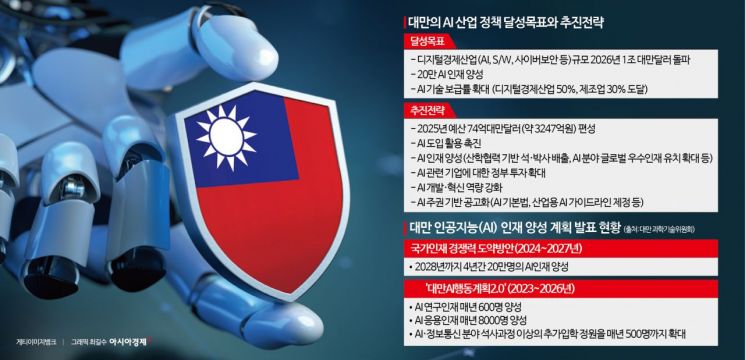
Can Taiwan raise an 'Artificial Intelligence (AI) Shield' following its 'Silicon Shield'? Taiwan, which has concentrated on the semiconductor foundry industry, is expanding its investment footprint in the AI sector. Internally, concerns have been raised that overconcentration in specific fields like semiconductors could threaten stable growth, leading to a policy to nurture AI as a next-generation strategic industry.
The Taiwanese Lai Ching-te government, launched last year, identified five 'trusted industries': semiconductors, AI, telecommunications, security, and defense. This year alone, it allocated a total budget of TWD 22.2 billion (approximately 974.1 billion KRW), with more than half, TWD 12.2 billion, focused on semiconductors. Notably, the AI sector received one-third of the total budget, TWD 7.4 billion. Other sectors include telecommunications at TWD 1.4 billion and security at TWD 600 million. This effectively declares a dual focus on semiconductors and AI for concentrated development.
"Excessive Dependence on Semiconductors... AI Could Be an Alternative"
It is true that Taiwan has grown its economic scale thanks to the rapid growth of the semiconductor foundry industry, but internally, concerns are raised that excessive concentration could become a future liability. Taiwan's semiconductor industry production scale is expected to surpass TWD 6 trillion this year, which is estimated to account for about 23% of nominal Gross Domestic Product (GDP). Among companies listed on the Taiwan Stock Exchange, half (48.5%) of the market capitalization belongs to the semiconductor sector. According to the Taiwan Stock Exchange Weighted Index (TAIEX), TSMC's market capitalization accounts for 39.2% of the total (as of January 22), with Foxconn and MediaTek at approximately 3.3% and 3.1%, respectively.
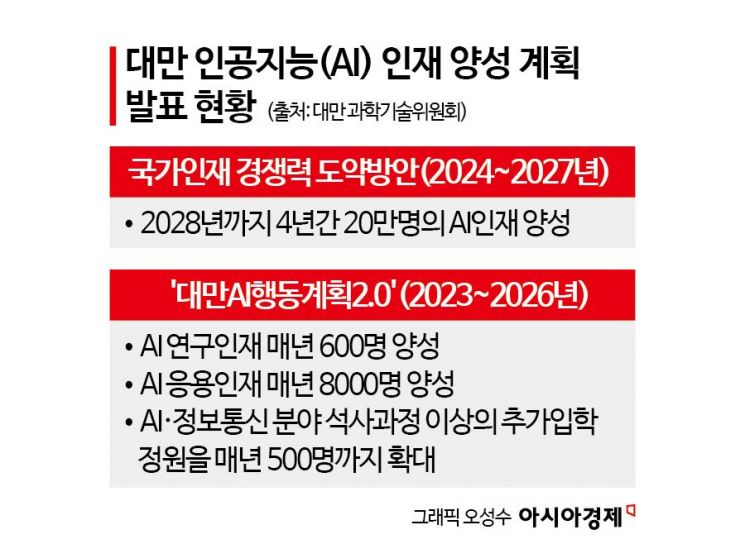
With the halo effect expected from AI semiconductor producers like TSMC, Foxconn, and MediaTek, Taiwan has long prepared a strategy to partially shift the industrial focus toward AI. In 2024, it established a five-year plan (2024?2027) called the 'National Talent Competitiveness Leap Plan,' aiming to nurture 200,000 AI talents over four years until 2028. Prior to this, it announced the 'Taiwan AI Action Plan 2.0' (2023?2026), which includes annually training 600 AI research talents, 8,000 AI application talents, and expanding additional admissions by 500 for master's degree or higher programs in AI and information and communications fields. The 'Taiwan AI Action Plan 1.0,' completed in 2021, led by the Ministry of Science and Technology, established 'AI Research Centers' at National Taiwan University, National Cheng Kung University, National Tsing Hua University, and National Yang Ming Chiao Tung University, serving as cradles for talent development.
Some argue that AI can quickly resolve problems caused by resource bias toward the semiconductor sector. The 'N+1' concept envisions integrating AI into traditional industries such as chemistry, textiles, and machinery to promote balanced development.
Ryu Meng-jun, Director of the First Economic Research Institute at the Taiwan Institute of Economic Research, told Asia Economy, "Recently, the appreciation of the Taiwan dollar has made traditional industries in Taiwan difficult. When the top engineering graduate goes to TSMC and the second to UMC, the concentration of talent in specific fields raises concerns about talent shortages in other industries." He added, "Ultimately, diversified development is the key, and the Taiwanese government maintains a policy of balanced development across all industries. They are envisioning 'N+1,' integrating AI into every industry."
Focus on Sovereign AI Development... TAIDE, Trust Is Key
Considering the active movements of private startups in the AI market, Taiwan's related ecosystem is improving annually. According to Blink's Global Startup Ecosystem Report (2024), Taiwan ranked 22nd globally in ecosystem score, up two places from 24th the previous year. It has shown steady improvement from 30th in 2020, 26th in 2021, and 25th in 2022. In contrast, South Korea, ranked 19th in 2021, slipped to 21st in 2022 and remained 20th last year.
Taiwan's representative AI unicorn is Appier, which operates a marketing automation platform. Over the past eight years, the company has aggressively expanded by acquiring five AI-related global companies. Last month, it acquired France's AdCreative AI, and in 2023, it acquired the U.S.'s Upra. It also acquired India's QGraph (2018), Japan's Emotion Intelligence (2019), and Taiwan's Botmoni (2021).
Taiwan is developing and training 'TAIDE,' an AI conversational engine and language model, to build its own AI ecosystem. The National Science and Technology Council (NSTC) recently announced an investment of TWD 7.4 million in TAIDE's development. The core of TAIDE is 'trust.' Director Ryu emphasized, "The 'T' in TAIDE stands not for 'Taiwan' but for 'Trustworthy.'" Taiwan recognizes related technologies from the perspective of sovereign AI, emphasizing the importance of domestic data and infrastructure.
The Industrial Technology Research Institute (ITRI), which played a leading role in founding TSMC, is also moving to support AI-related initiatives. ITRI recently received a government mandate for the 'Industrial Innovation Talent Support Promotion Plan' and has developed a separate curriculum to enable manufacturing employees to apply AI technologies. Since the 6th, workers have been able to study this curriculum free of charge.
© The Asia Business Daily(www.asiae.co.kr). All rights reserved.



















