11 a.m. on the 6th, near Hajungdo, Samho Island, Taehwagang
Explanation of rescue, treatment, and future monitoring of two eagles
A meaningful event where eagles carrying stories return to nature is drawing attention.
On the 6th at 11 a.m., Ulsan City held a release event for two eagles at Ha Jung-do, Samho Island, Taehwagang (Namsan-ro, Nam-gu), watched by about 40 people including participants from the Ulsan Wildlife Rescue and Management Center, Ulsan Eagle School, and representatives from the operating organization (Green Energy Promotion Citizens' Forum).
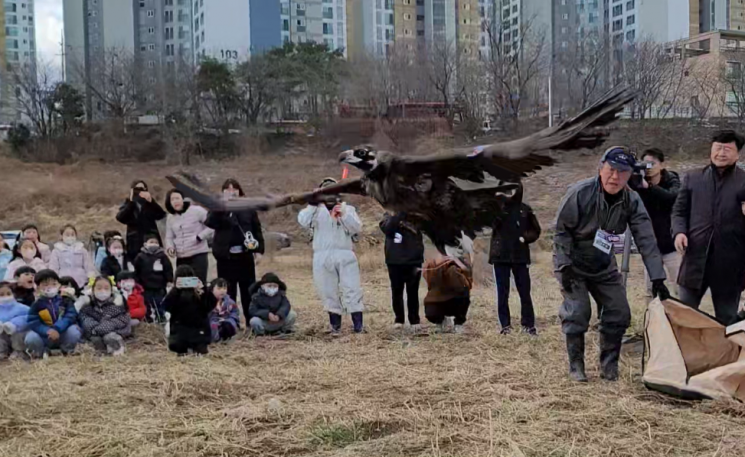 On the morning of the 6th, the 96th eagle, which was rescued with its right eye ruptured at Haju Island in Taehwagang, Ulsan, and fully recovered after treatment, is seen taking flight. Provided by Ulsan City
Before the release, Se-young Oh, head of the Ulsan Wildlife Rescue and Management Center who was in charge of rescuing and treating the eagles, explained to the participants about the treatment process of the eagles to be released, the attachment of GPS tracking devices, and the post-release monitoring process, followed by releasing them back into nature.
The eagles being released this time each have their own stories.
The eagle with the number 96 on its wing was rescued on December 8 last year at Magpie Observatory on Ugasan, Buk-gu, with a ruptured right eye, treated, and fully recovered.
The eagle numbered 97 was rescued on January 7 after falling into the Taehwagang River; it was found exhausted but without external injuries, and its rescue attracted attention through local media coverage.
Before releasing the two eagles, the attachment of GPS tracking devices was initiated by the Korea Waterbird Network (CEO Gi-seop Lee) at the request of the Green Energy Promotion Citizens' Forum.
The eagle number 97 was in a suitable condition to have the GPS device attached as it was recovering health through nutrition, but there were concerns about eagle number 96, which had lost vision in one eye, regarding its ability to adapt to the wild and survive.
Regarding this, Kim Hee-jong, director of the Wildlife Rescue Center, and Dr. Gi-seop Lee of the Korea Waterbird Network said, “Considering research results that ‘an eagle that has lost vision in one eye can live without problems’ and the fact that it adapted well during treatment, we decided to attach the device for survival wishes and research purposes.”
Based on the signals sent by these eagles, their future migration routes and survival status can be monitored.
Additionally, it can be confirmed whether they return to Ulsan. Among two eagles rescued and released in Ulsan in 2021, one was recorded returning to Ulsan.
A city official said, “While the number of eagles visiting Ulsan every year is increasing, rescues due to exhaustion and collisions are also rising, which is regrettable. We plan to help citizens properly understand eagles through food support and operating the Eagle School. We will also pay attention to post-release management through treatment and consider support measures, as in this case.”
© The Asia Business Daily(www.asiae.co.kr). All rights reserved.

















