Petroleum Products Rise 6.3%... Impact of Sharp Exchange Rate Increase
Processed Foods Up 2.9%... Highest in 13 Months
Dining Out Prices Climb 3.0% Due to Delivery App and Raw Material Costs
The consumer price inflation rate last month remained in the 2% range for the second consecutive month. The exchange rate surged sharply around the inauguration of the Donald Trump administration in the United States, driving up petroleum product prices. Import prices rose, and prices for processed foods and dining out also increased. However, agricultural products saw a slight price decline compared to the previous year due to the base effect.
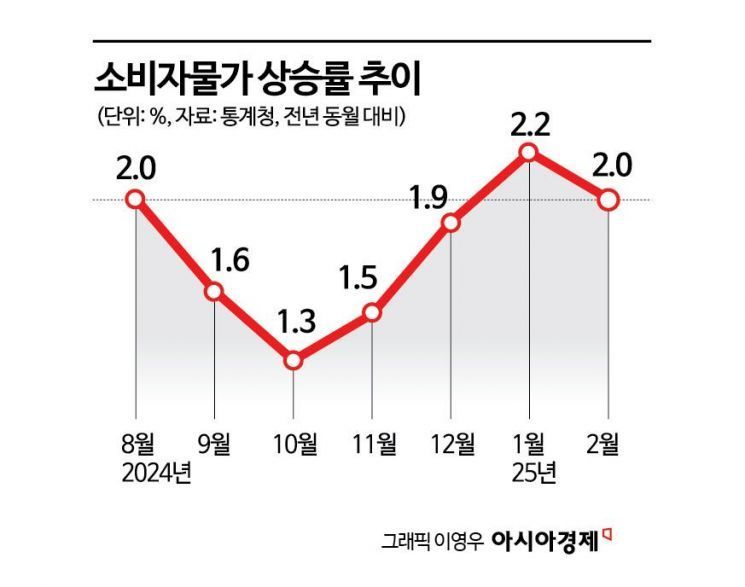
According to the 'February Consumer Price Trends' released by Statistics Korea on the 6th, the consumer price index last month rose 2.0% compared to a year earlier. This marks the second consecutive month of inflation in the 2% range following January's 2.2%. The consumer price inflation rate had stayed in the 1% range for three consecutive months last year?October (1.3%), November (1.5%), and December (1.9%)?before rebounding to the 2% range in the first month of the new year (2.2%).
Petroleum products rose 6.3% in February, following a 7.3% increase in January, pushing overall prices higher. Gasoline (7.3%) and diesel (5.3%) showed significant increases. Statistics Korea analyzed that petroleum prices, which had only risen 1.0% until January due to exchange rate increases, have surged sharply since then.
Lee Doowon, the Economic Trend Statistics Director at Statistics Korea, explained, "There was not much difference in international oil prices compared to this time last year," adding, "The exchange rate, which was 1,331 won in February last year, rose to 1,447 won this year, and the reduction in fuel tax cuts compared to the same month last year had a significant impact."
As petroleum prices pushed prices up, industrial products rose 2.0% compared to the previous year. Petroleum products have a broad ripple effect on various industrial products as well as overall energy prices. Processed food prices increased 2.9%, marking the largest rise in 13 months since January 2024 (3.2%). Statistics Korea attributed this to major processed foods such as bread and coffee raising their factory prices since the second half of last year, along with rising raw material costs due to import price increases.
Dining out prices also rose 3.0% compared to the same month last year. The dual pricing system, where some dining establishments apply different prices depending on whether delivery is included, also influenced the price increase. A Ministry of Economy and Finance official explained, "Processed foods are mainly produced using imported raw materials, and recent abnormal weather conditions and reduced cultivation areas have caused import raw material prices to rise."
In the case of dining establishments, increased labor costs and other management burdens were also analyzed to have contributed to the price rise. However, prices for services excluding dining out rose 2.9% as the travel off-season followed the end of the Lunar New Year holiday in January, reducing the increase compared to January's 3.5%.
Agricultural, livestock, and fishery products (1.0%) showed relatively small increases. In particular, agricultural products fell 1.2% compared to the same month last year. This was due to the base effect from last year's poor harvests, which had caused agricultural prices to rise sharply. Fruit prices also fell 5.4% due to the base effect. Statistics Korea analyzed that the government's applied tariff quotas partially offset the decline in import prices caused by the exchange rate increase. As fruit prices fell, the fresh food index, which covers fish, vegetables, and fruits, also dropped 1.4% compared to a year earlier. This is the first negative figure in 35 months since March 2022 (-2.1%).
However, prices surged significantly for some items, showing instability. Livestock products (3.8%) and fishery products (3.6%) rose relatively sharply. Fishery products recorded their largest increase in 18 months since August 2023 (6.0%). Due to poor harvests, prices for radish (89.2%), napa cabbage (65.3%), and carrots (59.6%) rose sharply compared to the previous year. Gim (seaweed) also increased by 33%. Statistics Korea analyzed that fruit prices are not at a low index level, so the difference with perceived inflation is likely significant.
The living cost index, which is composed mainly of frequently purchased items and is closer to perceived inflation, rose 2.6%. This is the highest level since July last year (3.0%). The living cost index including rent also rose 2.3%.
Core inflation, which excludes volatile food and energy prices and shows the underlying inflation trend, rose 1.8% in February following a 1.9% increase in January, indicating a stable trend.
The Ministry of Economy and Finance stated, "Since future prices are uncertain due to factors such as exchange rates and weather conditions, we will continue efforts to firmly establish a stable inflation trend, including stabilizing perceived inflation."
© The Asia Business Daily(www.asiae.co.kr). All rights reserved.

















