20GB Budget Phone Plans Drop from Mid-20,000 Won to 10,000 Won Range
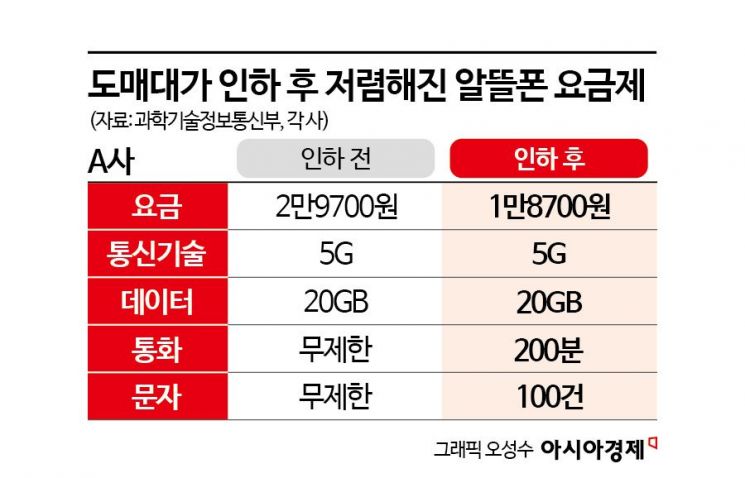
The price of ‘budget phone’ plans in the 20,000 won range has dropped to the 10,000 won range. This price reduction in newly launched plans is due to the government lowering the wholesale network usage fees that budget phone operators pay to telecom companies.
According to the industry on the 10th, budget phone provider Smartel launched a plan offering unlimited voice calls and text messages along with 20GB of 5G data for 19,800 won. Other providers applied the same calculation method and released plans offering 20GB of data in the high 10,000 won range. Considering that existing budget phone plans with the same data capacity were priced in the mid-to-high 20,000 won range, this represents about a 30% discount.
The increase in the maximum speed of data speed-limited products is also expected to help budget phone providers reduce their prices. Data speed-limited products allow users to continue using data at a certain reduced speed after the basic data allowance is exhausted. For LTE networks, the speed limit for these products has increased from the previous 400 Kbps to 1 Mbps. While 1 Mbps is insufficient for watching high-definition videos, it is adequate for viewing low-resolution videos, mobile messenger chatting, and internet browsing without inconvenience.
The reduction in budget phone prices is thanks to the introduction of a new wholesale fee calculation method. Previously, only the ‘retail price discount method’ was applied, which calculated fees by excluding marketing costs and other expenses from the charges billed by telecom companies to consumers. Since this method involved discounting some costs from the telecom companies’ set prices, the discount rate was limited. However, the Ministry of Science and ICT introduced the ‘cost-based method’ last month, which calculates wholesale fees based solely on the cost of leasing lines from telecom companies to budget phone providers. Because it settles only the actual costs required for network leasing, the discount rate has increased. With the introduction of the new calculation method, the wholesale data fee dropped from 1.29 won per megabyte (MB) to 0.82 won, a 36.4% decrease.
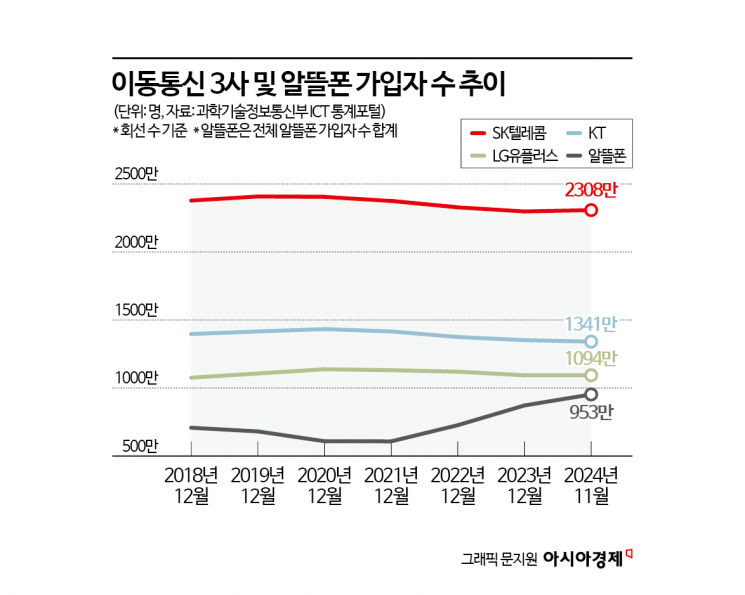
As budget phone prices decrease, the number of subscribers is also expected to rise. According to the Ministry of Science and ICT, as of November last year, the number of budget phone subscribers (based on lines) in South Korea reached approximately 9.53 million. This accounts for 16.7% of the total mobile subscribers (about 56.96 million). In January last year, the number of budget phone subscribers was 8.85 million, meaning the subscriber base grew by 700,000 in just over 10 months. The total number of budget phone subscribers is closely trailing LG Uplus, the third-largest mobile carrier, by 1.42 million subscribers (LG Uplus has 10.94 million subscribers).
However, a variable factor is the bill under discussion in the National Assembly that would limit the market share of large corporation-affiliated budget phone providers to 60%. This could reduce the business activities of these providers, who have been conducting aggressive marketing such as special price plans backed by their parent companies’ financial power.
The upcoming abolition of the Act on the Improvement of Distribution Structure for Mobile Communication Terminals (known as the DanTong Act) in July may also pose a negative factor for budget phone providers. The abolition will remove the cap on subsidies provided when purchasing mobile phones. Since the implementation of the DanTong Act, the subsidy cap has made the cost of purchasing phones similar regardless of the purchase channel. As a result, many budget phone subscribers have chosen to buy phones directly as unlocked devices to reduce costs and then subscribe to budget phone plans.
If, after the abolition of the DanTong Act, telecom companies compete to attract subscribers by offering subsidies, budget phone providers are expected to be negatively impacted. Smaller budget phone providers with relatively weaker capital will likely have limited capacity to offer subsidies for phone purchases.
© The Asia Business Daily(www.asiae.co.kr). All rights reserved.



















