Bioinspired design mimics tree root structure
Achieves up to 700% stretchability and strong adhesion
Opens new possibilities for next-generation stretchable electronics
Domestic researchers have developed an electronic substrate that can stretch up to 700%. By mimicking the structure of tree roots firmly anchored in soil, they secured elasticity, proving its broad applicability to stretchable electronic devices.
On the 6th, Professor Inkyu Park's research team from the Department of Mechanical Engineering at the Korea Advanced Institute of Science and Technology (KAIST) announced that, through joint research with the Electronics and Telecommunications Research Institute (ETRI), they developed an innovative technology called 'Bioinspired Interfacial Engineered Flexible Island (BIEFI)', overcoming existing limitations in the development of stretchable electronic devices.
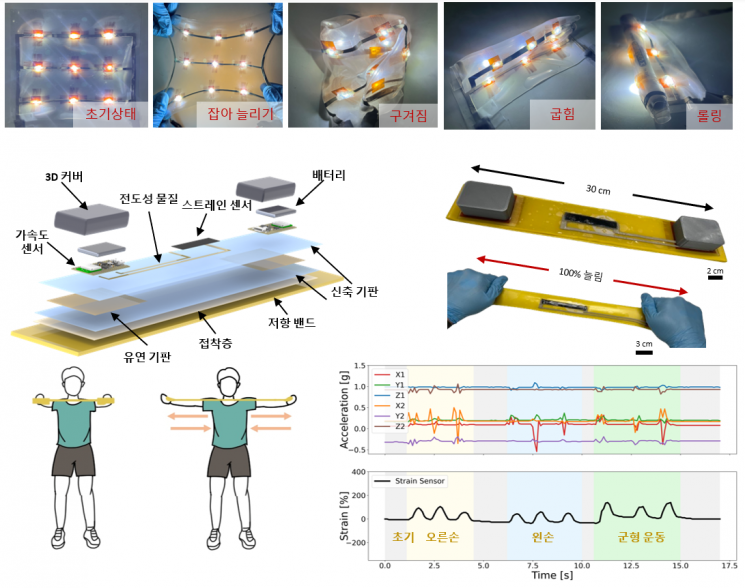 Introduction of stretcher-type LED array based on 'Bio-Inspired Interface Design (BIEFI)'. Provided by KAIST
The researchers applied the structure of primary roots and secondary roots to the design to disperse stress and implemented strong adhesion between the two substrates through mechanical coupling and interlocking.
In this structure, the primary roots effectively disperse stress and delay interface cracks, while the secondary roots enhance adhesion between substrates and help maintain interface stability during deformation.
Through this, the research team secured elasticity that stretches up to 700% and succeeded in designing a stable structure even after more than 1,000 physical deformation attempts. It is designed to withstand various physical deformations (stretching, twisting, compression, etc.), proving it can provide a long service life despite repetitive deformation.
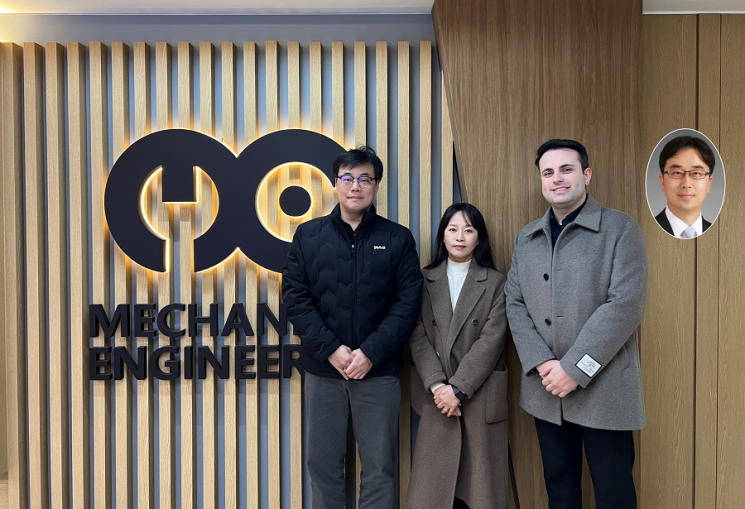 From the left, Professor Inkyu Park of KAIST, Dr. Hyejin Kim of ETRI, Osman Gul, PhD candidate at KAIST, Professor Taeksu Kim of KAIST (original plan). Provided by KAIST
Professor Inkyu Park stated, "This bioinspired design can become a new standard for next-generation electronic technology, and we plan to advance the technology further through optimization of interface design, enhancement of adhesion, and mimicking more complex root structures."
The study was led by Osman Gul, a doctoral student in the Department of Mechanical Engineering at KAIST, as the first author, with Professors Inkyu Park and Taeksu Kim from KAIST and Dr. Hyejin Kim from ETRI overseeing the research.
The research results were published online in the February 2025 issue of the prestigious international journal Nature Communications. (Paper title: Bioinspired Interfacial Engineering for Highly Stretchable Electronics)
© The Asia Business Daily(www.asiae.co.kr). All rights reserved.


















