Brand’s First to Feature Dual NVIDIA Drive AGX Orin
Core Computing Performance Enhanced Eightfold Over Previous Models
800V Technology Enables 700 km Range on a Single Charge
Launch Planned in Select Countries Including Europe This Year; Korean Release Undecided
Volvo Cars unveiled the next-generation electric flagship sedan ES90 for the first time in the world on the 5th (local time) in Stockholm, Sweden. The ES90 is the first Volvo model to be equipped with NVIDIA's 'Dual Drive AGX Orin chip,' delivering the most powerful computing performance in the brand's history. At the same time, it applies 800V technology to secure a driving range of 700 km on a single charge.
Volvo implemented NVIDIA chips in the ES90 to achieve core computing performance eight times higher than the previous generation. Based on this, it features innovative safety technologies including an advanced sensor system composed of one LiDAR, five radars, seven cameras, and twelve ultrasonic sensors, as well as a driver monitoring system installed inside the vehicle.
Jim Rowan, CEO of Volvo Cars, introduced, "The ES90 will take its place as one of the next-generation flagship lineups alongside the EX90," adding, "It will play a role in solidifying our leadership in the 'software-defined vehicle (SDV)' industry by leveraging the power of core computing."

Flagship Electric Sedan with Volvo’s Unique Practical Design
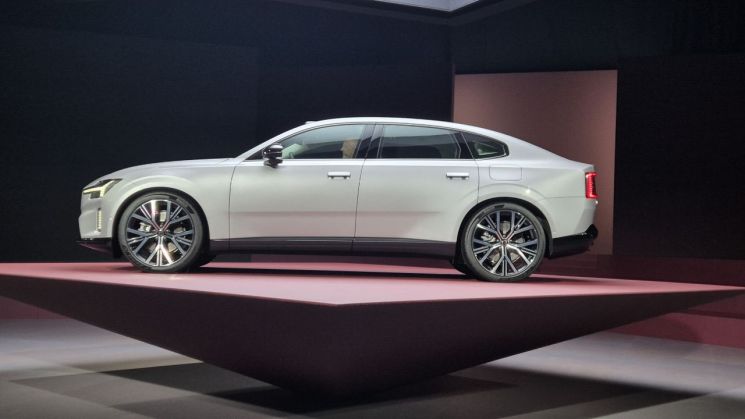
The exterior design immediately stands out with its distinctive styling, high ground clearance, and smooth roofline. This provides the driver with excellent visibility while balancing elegant design and spaciousness inside, and also enhances aerodynamic performance.
The front features Volvo’s iconic 'Thor’s Hammer' headlight design, reinterpreted with a modern feel. The rear is equipped with newly applied C-shaped LED rear lamps and rear window lamps. In particular, the tailgate hatch is designed to be wide and large to facilitate easy loading and unloading of luggage during travel or leisure activities. The trunk space offers up to 424 liters, which can be expanded to a maximum of 733 liters by folding down the second-row seats.
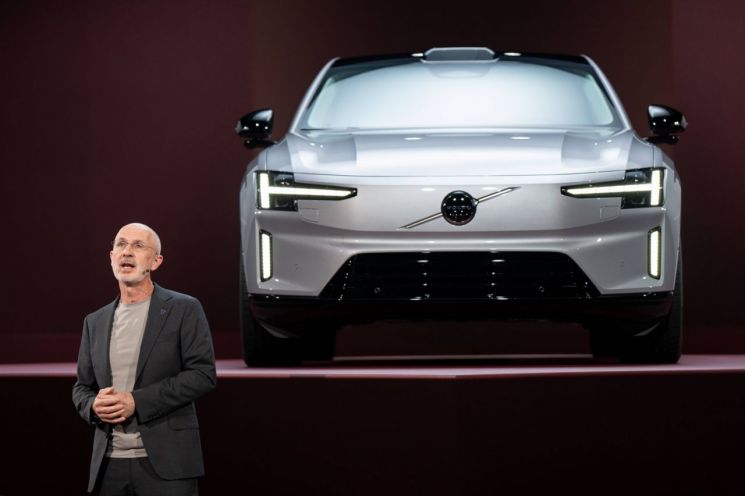 Jim Rowan, CEO of Volvo Cars, is unveiling Volvo's flagship electric sedan ES90 on the 5th (local time) in Stockholm, Sweden. Photo by Volvo Cars
Comfortable and Functional Interior Space
The interior of the ES90 emphasizes practicality with refined materials reflecting Volvo’s Scandinavian identity and design philosophy. Especially, the long 3.1-meter wheelbase secures ample legroom for second-row passengers.
Additionally, the ES90 comes standard with Google’s next-generation infotainment system and supports 5G communication technology. It is designed to provide intuitive information to the driver through a 9-inch driver display and a head-up display.
The ES90’s infotainment system operates on Qualcomm’s Snapdragon Cockpit platform, offering smooth connectivity and excellent responsiveness. It includes third-party apps via Google Maps, Google Assistant, and Google Play. Notably, for the Korean market, connectivity developed in collaboration with T Map Mobility will be installed.
800V Technology for Longer Range and Faster Charging
The ES90 is the brand’s first to adopt 800V technology. This enables a maximum driving range of 700 km on a single charge (WLTP standard), and during 350 kW fast charging, it can achieve a driving range of 300 km in just 10 minutes.
In particular, it integrates adaptive charging software from the UK startup 'Breed Battery Technology,' invested in by Volvo Tech Fund, the company’s venture capital. This shortens charging time from 10% to 80% to about 20 minutes.
Evolved into an SDV Applying Next-Generation Platform
Developed based on the dedicated electric vehicle platform 'SPA2,' the ES90 applies Volvo’s next-generation electric vehicle production strategy called 'Superset Tech Stack.' This concept integrates hardware and software as a modular set and will serve as the foundation for all future Volvo electric vehicles.
Through this, it offers 'over-the-air (OTA)' updates that keep the car up to date based on software. These include new connectivity, safety technologies, and various vehicle performance improvements such as battery range enhancements tailored to specific driving behaviors.
The ES90 was developed to protect not only drivers and passengers but also pedestrians, based on 55 years of accumulated real-world traffic accident data research. Such functions are made possible by high-performance computing technology, designed to reflect complex accident scenarios.
The ES90 is equipped with a strong body, state-of-the-art collision protection systems, and optimized impact absorption zones to effectively protect occupants in the event of an accident. Additionally, it features advanced sensor technology with one LiDAR, five radars, seven cameras, and twelve ultrasonic sensors that provide detection capabilities beyond human vision to identify road hazards in advance and enable proactive measures. A 'driver monitoring system' that detects driver distraction and provides immediate support against risks is also standard.
Anders Bell, Chief Technology Officer (CTO) of Volvo Cars, explained, "The ES90 boasts the most powerful core computing performance in the brand’s history," adding, "This allows us to enhance safety and overall performance by leveraging data, software, and artificial intelligence (AI)."
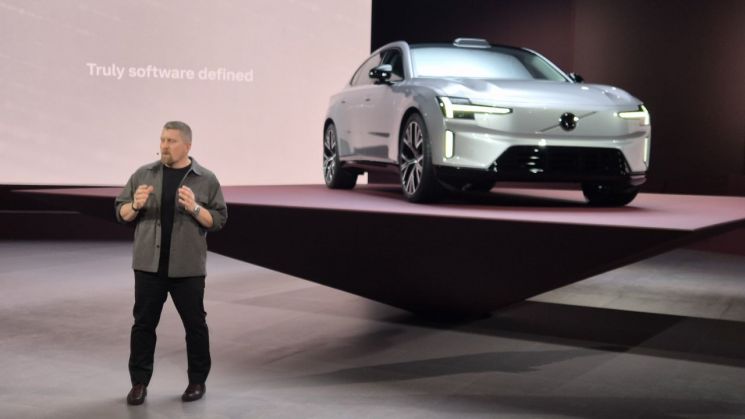 Andersson Bell, Chief Technology Officer (CTO) of Volvo Cars, is introducing the high-performance computer capabilities of the ES90. Photo by Woo Su-yeon
© The Asia Business Daily(www.asiae.co.kr). All rights reserved.



















