Chonnam National University College of Medicine and Hwasun Chonnam National University Hospital Research Teams Collaborate
 Chonnam National University and Hwasun Chonnam National University Hospital have identified the role of platelets in predicting the responsiveness of lung cancer patients to immuno-oncology treatment. Photo by Chonnam National University
Chonnam National University and Hwasun Chonnam National University Hospital announced on the 5th that they have identified the role of platelets in predicting the responsiveness of lung cancer patients to immunotherapy.
This study was conducted in collaboration between the research team of Professor Cho Jaeho from Chonnam National University School of Medicine and the research team of Professor Oh Injae from the Department of Pulmonology at Hwasun Chonnam National University Hospital.
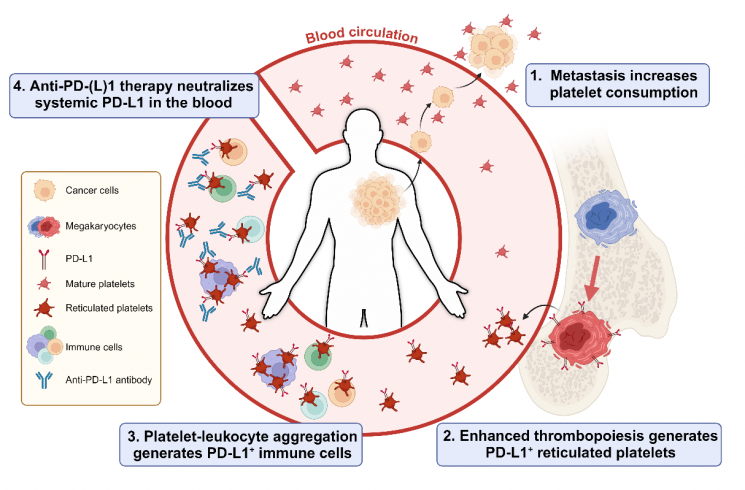
Going beyond previous research, this study analyzed the mechanism of PD-L1 expression in platelets and their interaction with immune cells, explaining the systemic immunosuppressive mechanisms observed in lung cancer patients. The study suggested the potential use of this mechanism as a more precise predictive marker for immunotherapy responsiveness.
Previous studies had revealed that patients with circulating immune cells expressing high levels of PD-L1 respond better to immunotherapy. However, this study was the first to identify that platelets expressing PD-L1 physically bind to circulating immune cells and serve as a major source of PD-L1.
Through this, the researchers demonstrated that the conventional method of predicting immunotherapy responsiveness based on PD-L1 expression in circulating immune cells actually reflects the PD-L1 of platelets.
In particular, the research team found that PD-L1 expression in platelets is an independent mechanism from tumor PD-L1 and is associated with increased platelet production. Therefore, they confirmed that combining the conventional tumor PD-L1-based TPS (Tumor Proportion Score) with platelet PD-L1 allows for a more precise prediction of immunotherapy responsiveness.
This study revealed that PD-L1 expression in platelets is not merely a phenomenon limited to the tumor microenvironment, but a new mechanism explaining systemic immunosuppression occurring under various cancer-related conditions such as cancer metastasis, tumor growth, and inflammatory responses.
This presents a systemic immunosuppressive mechanism distinct from the previously reported localized immunosuppression around the tumor, providing an important clue to understanding the unique immune environment of lung cancer patients.
Professor Cho Jaeho stated, "A biomarker based on PD-L1 expression in platelets can predict the responsiveness of lung cancer patients to immunotherapy more accurately," and added, "This study presents a new turning point in the approach to immunotherapy for lung cancer patients and is expected to be an important step in understanding the complex interactions between platelets and the immune system."
© The Asia Business Daily(www.asiae.co.kr). All rights reserved.

















