"High Private Education Expenses and Rising Housing Costs Are Key Factors"
"Expanding Female Employment Is Crucial... South Korea Ranks High in Gender Employment Gap"
The Organisation for Economic Co-operation and Development (OECD) has published a booklet addressing South Korea's severe low birthrate situation and response measures. It cited high private education expenses and rising housing costs as the main reasons why South Korea's fertility rate is particularly lower than other economically developed countries. This is the first time the OECD has officially released a booklet on South Korea's low birthrate issue.
According to the booklet titled "South Korea's Unborn Future: Understanding Low Birthrate Trends," published by the OECD on the 5th (local time), South Korea recorded a total fertility rate (the expected number of children a woman will have in her lifetime) of 0.72 in 2023. Although declining fertility rates are a global phenomenon, South Korea recorded the lowest fertility rate in the world.
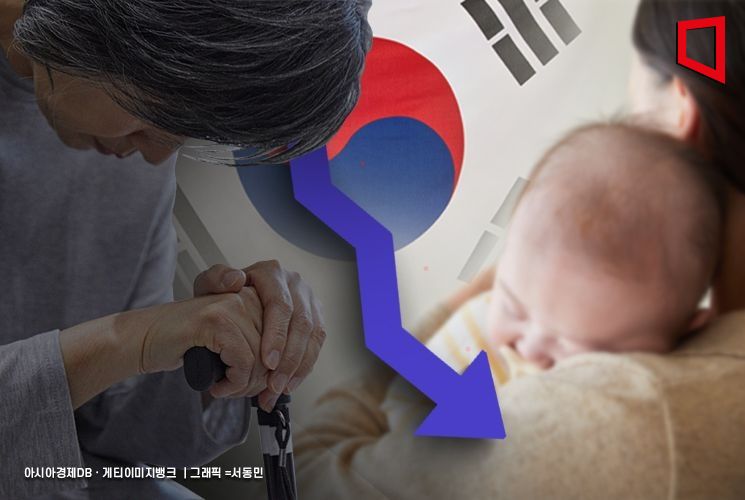
If the fertility rate remains at the current level, the OECD predicts that South Korea's population will be halved over the next 60 years. By 2082, about 58% of the total population is expected to be elderly aged 65 or older. During this period, the old-age dependency ratio (the ratio of people aged 65 and over to those aged 20-64) is projected to surge from the current 28% to 155%.
In particular, the OECD pointed out that although South Korea has made various efforts to reduce private education use?such as improving the quality of public education, regulating private education institutions, and removing killer questions from the college entrance exam?it has failed to properly address the fundamental problems of labor market dualism and university hierarchy. Housing costs also doubled between 2013 and 2019, which the OECD analyzed as reducing the likelihood of marriage by 4 to 5.7%.
Long working hours, lack of flexibility in working hours and locations making work-family balance difficult, and other factors were also cited as causes of the fertility rate decline. Social perceptions regarding gender roles, such as the belief that women should take care of the household, and attitudes toward out-of-wedlock births were also analyzed as influencing the fertility rate.
To prevent the decline in fertility rates, the OECD urged that family policies be reviewed by sector. In the childcare sector, it emphasized the need to better align childcare service hours with commuting times and to expand workplace childcare facilities.
It also pointed out the need to improve the parental leave system. South Korea’s income replacement rate during parental leave (80%) is the highest among OECD countries, but the payment ceiling (1.5 million KRW as of 2024) is 46% of the average wage, lower than Sweden (95%), Norway (124%), and France (82%). South Korea’s strict eligibility criteria for parental leave and low utilization rate among eligible individuals rank it third from the bottom among OECD countries.
Furthermore, the OECD stressed the importance of expanding female employment. South Korea’s female employment rate was 61.4% among the population aged 16 to 64 in 2023, lower than the OECD average of 63.2%. The gender employment gap ranks among the highest in the OECD. It also called for actively accepting foreign labor. This includes removing various visa barriers to attract skilled workers and improving poor working conditions for low-skilled workers.
The OECD projected that increasing the working-age population and immigration, and raising the total fertility rate to 1.1, could boost South Korea’s gross domestic product (GDP) by 12% by 2070.
© The Asia Business Daily(www.asiae.co.kr). All rights reserved.

















