The Principle of "Dispersing Only Older Generation Processes Overseas" May Be Weakened
Founder Morris Chang Opposed U.S. Plant Construction in the Past
<1> TSMC, the Deity... Visiting the '2nm' Sanctuary
<2> The '6 Challenges' Holding Back TSMC and Technology Security
<3> The Opening of Unnamed Taiwan
<4> Korea-Taiwan, Between Deterrence and Cooperation
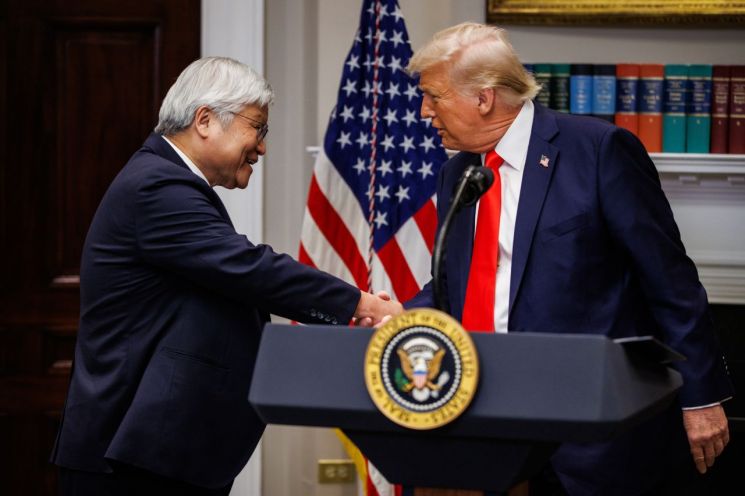 On the 3rd (local time), at the TSMC investment announcement press conference held at the White House in Washington D.C., USA, Wei Zhejia, Chairman of TSMC (left), and Donald Trump, President of the United States, shake hands. (Photo by EPA·Yonhap News)
TSMC's global production strategy of "only dispersing older generation processes overseas" appears to be shaken by tariff pressures from U.S. President Donald Trump. By deciding to build a factory in Phoenix, Arizona, equipped with cutting-edge processes below 2nm (1nm = one billionth of a meter), the long-held principle of technology security is likely to be diluted. There are concerns that an increase in advanced semiconductor production overseas could weaken the U.S.'s justification for protecting Taiwan.
According to local Taiwanese media and major foreign news outlets on the 5th, voices of concern are rising within Taiwan regarding TSMC's $100 billion (approximately 145.29 trillion KRW) new investment in the United States. On the 3rd (local time), TSMC Chairman Wei Zhejia announced plans to invest at least $100 billion to build three foundry factories with sub-2nm ultra-fine processes, two advanced packaging factories, and a research and development (R&D) center in Phoenix, Arizona.
The specific mass production scale, timing, and processes of the new factories have not yet been disclosed. However, President Trump stated that TSMC would build "state-of-the-art semiconductor facilities" in the U.S., adding, "The world's most powerful AI semiconductors will be made in the United States, and this is a matter of not only economic security but also national security." This statement directly conflicts with TSMC's global production strategy of operating the most advanced semiconductor processes (N) only in Taiwan while dispersing previous generation processes (N-1, N-2) overseas. Chairman Wei further explained that this investment "means producing the most advanced chips on American soil."
Both inside and outside the company, there are concerns about technology security and the burden of unplanned large-scale investments. At the Q4 earnings conference held in January, TSMC's Chief Financial Officer Wendell Huang projected an annual investment scale of $38 billion to $42 billion for this year. At that time, he explained, "About 70% of the budget will be allocated to advanced process technology." The possibility that TSMC's advanced process investments could be delayed due to large-scale investments in the U.S. cannot be ruled out.
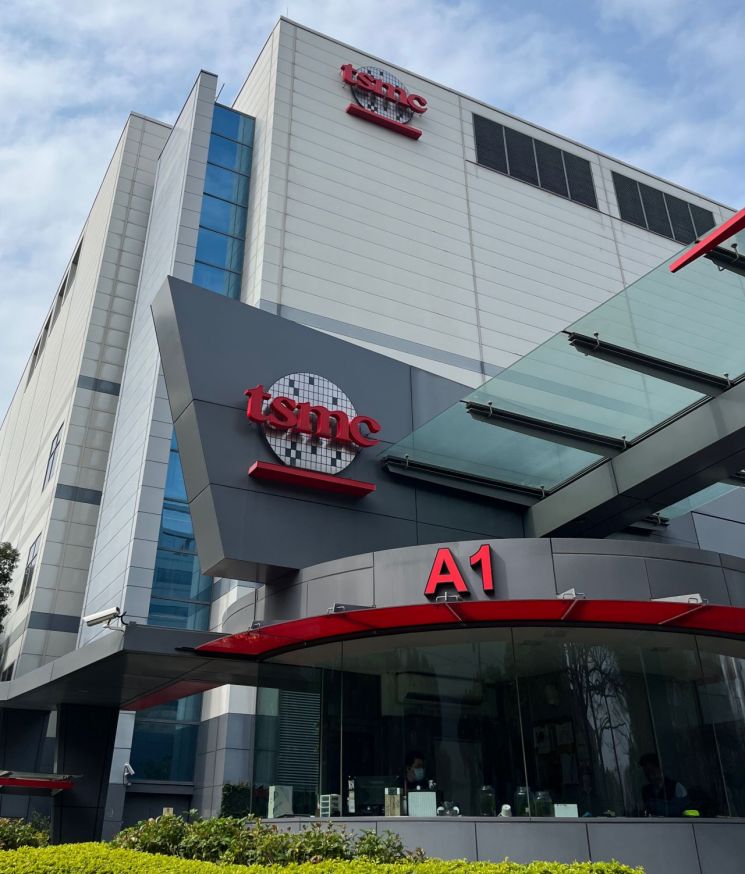 The exterior view of TSMC's headquarters, the 'Morris Chang Building,' located in the Hsinchu Science Park, Taiwan. (Photo by Kim Hyunjung)
Opposition politicians from the Kuomintang party have voiced concerns. Kuomintang legislator and caucus leader Fu Kunqi pointed out, "If TSMC becomes ASMC and the sacred mountain protecting the nation disappears, what will happen to Taiwan's national security?" Legislator Zhu Tianke emphasized, "The more semiconductor production TSMC has in the U.S., the less Taiwan's geopolitical importance becomes," adding, "The U.S. will also have fewer incentives to assist Taiwan in the future."
Guo Jihui, Taiwan's Minister of Economic Affairs, stated that the $100 billion investment plan is still a plan pending government approval related to overseas investment, and the government intends to consider the interests of investors and the nation.
TSMC founder Morris Chang has consistently opposed building semiconductor production plants in the U.S. He argued that it is difficult for the U.S. to replace Asian countries' manufacturing and cost competitiveness, and that the labor-intensive ultra-fine processes do not fit the local labor culture. Taiwanese experts have also argued that unless innovative methods are employed, the burden of production costs, which are 50-100% higher than in Taiwan, will be passed on to semiconductor prices, potentially harming product distribution and utilization.
© The Asia Business Daily(www.asiae.co.kr). All rights reserved.
![User Who Sold Erroneously Deposited Bitcoins to Repay Debt and Fund Entertainment... What Did the Supreme Court Decide in 2021? [Legal Issue Check]](https://cwcontent.asiae.co.kr/asiaresize/183/2026020910431234020_1770601391.png)
















