Pharmaceuticals from South Korean pharmaceutical and bio companies are increasingly being designated as orphan drugs by major regulatory authorities in key markets such as the United States and Europe. The strategy is to secure momentum and competitiveness in new drug development by utilizing systems that encourage the urgent development and introduction of drugs for rare diseases.
According to the industry on the 6th, last year, South Korean pharmaceutical and bio companies such as Boryung, Hanmi Pharmaceutical, and GC Green Cross had 16 cases of orphan drug designation by the U.S. Food and Drug Administration (FDA).
Orphan drug designations have continued this year as well. Last month, Ildong Pharmaceutical Group’s new drug research and development company, IRID BMS, received orphan drug designation from the FDA for its idiopathic pulmonary fibrosis drug candidate 'IL21120033.' IL21120033 is a new drug candidate that acts on 'CXCR7,' a receptor of the immune-related signaling protein 'chemokine,' which is involved in tissue fibrosis and inflammation.
EN Cell, a new drug development specialist company, also received orphan drug designation from the U.S. FDA for its Charcot-Marie-Tooth disease drug 'EN001.' EN001 is a stem cell therapy that suppresses cell aging and secretes more substances necessary for treatment. Charcot-Marie-Tooth disease is a hereditary disorder that causes deformities in the hands and feet and muscle atrophy, and in severe cases, can lead to loss of vision and hearing. There is currently no approved treatment.
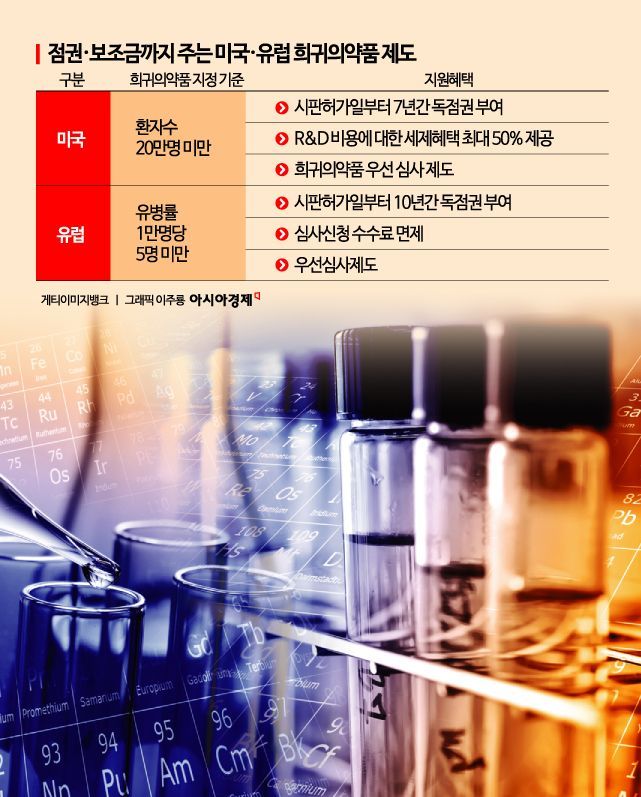
There are also cases of orphan drug designation in Europe. The European Medicines Agency (EMA) provides benefits such as clinical trial advice, reduced authorization fees, and 10 years of market exclusivity upon approval for candidates designated as orphan drugs to promote the development and approval of treatments for rare and intractable diseases.
NeoImmuneTech’s immuno-oncology drug candidate 'NT-I7' was designated as an orphan drug for acute radiation syndrome by the EMA. NT-I7 induces the proliferation of 'T cells,' which eliminate cancer cells and infected cells. This substance was previously designated as an orphan drug by the FDA as well.
An orphan drug refers to a drug that targets a rare condition with no adequate alternative treatments, requiring urgent introduction. In the case of the U.S. FDA, orphan drug designation applies to treatments for rare diseases affecting fewer than 200,000 patients. Designated companies receive benefits such as seven years of market exclusivity after approval and priority review under the orphan drug program.
In particular, the exclusivity benefit is considered the strongest incentive system because it restricts other companies from launching the same drug, allowing the designated company to monopolize profits.
Development and clinical costs are also supported through orphan drug grant programs. Tax reductions and clinical development grants are provided for 50% of the R&D costs incurred, and approximately 25% tax credits (ODTC) are given for clinical trial costs in the U.S. for the approved indications. The orphan drug designation is regarded as a recognition of the global competitiveness of domestic companies’ research and development.
A pharmaceutical and bio industry official said, "Although rare diseases have low economic incentives for new drug development, utilizing the orphan drug designation system allows support for development costs and shortens the time required. Having a track record of developing and obtaining approval for orphan drugs in major markets such as the U.S. and Europe is an element that can be recognized in the global market."
© The Asia Business Daily(www.asiae.co.kr). All rights reserved.

















