Important Clues to Understanding the Entire Structure of the Temple
Korea National University of Cultural Heritage announced on the 5th that during the excavation of the Luxor Ramesseum temple pylon, conducted in collaboration with the Egyptian Supreme Council of Antiquities and the Luxor West Bank Office, they confirmed the foundation facilities and floor stones leading into the interior of the temple. These are important clues that allow understanding of the entire structure of the temple and will be used as basic data for future restoration.
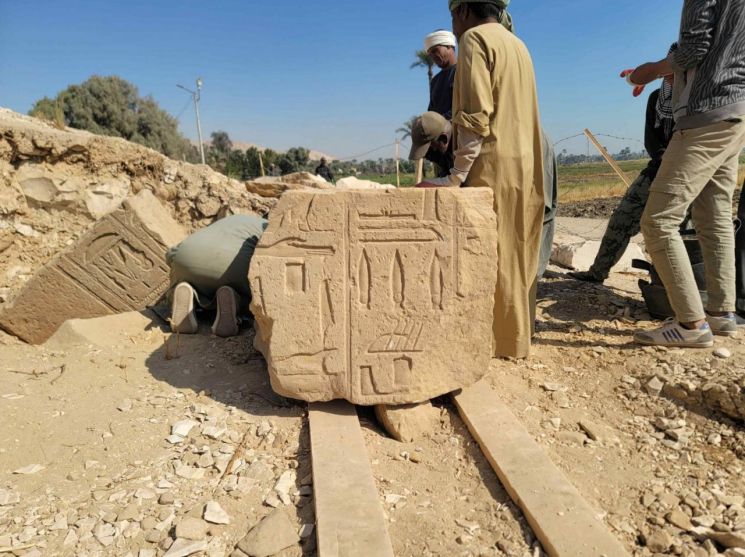 Stone materials recovered from the east side excavation site of the tower gate at the Ramesseum Temple in Egypt
 [Photo by the Cultural Heritage Administration]
The Ramesseum temple is the mortuary temple of the Egyptian king Ramesses II located on the west bank of the Nile River, with only partial remains surviving. Excavations and artifact restoration have been ongoing since 1990 with support from the French National Center for Scientific Research.
The Cultural Heritage Administration, utilizing its experience in restoring structures such as the Mireuksaji Stone Pagoda in Iksan, along with the human resources of Korea National University of Cultural Heritage and information and communication technology (ICT), has been restoring the entire Ramesseum temple pylon and improving the approach path since 2023. Based on the results of this excavation, they plan to soon begin foundational research for original restoration.
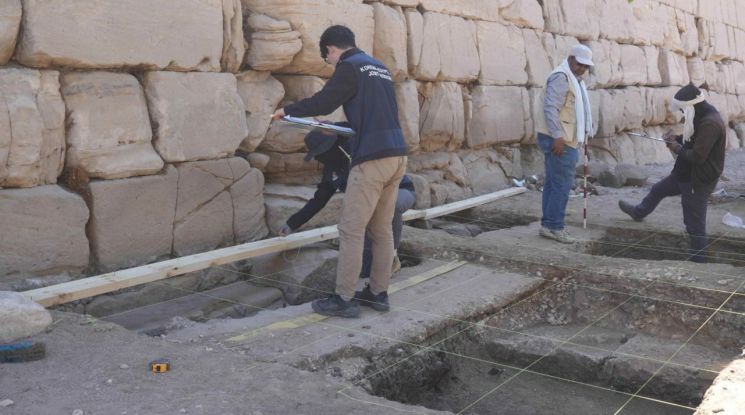 Excavation site of the west gate of the Ramesseum Temple in Egypt
 [Photo by National Heritage Administration]
An official stated, "Fourteen stone blocks, which will serve as basic materials for restoration, were also recovered from the collapsed eastern pylon," adding, "We will create a model case for cultural heritage protection and utilization through continuous excavation and preservation research."
© The Asia Business Daily(www.asiae.co.kr). All rights reserved.


















