77.7% of Local Government HR Departments Want to Abolish the Part-Time Public Official Recruitment System, Survey Finds in February 2025
83% of Part-Time Recruited Public Officials Work Over 30 Hours and Perform the Same Duties as Full-Time Staff
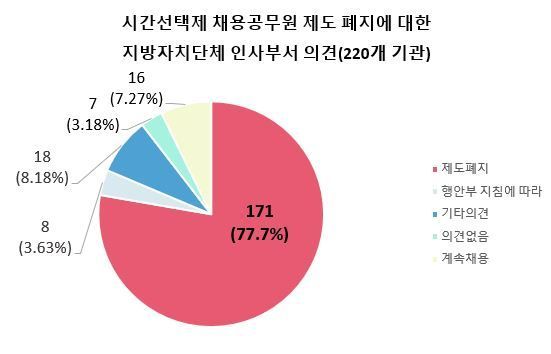
The National Part-Time Public Officials Labor Union (Chairperson Jeong Seong-hye) announced that among 220 institutions that responded to a survey sent to personnel departments of 243 local governments in February 2025 regarding whether to continue hiring or abolish the ‘part-time public official recruitment system’ introduced in 2014 (excluding 17 institutions without part-time recruited public officials), 171 institutions (77.7%) expressed a desire to abolish the system.
The Part-Time Public Officials Union conducts annual surveys targeting local government personnel departments, and this year added the question ‘difficulties in operating the part-time recruited public official system.’ As a result, 152 institutions (69.0%) out of 220 cited ‘short working hours’ as the main difficulty, an increase of 38 institutions compared to 2023. The second most cited difficulty was ‘difficulty in assignment,’ noted by 123 institutions (55.9%), which also increased by 24 institutions compared to 2023.
From the perspective of local government personnel departments operating the system, separate management of performance evaluations, staffing, salaries, and allowances for part-time recruited public officials causes waste of time and manpower. Additionally, due to short working hours, there are work gaps that inconvenience colleagues and lead to a decline in the quality of public services.
The part-time recruited public official system, intended to promote work-family balance and create quality jobs to raise the employment rate to 70%, has seen low satisfaction on the ground, resulting in frequent refusals of appointments and resignations. Acknowledging the system’s failure, the government ultimately stopped the unified recruitment of local part-time recruited public officials in 2018, just four years after its introduction.
Furthermore, the personnel department of Jongno-gu, which expressed the opinion to abolish the system, responded that “the number of full-time public officials wishing to switch to part-time work is increasing, and since they work under the same conditions as part-time recruited public officials, having both systems overlapping reduces effectiveness.”
The personnel department of Muan-gun, Jeollanam-do, actively expressed the need to abolish the system, stating, “Because part-time public officials have limited working hours, continuity and consistency of work may decline, and work interruptions may occur when handling urgent or complex tasks, which can affect work performance.”
Especially, many local government personnel departments operate a system where full-time public officials convert to part-time public officials, and maintaining a separate part-time recruited public official system causes duplication and fairness issues. Since most perform the same tasks and workload as full-time public officials, it is unreasonable for treatment among part-time public officials to differ. Many opinions favored abolishing the part-time recruited public official system and integrating it into a single system for rational operation.
Jeong Seong-hye, Chairperson of the National Part-Time Public Officials Labor Union, said, “Since launching the Part-Time Public Officials Union in 2017, we have worked to improve the part-time recruited public official system, but since all local government personnel department officials acknowledge the system has problems, I believe abolishing the system is a way to prevent administrative waste and improve personnel management efficiency.”
© The Asia Business Daily(www.asiae.co.kr). All rights reserved.

















