Failed to Be Selected Last Year, KRISS and KAERI Take On the Challenge Again
Quantum, which failed to be selected for the 'Global TOP Strategic Research Group' ambitiously launched last year by the Ministry of Science and ICT, is making a re-challenge.
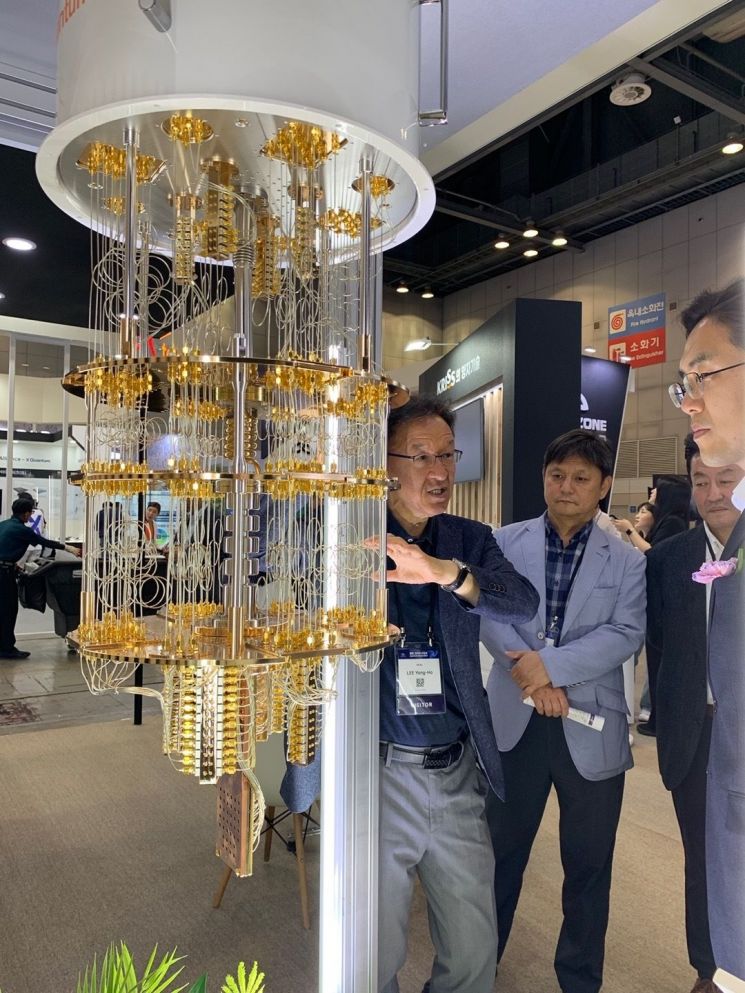 Lee Yong-ho, Head of the Superconducting Quantum Computing System Research Group at the Korea Research Institute of Standards and Science (left), is explaining a 50-qubit superconducting quantum computer model to Jung Ho-jong, Vice Mayor of Daejeon. Photo by Pyo Jun-yeon
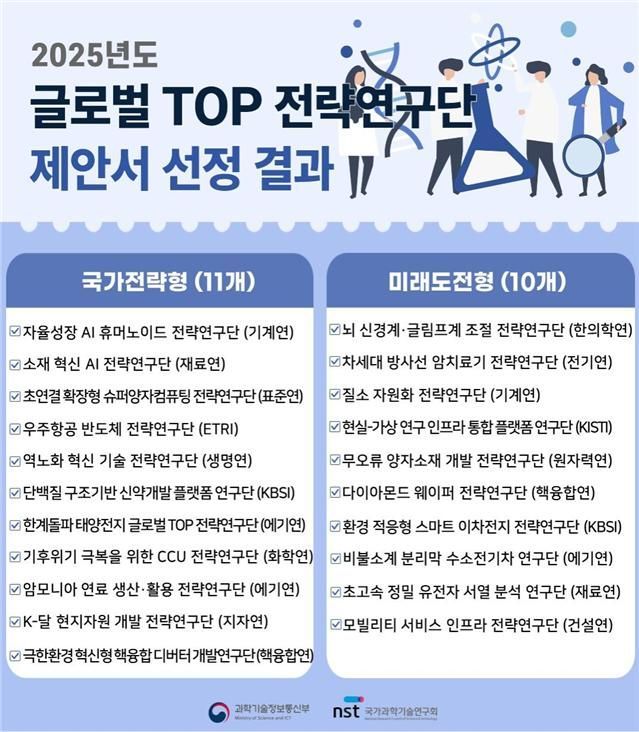
According to the scientific community on the 5th, the Ministry of Science and ICT and the National Science and Technology Research Council (NST) included the 'Hyperconnected Extended Super Quantum Computing Strategic Research Group' and the 'Error-Free Quantum Materials Development Strategic Research Group' in the first selection results of the 2025 Global TOP Strategic Research Group proposal.
Last year, the Korea Research Institute of Standards and Science (KRISS) challenged the Global TOP Strategic Research Group with the theme of 'Quantum Connection,' but although it passed the first screening, it failed to be finally selected. KRISS was the only research group that chose quantum. The scientific community expressed regret that quantum, identified by the government as one of the three major game-changing technologies, was excluded from the Global TOP Strategic Research Group selection, but there was also an assessment that achieving the goal within five years would have been difficult.
However, the situation changed as the quantum computer craze swept in since the end of last year. Lee Ho-sung, director of KRISS, also emphasized his determination to challenge by saying, "This year, we will do our best to be selected for the Global TOP Strategic Research Group."
KRISS revised the project and is making a re-challenge with quantum computers. Although the term 'hyperconnected' is attached, the focus is on quantum computers. KRISS is also scheduled to demonstrate a 20-qubit quantum computer, developed as a national project, later this month.
Choi Jae-hyuk, head of the Quantum Technology Research Institute at KRISS, explained, "The goal of the research group is to lead the development of technology that connects quantum processing units (QPU), which are collections of quantum bits (QUBIT) that even big tech companies like IBM and Google have not yet realized."
Currently, big tech companies are focusing on increasing the number of qubits, the core of quantum computers, but the technology to connect QPUs is also important. This is because there is a limit to increasing the number of qubits within a single QPU. If QPUs can be connected at ultra-high speed, a quantum computer with larger capacity can be created.
Director Choi said, "This area is one where we, who have fallen behind in the quantum computer field, can take the lead."
The research group includes government-funded research institutes such as the Korea Institute of Science and Technology (KIST), Korea Institute of Science and Technology Information (KISTI), and Electronics and Telecommunications Research Institute (ETRI), academia including Korea Advanced Institute of Science and Technology (KAIST), Pohang University of Science and Technology (POSTECH), Yale University, and industry players such as LG Electronics and ID Quantique (IDQ).
The Korea Atomic Energy Research Institute (KAERI) is also challenging the future-challenge type project with the 'Error-Free Quantum Materials Development Strategic Research Group.' KAERI's project focuses on securing quantum materials that will constitute qubits, the core of quantum computers. The goal of the research group is to develop topological phase-change materials being researched by Microsoft in the United States.
Lee Sung-soo, head of the Advanced Quantum Materials Research Lab at KAERI, emphasized, "We will focus on carrying out challenging projects in the quantum field as well."
The Global TOP Strategic Research Group is an organization where government-funded research institutes, universities, and industry form a coalition to conduct national R&D (research and development). Last year, five strategic research groups were launched with a budget of 100 billion KRW. This year, the budget has increased to 125 billion KRW, and a total of 21 projects, including 11 national strategic and 10 future-challenge types, have passed the first screening. The Ministry of Science and ICT expects that about five from each of the national strategic and future-challenge types will undergo a second evaluation and be finally selected.
▶ Qubit (QUBIT): The basic unit that processes and stores information in a quantum computer.
▶ Quantum Processing Unit (QPU): The brain of a quantum computer. It can be understood as the concept of a central processing unit (CPU) used in classical computers.
© The Asia Business Daily(www.asiae.co.kr). All rights reserved.


















