Trump: "25% Tariff on Canada and Mexico to Be Enforced from the 4th"
Canada Implements Retaliatory Tariffs Announced in February
Mexican President: "We Are Prepared"
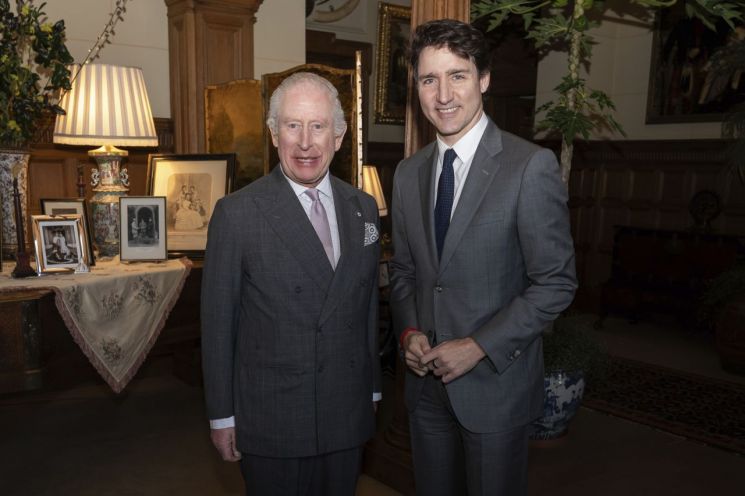 Canadian Prime Minister Justin Trudeau is meeting with British King Charles III on the 3rd (local time). Immediately after U.S. President Donald Trump announced that he would impose a 25% tariff on Canada and Mexico as scheduled on the same day, the Canadian government responded by preparing a retaliatory tariff package. /AP News Agency·Yonhap News Photo by AP
U.S. President Donald Trump announced on the 3rd (local time) that he will impose a 25% tariff on Canada and Mexico as scheduled starting from the 4th, and immediately after, the Canadian government responded by preparing a retaliatory tariff package. As announced in February, Canada plans to impose tariffs on U.S. imports totaling 155 billion Canadian dollars (155 trillion won).
According to Bloomberg News in the U.S., Canadian Foreign Minister M?lanie Joly said at a press conference following Trump's statement to enforce tariffs, "There are no options left for Mexico or Canada," adding, "Everything has been decided. It will be implemented starting tomorrow."
President Trump reaffirmed the tariff imposition plan on March 4 during an event at the White House announcing the investment plan of Taiwan's TSMC, the world's largest foundry (semiconductor contract manufacturer), stating that the policy on tariffs against Canada and Mexico "remains unchanged."
Canadian Prime Minister Justin Trudeau announced the first and second phases of tariff imposition plans against the U.S. earlier last month. The first phase includes imposing tariffs on U.S. products worth 30 billion Canadian dollars (30 trillion won), such as orange juice, peanut butter, wine, and coffee. The second phase includes imposing a 25% tariff on imports worth 125 billion Canadian dollars (125 trillion won), including automobiles, trucks, steel, and aluminum.
Minister Joly said, "This is an existential threat with thousands of Canadian jobs at stake," adding, "If the U.S. starts a trade war, we are prepared. However, this is not a situation we want or desire."
Bloomberg reported that the Bank of Canada warned that a prolonged tariff war could reduce Canada's economic output by about 3% over two years, making economic growth virtually difficult during this period. If demand for Canadian products in the U.S. shrinks, exporters will suffer in production and employment. Conversely, within Canada, rising prices of U.S. products are expected to reduce household and corporate consumption.
Prime Minister Trudeau also takes President Trump's threat of "incorporating Canada as the 51st state" seriously. On the same day, he met with King Charles III of the United Kingdom to discuss this threat, emphasizing independence and autonomous decision-making.
Mexico is equally under pressure. Mexican President Claudia Sheinbaum said at a press conference on the morning of the 3rd, "No matter what decision the U.S. makes, Mexico is prepared," and announced that further explanations would be provided on the 4th. However, this was before President Trump re-announced the tariff imposition plan.
President Trump warned that if Mexico and Canada do not take sufficient measures to prevent the inflow of synthetic drugs such as fentanyl and the movement of immigrants entering the U.S., he will impose broad tariffs as a crackdown.
© The Asia Business Daily(www.asiae.co.kr). All rights reserved.

















