Maintaining Around 5% Growth Target...
CPI Goal Set at 2% for the First Time in 20 Years
Up to 900 Trillion Won in Special Government Bonds
Focus on Response to Trade War
China's largest political event, the Two Sessions (Lianghui - the National People's Congress and the Chinese People's Political Consultative Conference), will open on the 4th. Coinciding with the opening day of the Two Sessions, U.S. President Donald Trump has forecasted a trade war, while China's economic growth targets and policy directions are expected to be presented.
On the afternoon of the same day, the Chinese People's Political Consultative Conference (CPPCC), an advisory body to the government, will hold its opening ceremony and first plenary session at the Great Hall of the People in Beijing. The National People's Congress (NPC), equivalent to the national legislature, will open on the morning of the 5th.
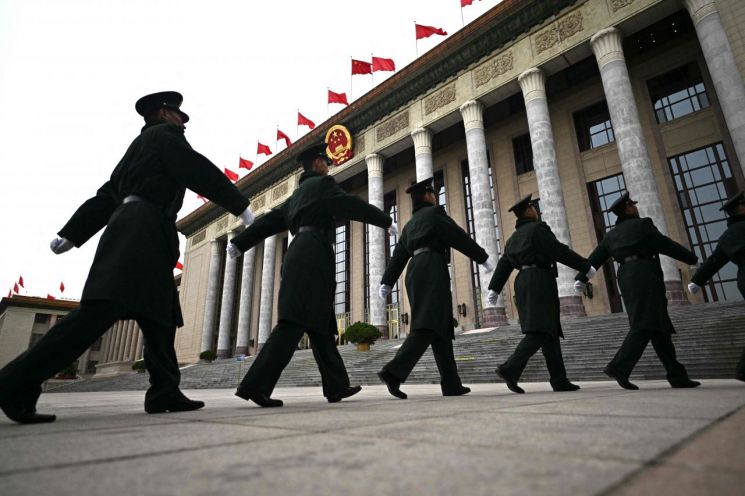 The People's Liberation Army of China is standing guard in front of the Great Hall of the People in Beijing, where the Chinese People's Political Consultative Conference (CPPCC) is being held. Photo by AFP Yonhap News
The main point of interest at this year's Two Sessions is the economic growth rate target. It will be disclosed through Premier Li Chang's government work report at the NPC opening. In addition, Premier Li will announce targets such as this year's inflation rate and the development strategies prioritized by the authorities, as well as the industrial sectors receiving focused support.
Experts expect the authorities to set an economic growth target of around 5%, similar to last year. Earlier, provincial-level local government Two Sessions set an average growth target of 5.3% for this year.
The Chinese government is expected to lower the consumer price index (CPI) target from 3% to 2% for the first time since 2004. Morgan Stanley previously evaluated the local governments' reduction of CPI targets from 3% to 2% as a key signal indicating the direction of this year's Two Sessions.
With attention on the scale of stimulus measures, the fiscal deficit ratio is expected to rise from 3% of GDP last year to 4% this year. The broad fiscal deficit ratio, which includes government bond issuance, is forecasted to reach a record high of up to 9%.
China Zhongxin Securities stated in a report that the scale of new special government bonds could increase to 4.5 trillion yuan (approximately 899 trillion won) this year. At the end of last year, foreign media reported that the authorities would issue a record 3 trillion yuan in special government bonds this year, so this is a larger amount. In December last year, the Chinese government announced a "more proactive fiscal policy" at the Central Economic Work Conference and set "appropriately accommodative monetary policy" as the economic policy direction for the first time in 14 years.
Revitalizing domestic demand is also considered a major task. Wang Tao, UBS chief economist, predicted that the authorities would expand subsidies for consumer goods replacement purchases to 300 billion yuan, more than double last year's amount.
However, the market expects that, considering the uncertainty due to the anticipated trade war with the U.S., all stimulus measures will not be released at once.
President Trump announced that starting from the opening day of the Two Sessions on the 4th, an additional 10% tariff will be imposed on China. This means a total of 20% additional tariffs will be applied. In response to the U.S.'s successive tariff pressures, China last month retaliated with tariffs on U.S. fossil fuels, controls on rare earth exports, and investigations of U.S. companies, but these responses are considered restrained. The international community is keenly watching what message China will send to the U.S. at this Two Sessions.
China's artificial intelligence (AI) DeepSeek has sparked a global craze, drawing attention to policies fostering private enterprises and a "second DeepSeek." Chinese President Xi Jinping held a private enterprise forum for the first time in over six years. Executives from technology companies such as Alibaba, Huawei, and DeepSeek attended, interpreted as a signal of support for the private sector. A revision bill for the Private Economy Promotion Law is expected to be submitted as an agenda item at the NPC.
© The Asia Business Daily(www.asiae.co.kr). All rights reserved.

















