The Gyeonggi Fire Department 119 ambulance team was dispatched once every 39 seconds last year, according to statistics.
On the 4th, the Gyeonggi-do Fire and Disaster Headquarters reported that the 119 ambulance team recorded 799,295 dispatches, 429,710 transports, and 433,763 transported individuals last year. Converted into time, this means one dispatch every 39 seconds, one transport every 1 minute and 14 seconds, and one person transported every 1 minute and 13 seconds.
Looking at transported patients by type, 288,744 were patients with illnesses, accounting for 67% of the total transported individuals. In particular, the four major severe patients?cardiac arrest, cardiovascular, cerebrovascular, and severe trauma?numbered 134,353, representing 46.5% of all patients with illnesses, which is a 0.5% increase compared to 2023 (107,887 patients).
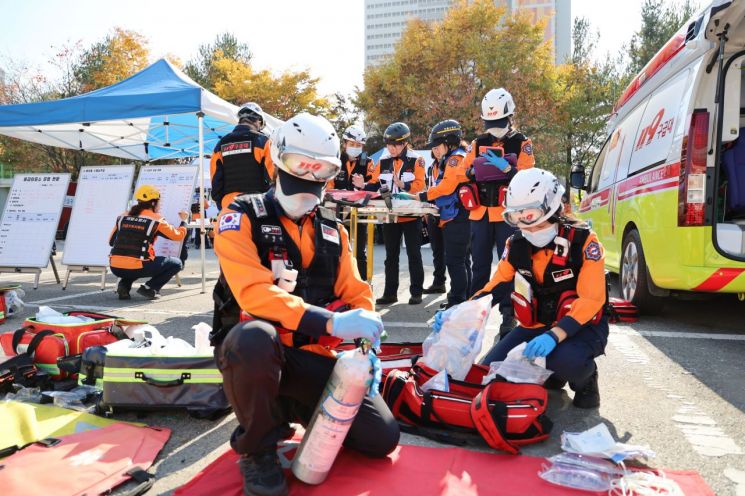 Emergency medical technicians from the Gyeonggi-do Fire and Disaster Headquarters are conducting emergency medical treatment training. Provided by Gyeonggi-do Fire and Disaster Headquarters
Although the total number of transported individuals decreased, patients aged 80 and above increased by 6.1% compared to the previous year, accounting for 20.5%. This is interpreted as a continuous increase in severe emergency patients such as cardiovascular and cerebrovascular diseases due to population aging.
Among transported patients other than those with illnesses, ‘accidental injuries’ were the most common at 82,017 cases. This was followed by traffic accidents (37,546 cases) and non-traumatic injuries (21,056 cases). Among these, non-traumatic injuries, including heat-related illnesses due to climate change and patients affected by insects, snakes, and other climate factors, increased by 55% compared to 2023 (13,583 cases), reaching 21,056 cases.
Cho Sun-ho, head of the Gyeonggi-do Fire and Disaster Headquarters, stated, "The Gyeonggi-do Fire and Disaster Headquarters recently deployed an additional 339 emergency personnel, improving the rate of three-person ambulance occupancy from 52% to the 70% range," and emphasized, "Through thorough preparation such as improving ambulance environments, establishing a transport system focused on severe emergency patients, and treatment education by specialists, we will create a Gyeonggi-do where residents can feel safe."
© The Asia Business Daily(www.asiae.co.kr). All rights reserved.
![Clutching a Stolen Dior Bag, Saying "I Hate Being Poor but Real"... The Grotesque Con of a "Human Knockoff" [Slate]](https://cwcontent.asiae.co.kr/asiaresize/183/2026021902243444107_1771435474.jpg)
















