Record-high Sea Surface Temperatures Last Year
Decline in Squid, Mackerel, and Anchovy Catches
Ministry of Oceans and Fisheries Begins Climate Change Countermeasures
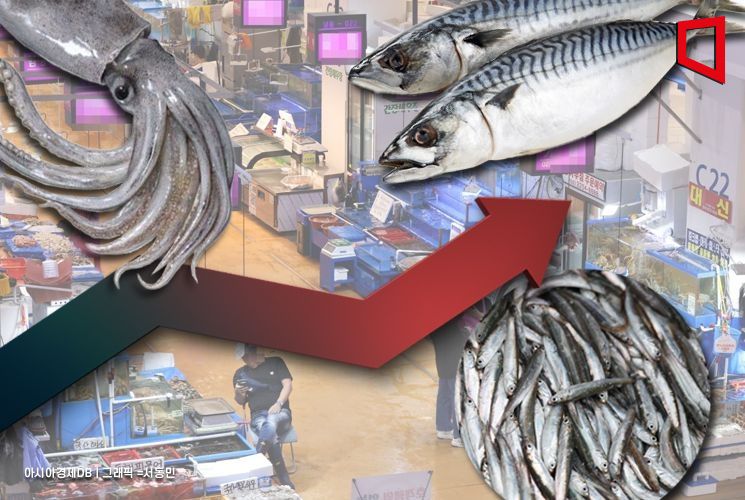
As soaring food prices increase the burden on consumers, prices of seafood such as squid, mackerel, and anchovies have also surged, raising concerns about so-called 'fishflation' (seafood + inflation). This is due to reduced catches caused by warming coastal waters from climate change. The Ministry of Oceans and Fisheries is working hard to devise measures to stabilize seafood supply and demand amid climate change.
According to the Korea Agro-Fisheries & Food Trade Corporation (aT) on the 3rd, prices of popular fish species such as squid, mackerel, pollock, and dried anchovies have remained higher than average and last year’s levels. As of the 28th of last month, the price of chilled squid from coastal waters was 9,417 KRW per fish, up 21.2% and 27.2% compared to the average and last year, respectively. In particular, in Seoul, the price per fish exceeded 10,000 KRW, reaching 11,430 KRW on the 28th of last month. This is a sharp increase of 49.4% compared to the previous month and 54.42% higher than the average.
The price of domestic chilled mackerel, known as the nation's fish, has also remained high. The retail price of one domestic chilled mackerel was 4,653 KRW at the end of last month, 20.7% more expensive than a year ago. The price of dried anchovies per 100g was 2,534 KRW, up 17.2% compared to a year ago. Compared to the average, dried anchovy prices are also 17.2% higher.
The main cause of rising seafood prices is the decrease in catch volume. According to the '2024 Fisheries Production Trend Survey' released by Statistics Korea, total fishery production last year was 3.61 million tons, down 2.2% from the previous year. In particular, coastal catches dropped to 841,000 tons, a decrease of 11.6%, marking the lowest level since 1971 (764,000 tons).
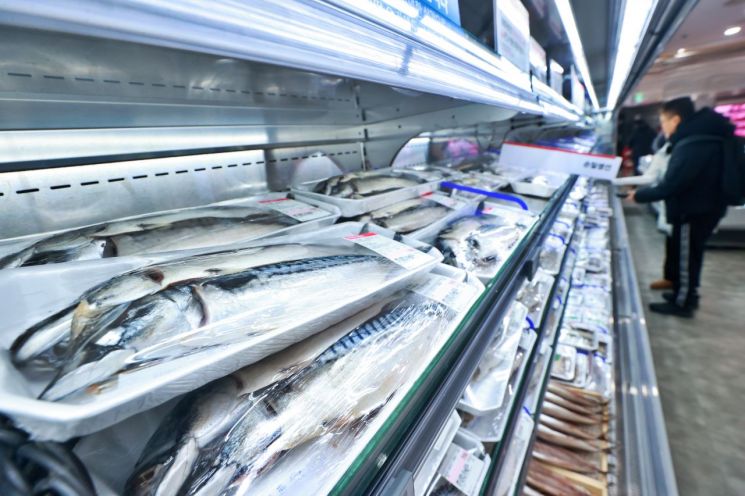
The decline in catch volume is closely related to the high water temperature phenomenon. According to the National Institute of Fisheries Science, the average surface water temperature in Korea’s coastal waters last year was 18.74 degrees Celsius, the highest level in the past 57 years. The '2024 Fisheries Production Trend Survey' released by Statistics Korea last month shows that the production of common squid, the webfoot octopus, was 14,000 tons last year, a sharp drop of 42% compared to the previous year. Compared to five years ago in 2019, the production decline reaches 74%. This is largely due to the rapid rise in sea water temperature and overfishing.
The unstable prices of mackerel and anchovies are also due to reduced production caused by rising water temperatures. Last year, mackerel and anchovy production dropped sharply by 17.4% and 18.8%, respectively. Hairtail catches have also decreased, making hairtail a rare commodity. According to aT, as of the end of last month, the price of one domestic chilled hairtail in Seoul was 18,400 KRW, a 22.2% increase from a year ago. Statistics Korea reports that hairtail production fell by 26.6% last year.
The Ministry of Oceans and Fisheries recently commissioned a research project titled 'Integrated Production of Marine Climate Change Monitoring and Prediction Information for 2025' to establish a system for monitoring changes in marine environment and ecosystems due to climate change. A ministry official explained, "The goal is to monitor climate factors such as water temperature, sea level, salinity, and currents to produce long-term marine climate prediction scenarios." The ministry also plans to build a system that comprehensively analyzes production volumes, local prices, inventory, and export/import quantities of mackerel, squid, hairtail, pollock, and other species to predict supply-demand and price volatility.
© The Asia Business Daily(www.asiae.co.kr). All rights reserved.
![Clutching a Stolen Dior Bag, Saying "I Hate Being Poor but Real"... The Grotesque Con of a "Human Knockoff" [Slate]](https://cwcontent.asiae.co.kr/asiaresize/183/2026021902243444107_1771435474.jpg)

















