Challenging the Mandatory Wheelchair Lift Ruling
Disabled Plaintiffs Appeal Against Kumho Express and Gwangju City
Disabled individuals who contested the first trial ruling mandating the installation of wheelchair boarding facilities (lifts) on express buses are proceeding to an appellate court to further secure their right to mobility.
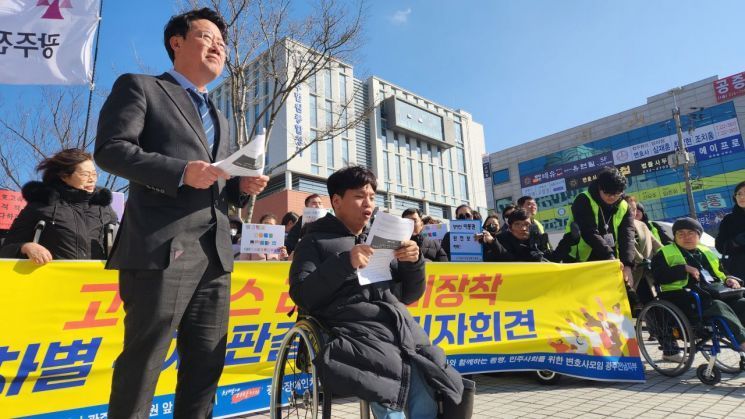 The Gwangju Coalition for the Elimination of Discrimination against the Disabled, the Gwangju-Jeonnam Branch of the Lawyers for a Democratic Society, and the Lawyers for Public Interest 'Donghaeng' held a press conference in front of the Gwangju Court Complex in Dong-gu, Gwangju, on the 20th of last month after the ruling on the discrimination relief lawsuit. Photo by Min Chanki
According to the legal community on the 3rd, five disabled plaintiffs including Bae Youngjun, who filed a discrimination relief lawsuit against Kumho Express (now Kumho Express as the successor in litigation), Gwangju City, and the government, submitted an appeal to the Gwangju District Court on the 25th of last month. They initially filed the lawsuit in 2017, arguing that Kumho Express violated the Act on the Prohibition of Discrimination against Persons with Disabilities by not installing wheelchair lifts on any of its buses, and partially won the case on the 20th of last month.
In this first lawsuit in Gwangju regarding discrimination against the mobility rights of the disabled, the court ruled that Kumho Express must gradually install wheelchair lifts on newly introduced express and intercity buses over a 15-year period from next year until 2040.
However, the demand to install lifts at bus terminals was dismissed, as Gwangju Shinsegae holds the terminal operating rights, not Kumho Express. The claim requiring Gwangju City and the government to allocate related budgets was also not accepted.
In response, the Gwangju Solidarity Against Disability Discrimination, the Gwangju-Jeonnam branch of Lawyers for a Democratic Society, and the public interest lawyers' group 'Donghaeng' held a press conference after the verdict on the 20th of last month, stating, "This ruling is a first step toward guaranteeing the mobility rights of the disabled," and emphasized, "Gwangju City and the Ministry of Land, Infrastructure and Transport must fulfill their responsibilities to guarantee mobility rights."
Attorney Lee Soa (Donghaeng) pointed out, "Although the Ministry of Land, Infrastructure and Transport has been providing budget support for wheelchair lift retrofitting since 2019, express bus companies including Kumho Express have not applied for it, resulting in budget cuts," and added, "Based on 10 new buses per year, the cost of introducing wheelchair lifts is only 250 million won, and considering the retrofitting budget, the burden would be even less."
Additionally, criticism was raised that Gwangju City, despite its obligation under the Act on Promotion of Transportation Convenience for the Mobility Disadvantaged to prepare plans and budgets for boarding and alighting convenience at intercity bus terminals, left 1 trillion won of last year's budget unused.
Attorney Lee, who represented the plaintiffs, stated, "We will continue to fight in the appellate court so that Gwangju City and the Ministry of Land, Infrastructure and Transport actively guarantee the intercity mobility rights of the disabled," expressing their intention to appeal. On the other hand, although Kumho Express, which lost the case, has not yet submitted an appeal, it is highly likely that they will do so.
© The Asia Business Daily(www.asiae.co.kr). All rights reserved.

















