Increase Rate for Other Income Groups Remains in the 20% Range
Bottom 20% Spend an Average of 430,000 KRW per Month on Food
The food expenses burden for households in the bottom 20% income bracket (1st quintile) has increased by 40% over the past five years.
According to the annual expenditure data from Statistics Korea's Household Income and Expenditure Survey on the 2nd, the amount spent on food by the 1st quintile, which corresponds to the bottom 20% income group, was an average of 434,000 KRW per month last year. Compared to 313,000 KRW in 2019, five years ago, this is an increase of 121,000 KRW (38.6%). The 1st quintile households spent 274,000 KRW on groceries and non-alcoholic beverages, and 160,000 KRW on dining out and other meal expenses.
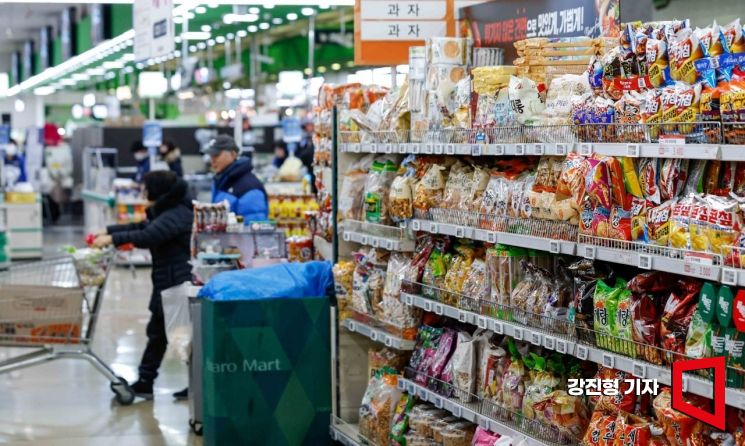 Snacks are displayed at Hanaro Mart Yangjae Branch in Seocho-gu, Seoul, where snack manufacturers raised consumer prices in January due to price increases of chocolate and palm oil. Photo by Kang Jin-hyung
The food expenses for the 1st quintile increased steadily from 313,000 KRW in 2019 to ▲342,000 KRW in 2020 ▲376,000 KRW in 2021 ▲399,000 KRW in 2022 ▲406,000 KRW in 2023. This rising trend is much steeper compared to the average for all households and other income quintiles. The average food expenses for all households increased from 666,000 KRW in 2019 to 841,000 KRW last year, a rise of 175,000 KRW (26.3%).
Other income quintiles also showed increases in the 20% range. During the same period, ▲2nd quintile increased by 25.3% or 123,000 KRW (from 486,000 KRW in 2019 to 609,000 KRW in 2024) ▲3rd quintile by 22.1% or 146,000 KRW (660,000 KRW to 806,000 KRW) ▲4th quintile by 24.7% or 205,000 KRW (828,000 KRW to 1,033,000 KRW) ▲5th quintile by 27.1% or 283,000 KRW (1,043,000 KRW to 1,325,000 KRW) in food expenses. Based on these results, it appears that the rising food prices have had a relatively greater impact on low-income households where essential living expenses constitute a higher proportion of their budget.
The domestic price index for groceries and non-alcoholic beverages rose 28.3% from 95.8 in 2019 to 122.9 last year, nearly double the overall consumer price index increase of 14.8%. The food service price index, which includes dining out, also increased by 22.0%, from 99.2 in 2019 to 121.0 last year. Among the 458 items surveyed for consumer prices, 9 out of the top 10 items with the steepest price increases last year were food items.
In the fourth quarter of last year, the disposable income for the bottom 20% income group (1st quintile) was 1,037,000 KRW per month. This means that the 1st quintile households spent about 45% of their disposable income on food expenses. For the 2nd quintile, the ratio of food expenses to disposable income (2,467,000 KRW) dropped to about 25.5%, and for the top 20% income group (5th quintile) with a disposable income of 8,912,000 KRW in the fourth quarter of last year, the proportion of food expenses to disposable income was below 15%.
© The Asia Business Daily(www.asiae.co.kr). All rights reserved.

















