Government National Project for Level 4 Autonomous Driving Implementation
Release of Domestic Customized Dataset Expected to Boost Research and Development
Object Detection and Recognition Performance Improved by 2-8%
Kakao Mobility announced on the 28th that it has released the "Artificial Intelligence (AI) Training Autonomous Driving Dataset," developed as part of the national project "Autonomous Driving Technology Development Innovation Project" led by the Ministry of Science and ICT and the Autonomous Driving Technology Development Innovation Project Group (KADIF).
This dataset has been made publicly available on the Korea Electronics and Telecommunications Research Institute (ETRI) 'AI Nanum' platform. Kakao Mobility aims to foster the domestic autonomous driving research and development ecosystem through this initiative.
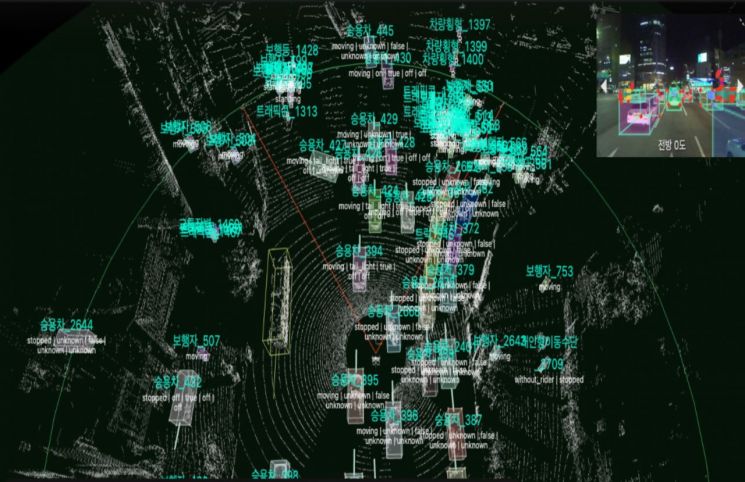 Multi-sensor Fusion 3D Dynamic Object Detection and Tracking Training Data for Autonomous Vehicles. Provided by Kakao Mobility
Participating in this project to realize Level 4 (Lv.4) autonomous driving, Kakao Mobility has completed the development of automated technologies for generating, managing, and distributing converged autonomous driving data that links vehicles, edge infrastructure, and intelligent learning. As part of the project, a de-identified AI training dataset built in domestic road environments has been released to the public. The intention is to allow anyone to freely use the data for autonomous driving research and development without copyright issues.
Until now, small companies, academia, and research institutions studying autonomous driving have found it difficult to directly acquire autonomous driving data using LiDAR, radar, and camera sensors due to enormous costs and time constraints. Most of the datasets already available were collected in overseas regions or specific time periods, limiting their applicability to research and development suited to domestic conditions.
The dataset released by Kakao Mobility this time was acquired through edge infrastructure such as LiDAR and camera sensors installed along major domestic roads, as well as autonomous vehicles directly operated by Kakao Mobility. The dataset consists of 150,000 instances across 10 categories, including 3D dynamic objects such as people, vehicles, and bicycles, and 2D static objects such as traffic lights and road signs. It is expected to be utilized for developing and training autonomous driving AI models suitable for the domestic environment.
Notably, this data was collected under 31 environmental condition categories, including road types (highways, national roads, underpasses, tunnels, etc.), time (day and night), and weather (clear, rain, fog, etc.). It includes not only the coordinate values of point clouds obtained via LiDAR sensors but also detailed segmentation data that can distinguish attributes of entities such as people and objects, allowing for diverse applications.
ETRI conducted validation by training autonomous vehicles with this dataset, revealing that the AI performance for detecting 3D dynamic objects such as people, vehicles, and bicycles improved by approximately 5-8%, and the AI performance for recognizing traffic lights improved by about 2%. AI performance also improved for sparse data such as nighttime urban traffic congestion and pedestrian traffic lights. Enhanced object detection and recognition performance in autonomous driving AI enables accurate perception of the surrounding environment.
Jang Sung-wook, Head of Kakao Mobility’s Future Mobility Research Center, stated, "We hope that the release of this dataset will serve as a cornerstone to accelerate the commercialization and advancement of domestic autonomous driving technology," adding, "We will continue to lead innovation in autonomous driving technology and the expansion of public data utilization by collaborating with various public and private enterprises."
Jung Kwang-bok, Director of KADIF, said, "We are pleased to release 150,000 instances of converged autonomous driving training datasets, which are called the ‘oil of the future,’ through this project," and added, "We hope that the released training data will serve as a growth foundation for related academia and startups, and further contribute to the advancement of AI autonomous driving technology."
Meanwhile, the government is promoting the "Autonomous Driving Technology Development Innovation Project" with the goal of completing the commercialization foundation for converged Level 4+ autonomous driving by 2027. Kakao Mobility carried out this project with support from the Ministry of Science and ICT, IITP, and KADIF.
© The Asia Business Daily(www.asiae.co.kr). All rights reserved.

















